
[ad_1]
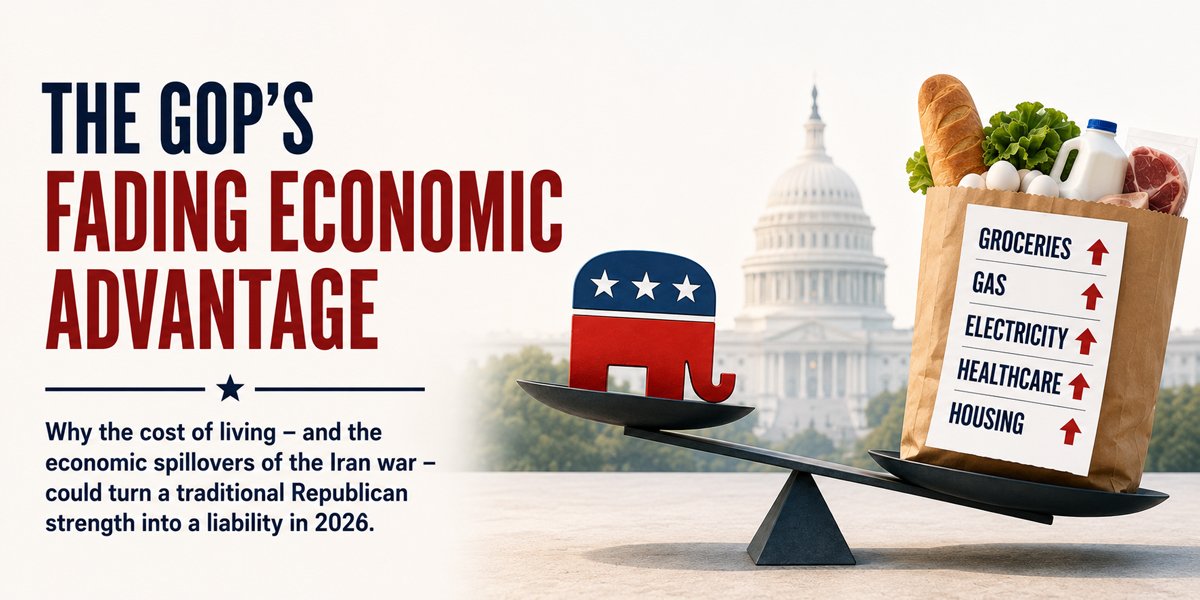
As the 2026 midterms approach, a nationwide poll released in early August delivered a warning that goes to the heart of the Republican Party’s political identity: for the first time in nearly a decade, voters said Democrats were better stewards of the economy than Republicans. For years, Republicans benefited from a broad perception that they were more trustworthy than Democrats on economic management, even when the record of Republican administrations was contested. Lower taxes, stronger domestic production, a robust private sector, affordable energy, and limited government intervention became part of the party’s economic identity. Now that advantage is beginning to crack – not because the U.S. economy is necessarily on the verge of collapse, but because many Americans are judging it less by macroeconomic indicators than by groceries, electricity bills, healthcare and insurance costs, housing, and what remains in their bank accounts at the end of the month. For Donald Trump and the Republican Party, that change in how voters measure economic performance could be costly.
Mitchell Brown, a Republican pollster, has noticed the same change in focus groups with voters in battleground states. People are not merely complaining that costs have risen; they know the numbers. They know how much their power bills have increased, what they pay for healthcare, and how much the price of beef is taking from the household budget. These details may look mundane, but in politics such details can drive larger shifts. For policymakers, the economy can mean GDP growth, unemployment, investment, and market performance. For voters, it is often much simpler: whether their income lasts until the end of the month.
That gap between the “economy on paper” and the “economy of everyday life” has become a serious problem for Republicans. The party can point to growth, investment, and the strength of the U.S. economy, but those arguments lose force if voters feel their cost of living is still rising. For Trump, the problem is especially sensitive because a central part of his political brand is the claim that he can make an economy that is failing ordinary Americans work better. Unlike many presidents, he has long presented himself not merely as a politician but as a successful manager – someone able to make tough decisions, strike better deals, and use American power to produce better economic outcomes. Economic dissatisfaction therefore cuts directly into one of his core political promises.
The challenge, however, is not confined to domestic policy. In Trump’s second term, the U.S. economy has also been exposed to geopolitical instability, disruptions in energy markets, and uncertainty over the future of global trade. These pressures can generate costs that are difficult for any White House to control. In that environment, a Middle East crisis can reach American households through energy and transportation costs. This is where the war with Iran matters, even if it is not always at the center of the administration’s domestic political narrative. Instability in the Persian Gulf and global energy markets can raise energy costs and put pressure on other parts of the economy. For Washington, that is part of a broader geopolitical calculation; for a household, it may simply mean more expensive gasoline, transportation, and goods.
That connection between foreign policy and domestic economics creates a political vulnerability. Trump may frame policy toward Iran in terms of confronting U.S. rivals, strengthening deterrence, or preserving Washington’s position in the Middle East. Voters do not necessarily judge those objectives through the same framework. They may see only the result they experience: higher costs. And when economic anxiety is already high, even factors outside the government’s direct control can be politically charged to the administration. Voters rarely separate the effects of global shocks, central-bank decisions, wars, supply disruptions, and government policies with precision. In the end, they judge the government that is in office while costs are rising.
This is the deeper risk for Republicans. The problem is not simply weaker approval of Trump’s economic management. It is the possible erosion of a longstanding belief that, whatever their other disagreements with the party, voters can trust Republicans more to manage the economy. If that belief fades, the electoral terrain changes. Democrats no longer have to concede the economy as Republican territory. They can instead define the contest around something far more tangible: the cost of living.
That shift in the political narrative matters enormously in a midterm election. Republicans can talk about growth, domestic production, tax cuts, and energy independence. Democrats can ask voters to look at their daily lives and decide whether their families are actually better off financially. Midterms are, in large part, political audits. Voters are judging the president and the governing party. They do not need to believe the opposition has a perfect substitute for every administration policy; they only need to conclude that the status quo is not working well enough. A question rooted in household experience can therefore matter more than pages of economic policy proposals.
Economic dissatisfaction also differs from many other political grievances because it continually renews itself. The next bill arrives. The next grocery trip happens. The next rent or mortgage payment comes due. The price at the gas station appears again. If a sense of economic pressure becomes entrenched, the administration receives a new reminder of that dissatisfaction every month. Time therefore matters for Republicans. They can argue that some problems began years earlier, that external shocks lie beyond the government’s control, or that higher energy production, tax cuts, and stronger domestic industry will eventually help. But those arguments work politically only if voters can connect them to a visible improvement in their own lives.
Otherwise, Republicans face a narrative problem: the party may say the economy is moving in the right direction while voters ask, “For whom?” That may be the most important economic question of the 2026 election. A government’s economic success is not measured only by what economists say about national performance. Politically, it is also measured by how secure ordinary people feel about their own economic future.
This is why foreign policy cannot remain separate from the economic argument. Wars, energy crises, and geopolitical rivalries become domestic political issues when their costs reach everyday life. If pressures associated with the Middle East crisis raise energy costs and deepen economic anxiety, Trump will have to answer not only for the objectives of his foreign policy but also for its economic consequences. That leaves him with one of the hardest equations of his second term: how to pursue an assertive, high-risk policy abroad while presenting an image of stability and declining living costs at home. The answer could shape important parts of the 2026 electoral contest.
For Republicans, the greatest danger is therefore larger than a bad poll or the loss of a handful of congressional seats. It is that voters may stop seeing the party as uniquely competent on the economy. If that happens, an important shift in American politics will have begun, and it could outlast the Trump administration. Political advantages rarely disappear overnight; they erode when voters compare their everyday experience with a party’s political story and can no longer reconcile the two.
Republicans still have an opportunity to show that the U.S. economy, despite domestic and external pressures, can improve in ways ordinary Americans can feel. But if bills, prices, and economic uncertainty continue to move faster than the administration’s promises, the 2026 midterms could become more than a contest over control of Congress. They could mark the point at which Americans stop viewing Republicans as the “party of the economy.” And once that image collapses, rebuilding it may be far harder than Washington now assumes.
Greg Pence is an international studies graduate of University of San Francisco and my articles have been published on websites like Middle East Monitor.
[ad_2]
Source link
