
[ad_1]
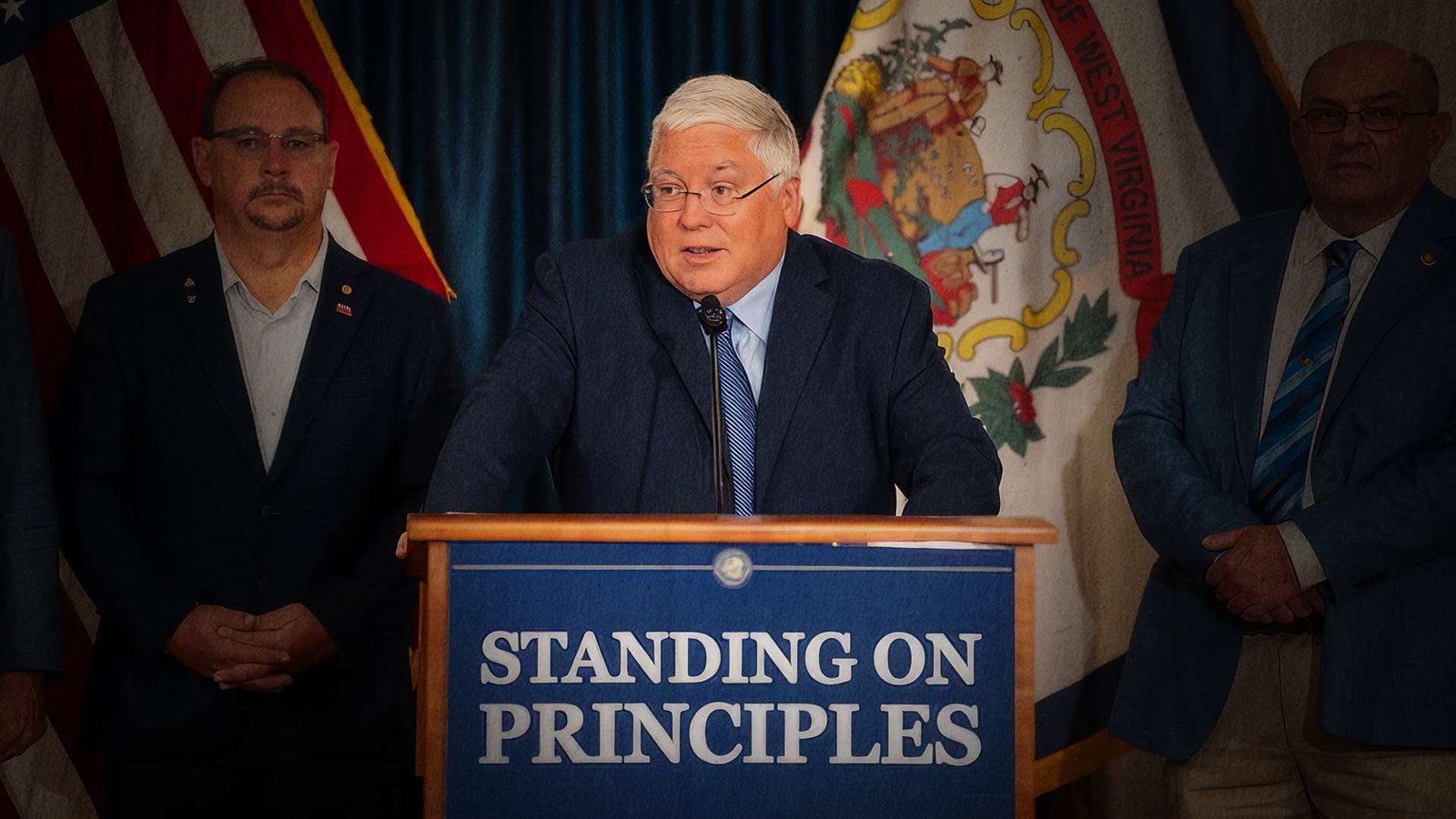
West Virginia Republican Gov. Patrick Morrisey is trying to head off public opposition to hyperscale data centers in his state by proposing a 20-year development framework that he hopes will revitalize West Virginia’s economy while addressing residents’ concerns.
Earlier this month, Morrisey unveiled the West Virginia Responsible Data Center Development Plan. The plan, built around seven core principles, sensibly holds data center developers and utilities responsible for covering “electrical infrastructure upgrades and energy capacity needs.” It also requires them to “build, bring, or procure sufficient power resources” needed for their projects. To mitigate concerns over water use, West Virginia will “actively recruit projects committed to water-efficient designs” and require them to adhere to the state’s environmental laws governing water resources. (Contrary to popular belief, data center water use is not a pressing issue.)
Under West Virginia’s Power Generation and Consumption Act, passed in 2025, local governments have little regulatory authority to block large technological infrastructure projects such as hyperscale data centers. But the development plan put forth by Morrisey and state lawmakers ensures they’ll still benefit when a project is approved.
Fifty percent of all revenue generated by hyperscale projects will go toward reducing or eliminating the state’s income tax. The plan will give counties 30 percent of the revenue of any project within their jurisdiction, with an additional 10 percent shared by all counties in the state. The remaining 10 percent will be used for “improved electrical, water, and wastewater projects for the citizens and communities” of West Virginia.
These provisions were likely written with Tucker County residents in mind, many of whom have opposed Fundamental Data LLC’s proposal to develop the state’s first hyperscale data center there, according to West Virginia Watch. Opponents have said the project offers no tangible benefits for residents while saddling them with all the costs. Despite the opposition, state regulators allowed the project to move forward on Monday, West Virginia Watch reports.
Morrisey claims West Virginia’s plan avoids “repeating the mistakes of other states.” On one hand, he’s not wrong: West Virginia has avoided issuing tax breaks and incentives to attract data center developers, a popular tactic nationwide before growing public backlash prompted a retreat. Lawmakers in the Mountain State have also eschewed the example set by states like New York and Texas, which recently adopted sweeping statewide bans on new data center development.
However, Morrisey’s plan still includes some of the worst provisions often seen in anti-data center legislation, namely new administrative bodies that serve as bottlenecks for any new development projects. To wit, the state’s plan creates a Data Center Advisory Council responsible for developing “statewide standards for property setbacks, noise mitigation, aesthetic integration, site security, and proximity to sensitive locations.” The advisory council will consist of “experts from academia, local government, conservation groups, industry, and utility providers”—an amalgamation with differing objectives that can hardly be expected to come to any working consensus in a reasonable time period.
A small consolation prize: The plan requires project sites to be acquired “through voluntary market transactions,” which would prevent the state from using eminent domain to seize property for approved projects.
With this framework, Morrisey is hoping to curtail the main talking points often used to stymie data center development. Using the booming industry to reduce the state’s tax burden is prudent, but adding more bureaucracy could backfire.
[ad_2]
Source link
