
[ad_1]
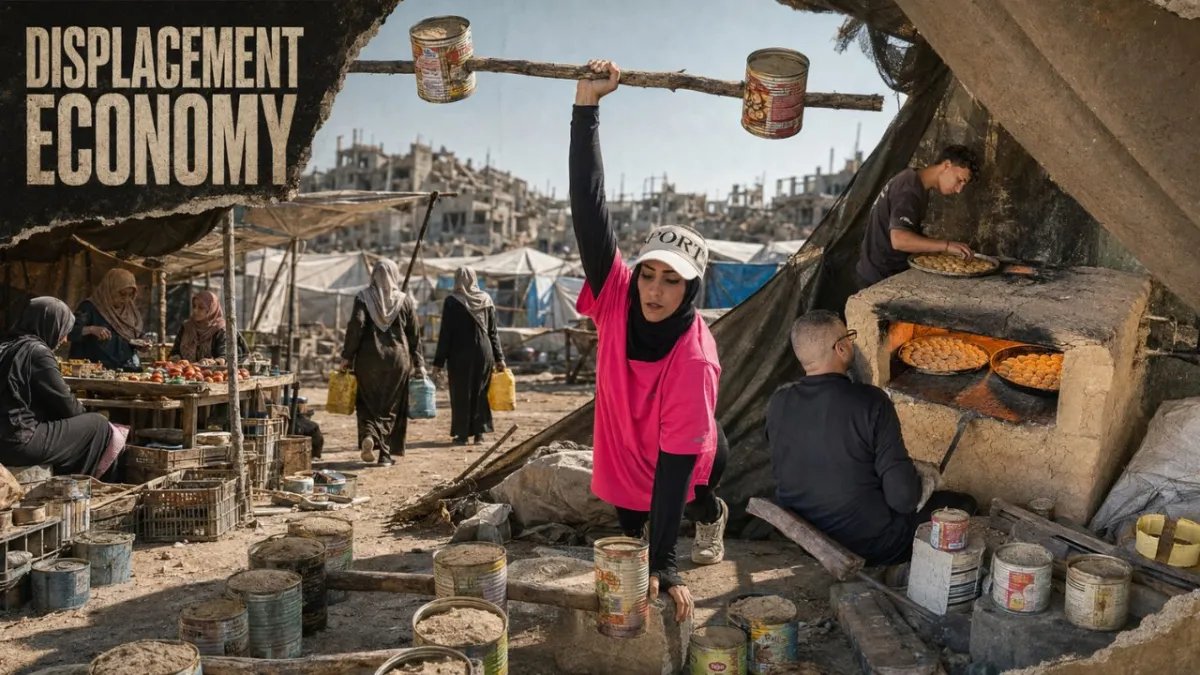
In Gaza’s displacement camps, survival has bred a new economy: a gym owner forges weights from empty cans, a supermarket owner turns baker, a housewife becomes a street vendor — each person rebuilding a livelihood from the wreckage of genocide.
Iman Mughira had spent months and up to $250,000 building a gym in Rafah with several partners before Israel destroyed it during the genocide. Displaced to al-Mawasi in southern Gaza’s Khan Younis, she tracked satellite images of her city until she was certain the gym was gone.
“When I realized it had been destroyed, I felt that my future had also been destroyed,” Mughira, 33, told Mondoweiss.
Mughira is one of thousands of Palestinians in Gaza who lost their livelihoods to what a UN Trade and Development (UNCTAD) report has called the “most severe economic crisis on record” in Gaza, erasing 22 years of development progress in less than two years.” Cut off from what they built before the genocide, many displaced Palestinians in the Strip have improvised new trades and businesses from what has been left behind, trying to continue what they once built in entirely different forms.
“When I was displaced, I left behind my life’s dream, something I had spent years building, and came to al-Mawasi, where there is neither safety nor stability,” Mughira told Mondoweiss. After fleeing Rafah for al-Mawasi, Mughira says that her biggest concern was what would become of her business. She had followed news from her city through satellite imagery, trying to determine what had happened to it, until one day, she received confirmation that it had been completely wiped out by the Israeli army, much like the rest of Rafah.
After the initial shock of losing her business, Mughira began looking for a way out of the grief that had overtaken her. She noticed what was piling up around every tent in the camp: empty cans from food aid and discarded cooking-oil containers.
“These materials are available in every tent, because every tent receives aid and then throws the empty cans into the garbage,” Mughira said. “That is when I had the idea of using these cans again for something new and positive for displaced people.”
“We filled them with sand and used pieces of wood as makeshift bars and lifted the cans, which became weights,” she explained.
Mughira began sharing her experience on social media, receiving messages from women in the camps telling her that they had carved out an hour to themselves each day to exercise and move their bodies again, without having to travel anywhere or pay money they didn’t have.
Other women told her that the exercises had helped them regain their fitness and flexibility, making it easier to cope with the physical demands of displacement, such as carrying water, hauling belongings by hand, sleeping on the sand, and washing clothes.
Eventually, women began coming personally to her tent to train with her. Mughira says she found that many of them were suffering from illnesses or physical problems, including muscle pain caused by sleeping on sand inside tents and by the tasks they were required to perform, such as washing clothes by hand and carrying and cleaning their belongings.
‘I have no choice’
Ayman Abu Muhareb, 44, spends his days in front of an oven his family built out of mud and straw near a displacement camp in Deir al-Balah in central Gaza, baking bread for a small income to support his family of eight, including a daughter with a heart defect.
“Doctors have repeatedly warned me about sitting for long hours in front of the smoke coming from the oven because I burn wood, plastic, and fabric to keep it going,” Abu Muhareb told Mondoweiss. “I started this work a year ago, and since then, my health and physical condition have deteriorated noticeably. But I have no choice. I have to work to bring food home for my family and provide for my sick daughter.”
Before the war, Abu Muhareb says, he owned a supermarket and lived with his family in relative stability. Since then, the supermarket has been bombed, and the remaining goods in it were looted. His entire livelihood was destroyed, forcing him to find alternative work to provide food for his family.
“I never expected that I would one day work as a baker for people and displaced families,” he said. “But circumstances forced me to do it, just as they forced many people to take up jobs that do not suit them to meet their daily needs.”
But despite working those long hours, ignoring the doctors’ advice, he says that there are still days he can’t provide everything his family needs from this work.
Muhareb isn’t the only person who has been forced into a profession not of his own choosing. Across Gaza, women who had previously never been a family’s sole breadwinner were suddenly forced to seek out work to provide for their families, especially in households where the husband or father was injured or killed.
Zeinab al-Najjar, 50, is a mother of eight. Her husband was injured during the war and became confined to a wheelchair, leaving her responsible for supporting their large family by whatever means possible.
After they were displaced to the seafront in Deir al-Balah, al-Najjar found herself facing a heavy responsibility. She started selling lupini beans, a common snack in Gaza, among the tents of displaced families.
She had once been a mother who prepared food for her children and cared for them while her husband worked. Now the roles have been reversed, and she is the one responsible for putting food on the family’s table.
“Displacement forces people to change their ways and change their professions,” al-Najjar explained. I start working in the afternoon, when the heat of the sun becomes less intense,” she said. “I work for long hours, and sometimes I return to my tent after midnight, when I know I have earned enough to take care of my family.”
“I couldn’t sit by and watch my children, especially the younger ones, cry from hunger. I know this work may not be suitable for me, but I have no other choice. I am not seeking profit or wealth. All I want is to feed my children, nothing more. This is what displacement has forced us to do, day after day,” she added.
Tareq S. Hajjaj is the Gaza Correspondent for Mondoweiss and a member of the Palestinian Writers Union. Follow him on Twitter/X at @Tareqshajjaj.
Editor’s Note: At a moment when the once vaunted model of responsible journalism is overwhelmingly the play thing of self-serving billionaires and their corporate scribes, alternatives of integrity are desperately needed, and ScheerPost is one of them. Please support our independent journalism by contributing to our online donation platform, Network for Good, or send a check to our new PO Box. We can’t thank you enough, and promise to keep bringing you this kind of vital news.
You can also make a donation to our PayPal or subscribe to our Patreon.
Please share this story and help us grow our network!
[ad_2]
Source link
