
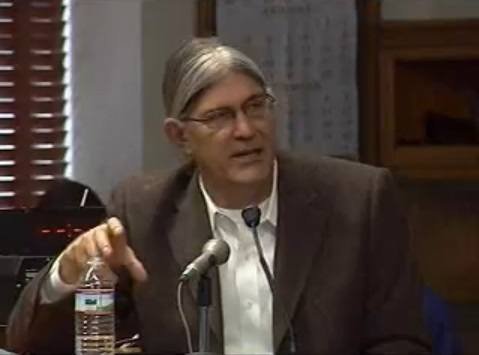
Churchill testifying in the civil trial of Ward Churchill v. University of Colorado – Public Domain
I write in remembrance of Ward Churchill, who died on August 11, 2026. I was a member of Ward’s defense team, headed by the civil rights attorney David Lane, both at hearings at the University of Colorado at Boulder in 2007 and in state court in Denver in 2009, when he sued the university for his firing for charges of “research misconduct” and “plagiarism,” both of which I analyzed thoroughly in a 2008-09 edition of the journal “Works & Days.” The title of my essay is “Framing Ward Churchill: The Political Construction of Research Misconduct.” The title points to the political motivations of the charges against Ward. Those charges were manufactured to mask the attack on Ward from the Right (Fox News, the Colorado governor and legislature, and the UCB administration with the complicity of certain faculty committees) for his activism and speech on behalf of social justice, particularly focused on an essay he published a day after 9/11, titled “Some People Push Back: On the Justice of Roosting Chickens,” on which I will focus in Part II of this essay. Indeed, the Denver jury, to which I gave expert testimony as a scholar of American Indian Studies and federal Indian law, found that Ward’s “protected speech [was]a substantial or motivating factor in the decision to discharge [him]” and that the University had not “shown by a preponderance of the evidence that [Churchill] would have been dismissed for other reasons.” Nevertheless, on July 7, 2009, District Court Judge Larry Neves “denied Churchill’s motion for employment reinstatement as a tenured professor and concluded that back pay ‘is not an appropriate remedy in this case’” (CU Connections). The Colorado Court of Appeals and Supreme Court upheld the Neves verdict, which served the university’s agenda against Ward.
Ward was and through his writing still is a generative figure in Native studies with his focus on colonialism and imperialism as it played and plays out in the Americas. His wide-ranging influence was represented by the strong Native and non-Native support he received in his fight with UCBoulder from both his students and certain colleagues, and national scholars such as Michael Yellow Bird, then of the University of Kansas, who also acted as an expert witness. Ward’s support was national and international. I did not know Ward before I joined his defense team, but I necessarily knew his work, which had a significant influence on my own work in comparative settler colonialism as it did on the work of so many others; and it was my high regard for his work that led me to accept the invitation to join his defense team.
At this moment, with the genocide continuing in Gaza and spreading to the West Bank and Lebanon, I think particularly of Ward’s 1997 classic A Little Matter of Genocide: Holocaust and Denial in the Americas 1492 to the Present, of which David Stannard, who testified in the Denver trial on behalf of Ward and is himself the author of the 1992 classic American Holocaust: The Conquest of the New World, wrote in the Preface: “So it is a good thing that Ward Churchill, with this book, A Little Matter of Genocide, had decided once again to go looking for trouble. He will get plenty of it. But it is only because of trouble-makers like him that the deadened conscience of this nation might some day begin to stir. May his kind multiply.” I am reminded here of civil rights activist and Congressman John Lewis urging us all to “find a way to get in the way” and get into “good trouble, necessary trouble.” We need this kind of trouble more than ever as the United States continues to support Indigenous genocide both at home and in Palestine.
What follows in Part II of this essay is an excerpt from my essay, referenced above, “The Framing of Ward Churchill.” The excerpt looks into Ward’s essay “Some People Push Back: On the Justice of Roosting Chickens” that got him into the “good trouble” that led to the Denver trial. We should remember that Ward’s case was centrally about academic freedom, which has been increasingly under fire since Ward exercised it and defended it, paying the price of his job for his activism, a price that so many faculty are paying today or are under threat of paying for their defense of Palestinian rights. In his obituary in the New York Times, Ward, speaking at UCB in 2017 is quoted as saying, “Academic freedom in America is dead….I had my identity before I was a professor. I had it while I was a professor, and I have it now.” If academics in America are to resurrect academic freedom, we must follow the example of Ward Churchill and give up the identity of professor, which is becoming more and more constricting, for the identity of activists for social justice in word and deed.
With a few small edits, the following section from my 2008-2009 essay “The Framing of Ward Churchill” is an example of Ward’s activism, of his courage and critical insight:
II
Issues that bear on the Churchill case began receiving national attention in late January and early February 2005. This attention focused on an essay Churchill published on the Internet between September 12 and October 7, 2001, when the United States invaded Afghanistan, titled, “‘Some People Push Back’: On the Justice of Roosting Chickens.” The essay served as a polemical analysis of what Churchill terms the “counterattacks” on the World Trade Center (WTC) and the Pentagon on 9/11 by Arab militants. (Of this constituency it was later disclosed that 15 of the 19 operatives were from the U.S. ally Saudi Arabia.) Churchill argues that the attacks were a response to the West’s violent history in the Middle East, beginning with the Crusades and continuing in the present moment with the Israeli occupation of Palestinian homelands. But the focus of Churchill’s polemic is the 1991 U.S. bombing of Iraq’s water and sewage facilities—“‘aerial warfare’ constitut[ing] a Class I Crime Against humanity, entailing myriad gross violations of international law”—and the subsequent ten-year U.S. embargo of Iraq following the first Gulf War, which resulted in the deaths of an estimated 500,000 Iraqi children from the interdiction of food and medicine, deaths that former U.N. Assistant Secretary-General, Denis Halliday, termed a “genocide.”
What public commentary seized on as particularly egregious in Churchill’s essay, and what was duly noted in the UCB chancellor’s review, is his comparison of the “technocratic corps” of business operatives in the WTC, all serving “America’s global financial empire,” to “little Eichmanns.” Concomitantly in this essay, Churchill casts Americans in their passive acceptance of the Iraqi genocide in the role of “good Germans.” The Eichmann comparison undoubtedly offended because at a moment of national and private grief, it took the other side—an outrageous possibility for the media commentators, the Colorado governor, the state legislature, and the university administration—where critical scrutiny turns the innocent into the guilty, the dead and the grieving into the perpetrators of violence. At a time that demanded sympathy for “us,” it displaced that sympathy with a plea for us to understand “them.”
I remember thinking at the time how inapt and inept the comparison to Eichmann was as a strict historical comparison—the demonizing force of the figure tends to erase history by collapsing crucial differences rather than articulating them. From a strictly historical standpoint, my take on the comparison hasn’t changed. But five years into the U.S. preemptive attack on Iraq—with its Orwellian justification of the invasion as the center of the so-called “war on terror”; the hundreds of thousands of Iraqi civilians dead and an estimated 5 million-plus displaced, 2.7 million internally and 2.4 million externally; with the U.S. use of torture, extraordinary renditions, the building and maintenance of the detention center at Guantánamo Bay (et al.); the abrogation of civil liberties in crucial areas through the PATRIOT and related Acts; the extensive use of surveillance on U.S. citizens; and the massive waste of human and material resources in order to maintain a “culture of death”3—Congress can be seen as essentially condoning such actions and thus making itself complicit in war crimes. With these considerations at hand, I do not think that one can simply dismiss Churchill’s comparison as farfetched, though the comparison begs for such dismissal. Even if it does not work literally, the comparison does gesture toward another America that shadows “the land of the free and the home of the brave,” in which many of us think we live. To its credit, Churchill’s scholarship and criticism has consistently demanded that we acknowledge living in this other America. And this has angered those people who have a stake in the narrative of American exceptionalism.
In an op-ed piece I wrote for Indian Country Today on June 9, 2004, at the time when Abu Ghraib first entered U.S. headlines, I noted: “Deadly policy can happen and continue to happen in a democracy precisely because democracy itself can become the alibi for atrocities.” The Indian Removal Act of 1830 passed the House of Representatives by only five votes (102-97) and then only after President Jackson “pressured and bullied” House Democrats into breaking a tie over legislation that “would [have] delay[ed] consideration of removal for a year” (Jill Norgren). Thus, what would materialize as the ethnic cleansing and forced death marches of the Trail of Tears was democratically enacted. But, we might ask, what does it mean for a society to be voting on such a measure in the first place? What does it mean to hold a vote on genocide? Writing against slavery, the Mexican War, and populist democracy, Henry David Thoreau in “Resistance to Civil Government” (1849) remarks on the limits of the vote as a tool of democratic social action:
All voting is a sort of gaming, like checkers or backgammon, with a slight moral tinge to it, a playing with right and wrong, with moral questions; and betting naturally accompanies it. The character of the voters is not staked. I cast my vote, perchance, as I think right; but I am not vitally concerned that that right should prevail. I am willing to leave it to the majority. Its obligation, therefore, never exceeds that of expediency. Even voting for the right is doing nothing for it. It is only expressing to men feebly your desire that it should prevail. A wise man will not leave the right to the mercy of chance, nor wish it to prevail through the power of the majority.
I think this passage inhabits the same space as Churchill’s 9/11 essay, of his “good Germans” comparison, though it does so with much more precision; and so we, whatever our criticisms of Churchill, might recognize that his essay, however expressed, belongs to a vital American heritage of dissent and carries a message about which we ought to think.
We now know that no Iraqis as individuals nor Iraq as a state were involved in 9/11. But as Churchill acknowledges in an “Addendum” to his essay, he was not writing in a strictly literal mode (nor apparently was George W. Bush acting in one, though he thought he was, when he linked Saddam Hussein to 9/11); it was “more a stream-of-consciousness interpretive reaction to the September 11 counterattack than a finished piece on the topic” (in an eerie kind of way Churchill’s words here could characterize Bush’s war plan, which, however, had and continues to have literally devastating results). That is, the genocide committed on Iraqi civilians by the U.S. bombing and embargo of Iraq prior to 9
I write in remembrance of Ward Churchill, who died on August 11, 2026. I was a member of Ward’s defense team, headed by the civil rights attorney David Lane, both at hearings at the University of Colorado at Boulder in 2007 and in state court in Denver in 2009, when he sued the university for his firing for charges of “research misconduct” and “plagiarism,” both of which I analyzed thoroughly in a 2008-09 edition of the journal “Works & Days.” The title of my essay is “Framing Ward Churchill: The Political Construction of Research Misconduct.” The title points to the political motivations of the charges against Ward. Those charges were manufactured to mask the attack on Ward from the Right (Fox News, the Colorado governor and legislature, and the UCB administration with the complicity of certain faculty committees) for his activism and speech on behalf of social justice, particularly focused on an essay he published a day after 9/11, titled “Some People Push Back: On the Justice of Roosting Chickens,” on which I will focus in Part II of this essay. Indeed, the Denver jury, to which I gave expert testimony as a scholar of American Indian Studies and federal Indian law, found that Ward’s “protected speech [was]a substantial or motivating factor in the decision to discharge [him]” and that the University had not “shown by a preponderance of the evidence that [Churchill] would have been dismissed for other reasons.” Nevertheless, on July 7, 2009, District Court Judge Larry Neves “denied Churchill’s motion for employment reinstatement as a tenured professor and concluded that back pay ‘is not an appropriate remedy in this case’” (CU Connections). The Colorado Court of Appeals and Supreme Court upheld the Neves verdict, which served the university’s agenda against Ward.
Ward was and through his writing still is a generative figure in Native studies with his focus on colonialism and imperialism as it played and plays out in the Americas. His wide-ranging influence was represented by the strong Native and non-Native support he received in his fight with UCBoulder from both his students and certain colleagues, and national scholars such as Michael Yellow Bird, then of the University of Kansas, who also acted as an expert witness. Ward’s support was national and international. I did not know Ward before I joined his defense team, but I necessarily knew his work, which had a significant influence on my own work in comparative settler colonialism as it did on the work of so many others; and it was my high regard for his work that led me to accept the invitation to join his defense team.
At this moment, with the genocide continuing in Gaza and spreading to the West Bank and Lebanon, I think particularly of Ward’s 1997 classic A Little Matter of Genocide: Holocaust and Denial in the Americas 1492 to the Present, of which David Stannard, who testified in the Denver trial on behalf of Ward and is himself the author of the 1992 classic American Holocaust: The Conquest of the New World, wrote in the Preface: “So it is a good thing that Ward Churchill, with this book, A Little Matter of Genocide, had decided once again to go looking for trouble. He will get plenty of it. But it is only because of trouble-makers like him that the deadened conscience of this nation might some day begin to stir. May his kind multiply.” I am reminded here of civil rights activist and Congressman John Lewis urging us all to “find a way to get in the way” and get into “good trouble, necessary trouble.” We need this kind of trouble more than ever as the United States continues to support Indigenous genocide both at home and in Palestine.
What follows in Part II of this essay is an excerpt from my essay, referenced above, “The Framing of Ward Churchill.” The excerpt looks into Ward’s essay “Some People Push Back: On the Justice of Roosting Chickens” that got him into the “good trouble” that led to the Denver trial. We should remember that Ward’s case was centrally about academic freedom, which has been increasingly under fire since Ward exercised it and defended it, paying the price of his job for his activism, a price that so many faculty are paying today or are under threat of paying for their defense of Palestinian rights. In his obituary in the New York Times, Ward, speaking at UCB in 2017 is quoted as saying, “Academic freedom in America is dead….I had my identity before I was a professor. I had it while I was a professor, and I have it now.” If academics in America are to resurrect academic freedom, we must follow the example of Ward Churchill and give up the identity of professor, which is becoming more and more constricting, for the identity of activists for social justice in word and deed.
With a few small edits, the following section from my 2008-2009 essay “The Framing of Ward Churchill” is an example of Ward’s activism, of his courage and critical insight:
II
Issues that bear on the Churchill case began receiving national attention in late January and early February 2005. This attention focused on an essay Churchill published on the Internet between September 12 and October 7, 2001, when the United States invaded Afghanistan, titled, “‘Some People Push Back’: On the Justice of Roosting Chickens.” The essay served as a polemical analysis of what Churchill terms the “counterattacks” on the World Trade Center (WTC) and the Pentagon on 9/11 by Arab militants. (Of this constituency it was later disclosed that 15 of the 19 operatives were from the U.S. ally Saudi Arabia.) Churchill argues that the attacks were a response to the West’s violent history in the Middle East, beginning with the Crusades and continuing in the present moment with the Israeli occupation of Palestinian homelands. But the focus of Churchill’s polemic is the 1991 U.S. bombing of Iraq’s water and sewage facilities—“‘aerial warfare’ constitut[ing] a Class I Crime Against humanity, entailing myriad gross violations of international law”—and the subsequent ten-year U.S. embargo of Iraq following the first Gulf War, which resulted in the deaths of an estimated 500,000 Iraqi children from the interdiction of food and medicine, deaths that former U.N. Assistant Secretary-General, Denis Halliday, termed a “genocide.”
What public commentary seized on as particularly egregious in Churchill’s essay, and what was duly noted in the UCB chancellor’s review, is his comparison of the “technocratic corps” of business operatives in the WTC, all serving “America’s global financial empire,” to “little Eichmanns.” Concomitantly in this essay, Churchill casts Americans in their passive acceptance of the Iraqi genocide in the role of “good Germans.” The Eichmann comparison undoubtedly offended because at a moment of national and private grief, it took the other side—an outrageous possibility for the media commentators, the Colorado governor, the state legislature, and the university administration—where critical scrutiny turns the innocent into the guilty, the dead and the grieving into the perpetrators of violence. At a time that demanded sympathy for “us,” it displaced that sympathy with a plea for us to understand “them.”
I remember thinking at the time how inapt and inept the comparison to Eichmann was as a strict historical comparison—the demonizing force of the figure tends to erase history by collapsing crucial differences rather than articulating them. From a strictly historical standpoint, my take on the comparison hasn’t changed. But five years into the U.S. preemptive attack on Iraq—with its Orwellian justification of the invasion as the center of the so-called “war on terror”; the hundreds of thousands of Iraqi civilians dead and an estimated 5 million-plus displaced, 2.7 million internally and 2.4 million externally; with the U.S. use of torture, extraordinary renditions, the building and maintenance of the detention center at Guantánamo Bay (et al.); the abrogation of civil liberties in crucial areas through the PATRIOT and related Acts; the extensive use of surveillance on U.S. citizens; and the massive waste of human and material resources in order to maintain a “culture of death”3—Congress can be seen as essentially condoning such actions and thus making itself complicit in war crimes. With these considerations at hand, I do not think that one can simply dismiss Churchill’s comparison as farfetched, though the comparison begs for such dismissal. Even if it does not work literally, the comparison does gesture toward another America that shadows “the land of the free and the home of the brave,” in which many of us think we live. To its credit, Churchill’s scholarship and criticism has consistently demanded that we acknowledge living in this other America. And this has angered those people who have a stake in the narrative of American exceptionalism.
In an op-ed piece I wrote for Indian Country Today on June 9, 2004, at the time when Abu Ghraib first entered U.S. headlines, I noted: “Deadly policy can happen and continue to happen in a democracy precisely because democracy itself can become the alibi for atrocities.” The Indian Removal Act of 1830 passed the House of Representatives by only five votes (102-97) and then only after President Jackson “pressured and bullied” House Democrats into breaking a tie over legislation that “would [have] delay[ed] consideration of removal for a year” (Jill Norgren). Thus, what would materialize as the ethnic cleansing and forced death marches of the Trail of Tears was democratically enacted. But, we might ask, what does it mean for a society to be voting on such a measure in the first place? What does it mean to hold a vote on genocide? Writing against slavery, the Mexican War, and populist democracy, Henry David Thoreau in “Resistance to Civil Government” (1849) remarks on the limits of the vote as a tool of democratic social action:
All voting is a sort of gaming, like checkers or backgammon, with a slight moral tinge to it, a playing with right and wrong, with moral questions; and betting naturally accompanies it. The character of the voters is not staked. I cast my vote, perchance, as I think right; but I am not vitally concerned that that right should prevail. I am willing to leave it to the majority. Its obligation, therefore, never exceeds that of expediency. Even voting for the right is doing nothing for it. It is only expressing to men feebly your desire that it should prevail. A wise man will not leave the right to the mercy of chance, nor wish it to prevail through the power of the majority.
I think this passage inhabits the same space as Churchill’s 9/11 essay, of his “good Germans” comparison, though it does so with much more precision; and so we, whatever our criticisms of Churchill, might recognize that his essay, however expressed, belongs to a vital American heritage of dissent and carries a message about which we ought to think.
We now know that no Iraqis as individuals nor Iraq as a state were involved in 9/11. But as Churchill acknowledges in an “Addendum” to his essay, he was not writing in a strictly literal mode (nor apparently was George W. Bush acting in one, though he thought he was, when he linked Saddam Hussein to 9/11); it was “more a stream-of-consciousness interpretive reaction to the September 11 counterattack than a finished piece on the topic” (in an eerie kind of way Churchill’s words here could characterize Bush’s war plan, which, however, had and continues to have literally devastating results). That is, the genocide committed on Iraqi civilians by the U.S. bombing and embargo of Iraq prior to 9/11 is, for Churchill, symbolic of the many genocides committed by the United States throughout its history, beginning with the genocide against American Indians. However controversial or debated this position of deliberate genocide against American Indians is within American history and American Indian studies, Churchill is far from being alone in holding it, both in his writing and teaching (for which he won a student award at Colorado). I hold this position myself. More importantly, the position that American Indians have been (and in specific ways still are) the victims of genocide, is a position widely held throughout Indian country.
III
Since I wrote the essay in 2009, when Churchill’s charge of Native American genocide was still being contested by a vocal but loud minority of American studies and American Indian studies scholars, as his hearing and trial attests (I doubt such scholars can be found today, if they are around they are certainly in hiding, although Trump and friends would like them to come out). But it is true, and this is a central point of A Little Matter of Genocide, that the U.S government and the US educational system by and large have erased the genocide. To this point, and as a companion to Ward’s work, I suggest Lakota poet Layli Long Soldier’s long poem Whereas (2017) for anyone who wants to read the force of this erasure in the U.S. government’s bad-faith 2009 Congressional Resolution of Apology to Native Americans. Satirizing all the “whereas” clauses that compose the Apology, Long Soldier at one point in the poem comments on a conversation with a “scholarly” “circle”: “Whereas I could’ve but I didn’t broach the subject of ‘genocide’ the absence of this term from the Apology and its rephrasing as ‘conflict’ for example.” Ward Churchill’s generative work remains an ongoing exposure of this absence in the history of the United States. May his work continue to trouble us and urge us to get into trouble, to get in the way, as he did throughout his career.
