
The policy brief, “Make Housing More Affordable,” part of CEPR’s Majority Agenda, points out that “federal housing policy directs too much funding to the wealthy and too little for everyone else.” For instance, most of the benefit of the mortgage interest deduction goes to households with incomes over $200,000, and this policy costs the government more than twice as much as the Low-Income Housing Tax Credit. Also, only a quarter of renters eligible for housing assistance receive it, and less than 10 percent of unhoused people are provided housing by homelessness programs.
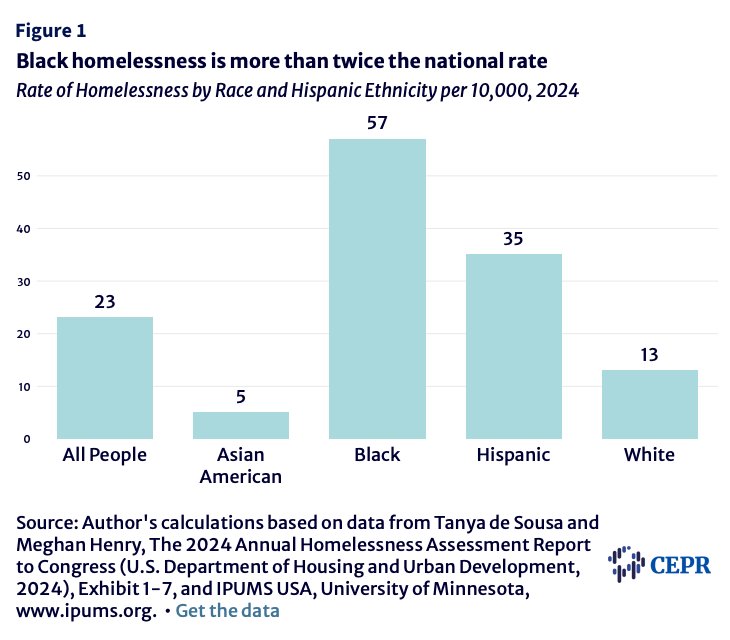
Prioritizing the wealthy has contributed to a high rate of homelessness which disproportionately harms Black and Hispanic people.1 Although the Black population makes up 12 percent of the overall population, they made up 30 percent of the homeless population in 2024.2 The Hispanic population makes up 20 percent of the US population but made up 31 percent of the homeless.3
Men were homeless at a higher rate than women (27 versus 18 per 10,000) in 2024.4 Data by race and sex is not provided in the Department of Housing and Urban Development’s Annual Homelessness Assessment Report (AHAR).5 Figure 2 shows a guesstimate made by applying the overall AHAR share of men in the homeless population to the White and Black counts. Applying that share yields a Black male homelessness rate of 71 per 10,000.
But it is not likely that Black men are merely as disadvantaged as men overall. Black men are worse off than White men on many of the predictors for homelessness (e.g., low income, debt, and a history of incarceration). A study of homelessness in California by the University of California San Francisco (UCSF) from 2021 to 2022 found that 75 percent of the Black people experiencing homelessness were male. This is higher than the share of men – 59.6 percentoverall – in the AHAR data. Applying the UCSF share for Black men yields a Black male homelessness rate of 89 per 10,000. This guesstimate is likely to be closer to the real rate.

Policy changes could drastically reduce or even eliminate homelessness. From 2009 to 2022, homelessness among veterans declined by 55 percent. This was accomplished with strategic Housing First investments by the Department of Veterans Affairs in collaboration with the Department of Housing and Urban Development. The National Alliance to End Homelessness observes:
Congress could fund an end to homelessness nationwide. The estimated 9.6 billion dollars required to house everyone living in a shelter during a given year is a small fraction of other federal programs. For example, just over one percent of annual funding for the Department of Defense is enough to house every person experiencing homelessness. But the Administration’s proposed cuts to homeless services along with recent changes to Medicaid, Supplemental Nutrition Assistance Program (SNAP), Supplemental Security Income and other supports will hurt response workers’ efforts and make the crisis worse.
The Trump administration also no longer supports the Housing First approach to address homelessness even though it has been proven to be effective. It is important to remember that the safety net cuts in the One Big Beautiful Bill Act were done to help pay for tax cuts to the rich. There would be much more affordable housing if policymakers were to prioritize the needy over the rich.
Notes.
1) This discussion focuses on the rate of homelessness for Black people, but the rates for American Indians and Alaska Natives (95 per 10,000) and for Native Hawaiians and Pacific Islanders (186 per 10,000) are even higher. One should also note that the Black homeless population is more than eight times the size of the American Indian and Alaska Natives, and Native Hawaiians and Pacific Islanders homeless populations combined.
2) Author’s calculations based on data from Tanya de Sousa and Meghan Henry, The 2024 Annual Homelessness Assessment Report to Congress (U.S. Department of Housing and Urban Development, 2024), Exhibit 1-7; and IPUMS USA, University of Minnesota, www.ipums.org.
3) Ibid.
4) Ibid.
First published in CEPR.
