
[ad_1]

There’s a theme in Democratic commentary this summer: Voters don’t care about the party’s internal fights, they care about the affordability crisis. So Democrats should stop navel-gazing around internal governance and get back to kitchen-table issues. It’s a reasonable instinct much of the time. Most DNC personnel disputes really are inside baseball.
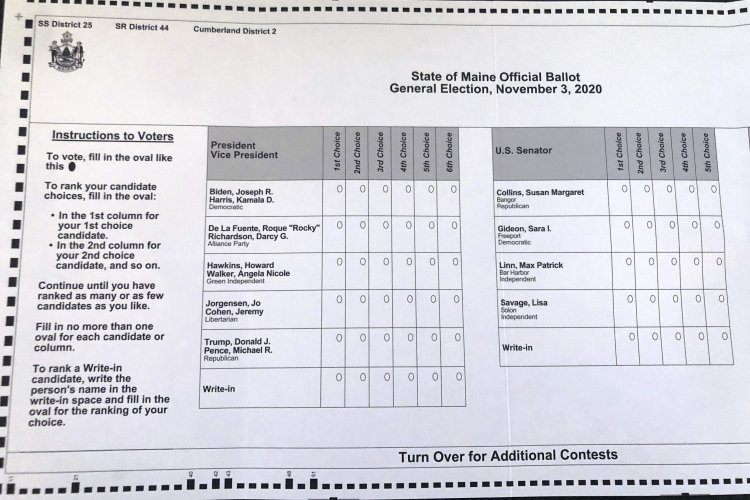
But that framing should not be used to wave off a decision that isn’t inside baseball at all. In mid-August, the DNC is set to finalize a rule banning state parties from using ranked choice voting to select delegates in the 2028 presidential primary cycle – overriding laws that voters in Maine and Washington, D.C., passed for themselves and plans in several states where parties run their primaries. It has gotten little national press coverage, yet is exactly the kind of “internal politics” story that actually determines whether voters get the kind of candidates they say they want.
There’s a narrow case for why this ban is so wrong-headed. Ranked choice voting (RCV) would be used to give a second chance to voters whose candidate finishes below the 15% threshold that the party establishes to earn delegates with proportional representation. In four states where RCV was used in Democratic presidential primaries in 2020, 98% of voters ended up with their vote counting toward a candidate earning delegates. A total of 99.8% of voters cast valid ballots, and nearly 90% of backers of trailing candidates ranked a backup who won delegates.
But there’s a broader point about democracy that matters to most Democrats. New polling by my organization, RepresentWomen, conducted with Murmuration, found that Americans across party lines want more voter choice. Seventy-eight percent said it’s more important for voters to have flexibility to support their preferred candidate than for parties to control who’s on the ballot. Nearly six in 10 said the country needs major changes to how elections and representation work. This is not a fringe sentiment. It’s the broad public verdict on elections that frustrate and alienate voters.
A big problem addressed by RCV has a name: vote-splitting. When a crowded field divides similar candidates’ support, less representative candidates are rewarded. A national poll released by FairVote found 47% of voters felt they’d voted for the lesser of two evils in at least one race in 2024. Ranked choice voting exists specifically to fix this. It lets voters rank candidates instead of picking just one, so that if their first choice can’t win, their vote counts for their next choice instead of disappearing. In a crowded primary, it rewards the candidate who can help unify the party.
Presidential primaries make this problem worse because they’re sequential. States vote over months, not on a single day, and candidates regularly drop out between the early contests and the later ones. A voter in a state that votes in March can cast an early vote for a candidate who withdraws before it’s counted. In 2020, more than three million Democratic primary voters ended up having cast a ballot for a candidate no longer running. Ranked choice voting fixes exactly this: If a voter’s first choice drops out, their vote moves to their next-ranked choice instead of vanishing. It’s the difference between a vote that counts only if you guessed the eventual frontrunner correctly, and a vote that counts no matter when your preferred candidate exits the race.
Maine Democrats support their state’s RCV law by an overwhelming margin of 84% to 6%. Washington, D.C., voters just used ranked ballots in a smooth primary rollout and District Democrats back RCV by 74% to 16%. State party leaders in several other states want to use it too, and lawmakers in several states are looking to put it into primary election law. Yet the DNC – in the name of “simplicity” – may shut these uses down.
Younger voters see the stakes here more clearly. Our polling found that adults under 35 favor ranked choice voting as an improvement over the current system by a wide margin, while support drops off sharply among voters over 65 – the demographic that dominates the committee actually writing the rule to ban RCV.
Here’s the uncomfortable math for anyone tempted to file this under noise: If the party bans RCV now and ends up in 2028 with millions of votes going to candidates who have already exited the race and with a nominee that disappoints most of its own voter base, there will be no honest claim that nothing could have been done. There will be a paper trail. This was the one lever available, and the committee chose to discard it, quietly, while everyone was looking somewhere else.
Democrats are right that voters care more about affordability than about DNC org charts. But the rules that decide who gets nominated aren’t separate from whether the party can field a candidate voters trust to fix the economy. They’re upstream from it. A process that keeps forcing voters into limited choices they didn’t ask for isn’t a distraction from the affordability fight. It’s part of why the party keeps struggling to win the argument.
The DNC can spend mid-August finalizing a rule when nobody’s watching. Or it can back off and let the states that want ranked choice voting use it.
[ad_2]
Source link
