
[ad_1]
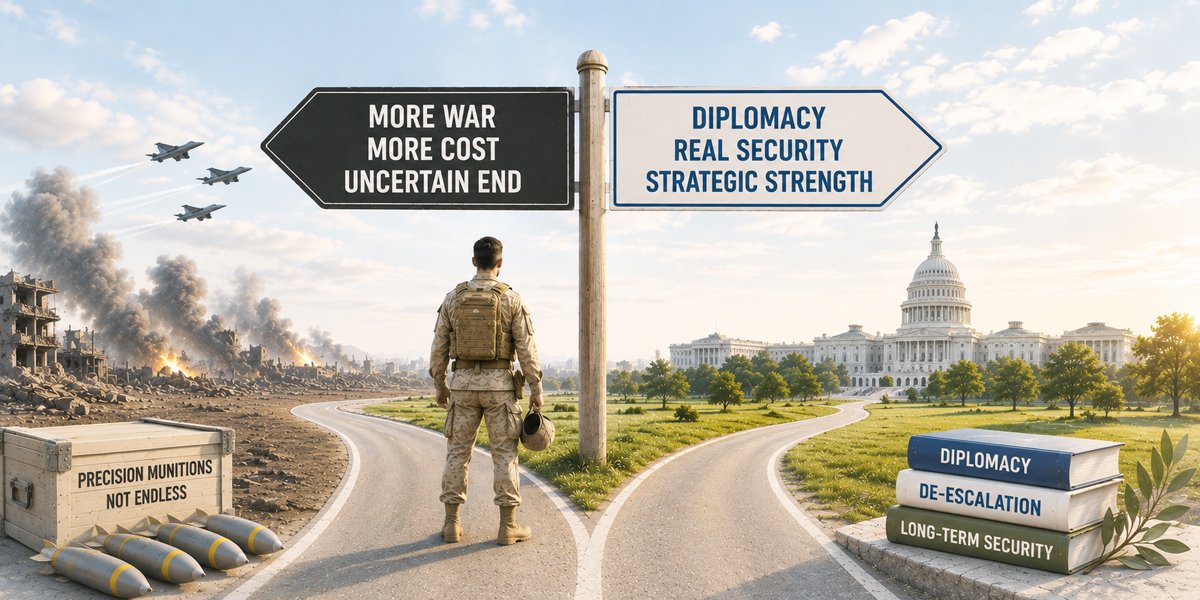
The question for Washington is not whether it can keep fighting, but whether the mission still warrants the lives, munitions, and future military readiness being spent on it.
CNN reported this weekend that Gen. Dan Caine, chairman of the Joint Chiefs of Staff, has privately urged senior Trump administration officials to look for an “off-ramp” from the war with Iran. According to three sources familiar with the discussions, Caine has warned that further escalation could backfire and that airpower alone is unlikely to achieve President Donald Trump’s stated objectives. His team declined to discuss confidential conversations, and the White House emphasized that Caine provides the president with options rather than policy prescriptions. That distinction matters. Caine is the president’s senior military adviser, not the official who decides where the war should end.
But the report exposes the question Washington can no longer avoid: not whether the United States has enough power to continue fighting, but how much of its future power it should spend on a mission whose political endpoint remains uncertain. A powerful country can continue a war. A strategically disciplined one must also know when further fighting begins to reduce, rather than increase, its security.
The Cost of Consuming Power
The U.S. military exists to achieve political objectives, not to make the continuation of military activity an objective in itself. A mission therefore needs a defined purpose, a measurable standard of success, and a reasonable relationship between expected gains and costs. When additional strikes no longer improve the chances of producing the desired political outcome, the ability to keep striking is not, by itself, a strategy.
Reuters reported last week that the United States has used much of its inventory of highly accurate long-range missiles during the five-month conflict, while advanced air-defense inventories have also come under pressure. President Trump has disputed suggestions that the military is short of munitions, saying the United States has more than it needs. The disagreement over exact stockpile levels does not erase the underlying strategic issue: high-end weapons take time to replace.
Not every military cost can be treated the same way. Money can be appropriated. Some weapons can eventually be replaced. But rebuilding inventories takes time, and the lives of American service members cannot be restored. Every operation therefore has an opportunity cost: resources committed to Iran are resources that cannot simultaneously be held at the same level of readiness for another contingency.
That matters because the United States does not maintain a military only for today’s war. Its own 2026 National Defense Strategy places major emphasis on deterring China in the Indo-Pacific while maintaining commitments and partnerships in Europe and the Middle East. A prolonged war of attrition in one theater can therefore affect deterrence in another. The relevant measure of strength is not simply how much force America can employ today, but what military options remain available tomorrow.
This is why asking whether the mission is worth American lives and scarce military capacity is not an anti-military argument. It is an argument for using the military with discipline. Service members should be placed in harm’s way when there is a clear political purpose, a genuine security requirement, and a reasonable prospect that military action can achieve the intended result. Continuing a war primarily to demonstrate that the United States will not “back down” risks substituting political symbolism for strategy.
Define the End Before Escalating Again
The administration’s own public descriptions of the war illustrate the problem. At the outset of Operation Epic Fury, the White House identified several objectives: eliminating Iran’s nuclear threat, destroying its ballistic-missile arsenal, degrading proxy networks, and crippling its naval forces. These are not identical goals, and each demands a different measure of success.
If the objective is to eliminate a nuclear threat, Washington needs a credible standard for determining what capability has been destroyed and what can be rebuilt. If the objective is to change Tehran’s behavior, the relevant question is whether additional attacks make a change in behavior more or less likely. If the objective is a negotiated settlement, Washington must judge whether military pressure is improving its bargaining position or hardening Iranian resistance. And if the objective has expanded during the war, the administration owes the public an explanation of what the new endpoint is.
Supporters of continued pressure can make a serious case. De-escalating while Iran continues to resist could be read in Tehran as evidence that endurance works. It could reduce American bargaining leverage, reassure Iran that Washington lacks staying power, and make future coercive threats less credible. Those risks should not be dismissed.
But that argument only works if further military action is actually moving the United States toward a defined political result at an acceptable cost. Resolve is not measured by the duration of a war. If additional attacks consume scarce capabilities without materially improving the probability of achieving the objective, continuing them can weaken the leverage they are meant to demonstrate.
This is where the idea of an “off-ramp” should lose its stigma. An off-ramp is not necessarily surrender. Negotiation is not necessarily weakness, and reducing military operations is not automatically defeat. If core objectives have been achieved, or if military action has reached the point of diminishing strategic returns, changing course can preserve rather than squander American power.
The alternative is the logic of sunk costs: because lives, money, and munitions have already been spent, Washington concludes that it must spend more so the earlier costs will not appear wasted. That logic has prolonged wars before. Past sacrifice can explain why a decision feels difficult; it cannot by itself justify future sacrifice.
The real test of Trump’s Iran policy will therefore not be the number of targets destroyed or the length of time the United States remained willing to fight. It will be whether America emerges from the conflict safer, strategically stronger, and better prepared for the next threat.
The United States is powerful enough to continue the war. That is not the same as having a sufficient reason to do so. The standard should be objective, outcome, and cost. If American lives, hard-to-replace munitions, and future military readiness are being spent, the administration must show that the strategic return justifies the price. If it cannot, searching for an off-ramp is not an admission of weakness. It is an exercise in judgment.
Timothy Hopper is an international relations graduate of American University and a freelance foreign policy writer.
Join the Discussion!
We welcome thoughtful and respectful comments. Hateful language, illegal content, or attacks against Antiwar.com will be removed.
For more details, please see our Comment Policy.
[ad_2]
Source link
