
[ad_1]
Blake Fleetwood ScheerPost
Pundits are fear-mongering that Dr. Abdul El-Sayed’s Michigan victory is the clearest sign yet that his party’s old establishment is under a threatening siege.
“In the words of Muhammad Ali, ‘We shook up the world,’” El-Sayed proclaimed after the results were in.
What the pundits are missing is that almost everything in America is under siege.
El-Sayed and Mamdani are not the cause of the political upheaval; they are symptoms of a country that has stopped delivering the economic security Americans were promised.
El-Sayed overcame an extraordinary 11-to-one spending disadvantage to secure a remarkable victory. Outside groups poured more than $70 million into the race aimed at defeating him.
El-Sayed was labeled a Communist, a socialist, and an antisemite.
But he won against extraordinary odds because, for many voters, the system had become more frightening than the labels.
“What we showed is that the power of our many is greater than the power of their money.”
That may prove to be the most important message of the election.
The instinct among much of the political class and mainstream media has been to argue that Democrats have moved too far left and need to run more conventional centrists to defeat Donald Trump and the Republicans in November.
The Washington Post, The New York Times and other mainstream outlets, along with much of the Democratic establishment, have reacted with alarm to the wave of progressive victories represented by Mamdani and now El-Sayed, fearing that these candidates could jeopardize Democratic chances in the midterms.
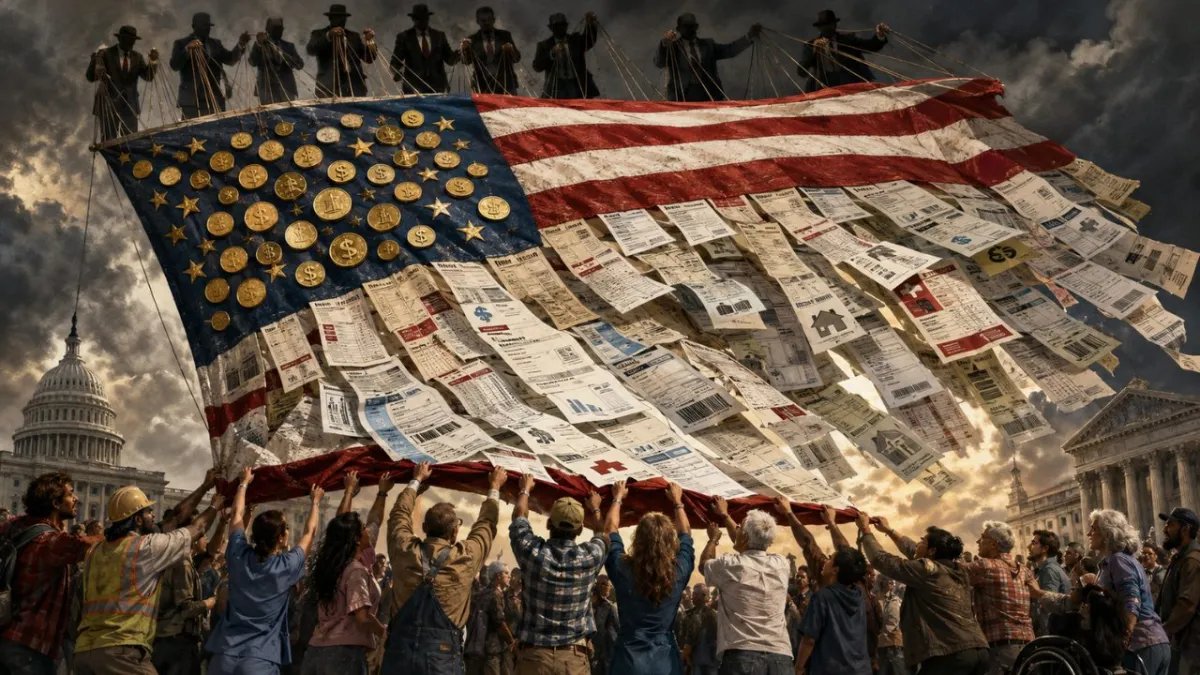
Perhaps they are worried about something larger: that the wealthy oligarchy accommodated by both political parties is approaching a watershed moment — a populist insurgency that threatens to reorder American politics.
But voters are not suddenly reading Marx.
They are reacting to a country in which the basic promise of American life has become harder and harder to obtain.
El-Sayed’s platform is straightforward, simple, and broad in its appeal:
Money Out of Politics Means More Money in People’s Pockets.
Medicare for All.
These are ideas with considerable popular support. Yet much of the political and media establishment treats them as dangerously radical even though voters themselves consistently express support for government-backed healthcare and higher taxes on the wealthy. Government-supported healthcare is favored by 66%, and taxing the wealthy by 63%, large majorities. And they’re not minor concerns.
El-Sayed’s populist message draws a direct connection between corporate and special-interest money in politics and federal policies that fail working families.
Strip away the modern political labels, and much of that message could have been embraced by Franklin D. Roosevelt — or even Theodore Roosevelt.
It speaks to an old American aspiration: the government should protect ordinary citizens against concentrations of private power.
When America revolted against King George III, the Declaration of Independence proclaimed the rights to “Life, Liberty and the pursuit of Happiness.” It declared these to be unalienable rights under god, and said that governments are instituted to secure them.
Those promises were profoundly aspirational in 1776. Of course America notoriously failed to extend them at the time to millions of its own people.
But the enduring American project has been to make those promises more real with each generation.
Today, surely, the pursuit of happiness must mean more than an abstraction. It should include access to medical care, the possibility of owning a home, the right to vote and the opportunity for a decent education. Simple rights that most people in Scandinavian countries have come to expect.
Yet tens of millions of middle-class Americans increasingly believe those elements of the American Dream are slipping beyond their reach.
Americans without college degrees have experienced decades of economic insecurity while the fortunes of the ultra-rich have exploded.
And that is why the political establishment is so concerned about El-Sayed’s victory. It follows other victories on the left: Zohran Mamdani, the Democratic Socialists of America primary victories in June, and now El-Sayed — who is not a DSA candidate but who might be described by Cold Warriors as a fellow traveler.
Healthcare illustrates why these candidates can connect with voters.
Healthcare costs top the list of voters’ healthcare priorities for the midterm elections, with 51 percent of all voters — and 60 percent of Democrats and 55 percent of independents — saying the issue is extremely important for candidates to address.
And it might not cost more. A new Yale University study predicts that Medicare for all would save 114,000 lives and a trillion dollars a year from our bloated health care budget.
Trump is not the only threat to our democracy.
We are.
Our political culture, our institutions and our tolerance for a system increasingly dominated by money created the conditions and the dissatisfactions that Trump was able to exploit.
Donald Trump and the Republicans have already labeled Mamdani a “communist lunatic.” Republicans routinely call Democratic candidates “socialists.”
There is no escaping that attack. Democrats have spent decades running from it.
And certainly the word socialism has been toxic in American politics for more than a century.
But things may be changing.
The driving force in American politics today may be less an ideological movement to the left or right than an overwhelming hatred of the establishment and an almost desperate desire for change.
El-Sayed himself has said that voters gave him the benefit of the doubt because they hated the existing system even more.
Think about the pattern of the past two decades.
Americans voted left for “change” with Barack Obama in 2008. Eight years later, they made an extraordinary 180-degree turn and voted for Donald Trump, another self-proclaimed agent of change.
Then they voted Trump out and elected Joe Biden.
Four years later, dissatisfied again, they returned Trump to office.
That is not an electorate marching steadily left.
It is not an electorate marching steadily right.
It is an electorate pounding on the doors of the political system, demanding that somebody — anybody — change it.
Again and again, voters have been promised transformation. Again and again, many middle- and working-class Americans believe they have received little more than politics as usual while inequality continues to grow and the necessities of middle-class life — housing, food, gas, medical care — become more expensive.
They want change from a political system that they believe has been turned over to an oligarchy and an election system awash in enormous amounts of special-interest and dark money.
That is why Cold War red-baiting may no longer work the way it once did.
When Trump and his Republican allies denounce progressive Democrats as socialists and Communists, some voters may have a very different visceral reaction:
If the establishment is this terrified of these candidates, maybe they really do represent change.
The red-baiting strategy already appears to have failed against Mamdani and El-Sayed.
Trump understood the anger and alienation of the American electorate far better than the political establishment did. But Trump did not create that anger.
He exploited it.
The deeper threat to American democracy does not originate with one politician. It arises when millions of citizens cease believing that democratic government is capable of improving their lives.
Franklin Roosevelt understood this.
In his 1938 fireside chat, as dictatorships spread across Europe, Roosevelt warned that democracy had disappeared in other great nations not because people suddenly despised liberty, but because they had grown exhausted by “unemployment and insecurity.”
In desperation, people were willing to sacrifice political liberty in return for the promise of economic security.
Roosevelt’s answer was not to lecture those people about democracy.
It was to make democracy work for them.
That was not some alien philosophy imposed on America. It was the New Deal — and one of the most successful political programs in American history.
Roosevelt understood something our political establishment repeatedly forgets:
Democracy cannot survive indefinitely on abstractions. It has to deliver for the majority.
And that is the real significance of El-Sayed’s victory.
The political establishment can dismiss these insurgent candidates as socialists, radicals, or dangerous populists.
But it would be wiser to ask why voters are increasingly choosing candidates who promise to overturn the system.
America was founded on a revolutionary idea: the government exists to secure the rights and improve the prospects of its citizens.
When the richest country in the world can no longer convince millions of its citizens that they will be able to afford healthcare, educate their children, own a home, or have a meaningful voice in their government, those citizens are not necessarily rejecting America.
They may be demanding that America live up to itself.
Perhaps what has become truly anti-American is the system that no longer delivers the American promise.
Blake Fleetwood
Blake Fleetwood was formerly a reporter on the staff of The New York Times and has written for The New York Times Magazine, New York Magazine, The New York Daily News, the Wall Street Journal, USA Today, the Village Voice, Atlantic, and the Washington Monthly on a number of issues.
He was born in Santiago, Chile and moved to New York City at the age of four. He graduated from Bard College and did graduate work in political science and comparative politics at Columbia University. He has also taught politics at New York University. He can be reached at jfleetwood@aol.com.
Editor’s Note: At a moment when the once vaunted model of responsible journalism is overwhelmingly the play thing of self-serving billionaires and their corporate scribes, alternatives of integrity are desperately needed, and ScheerPost is one of them. Please support our independent journalism by contributing to our online donation platform, Network for Good, or send a check to our new PO Box. We can’t thank you enough, and promise to keep bringing you this kind of vital news.
You can also make a donation to our PayPal or subscribe to our Patreon.
Please share this story and help us grow our network!
[ad_2]
Source link
