
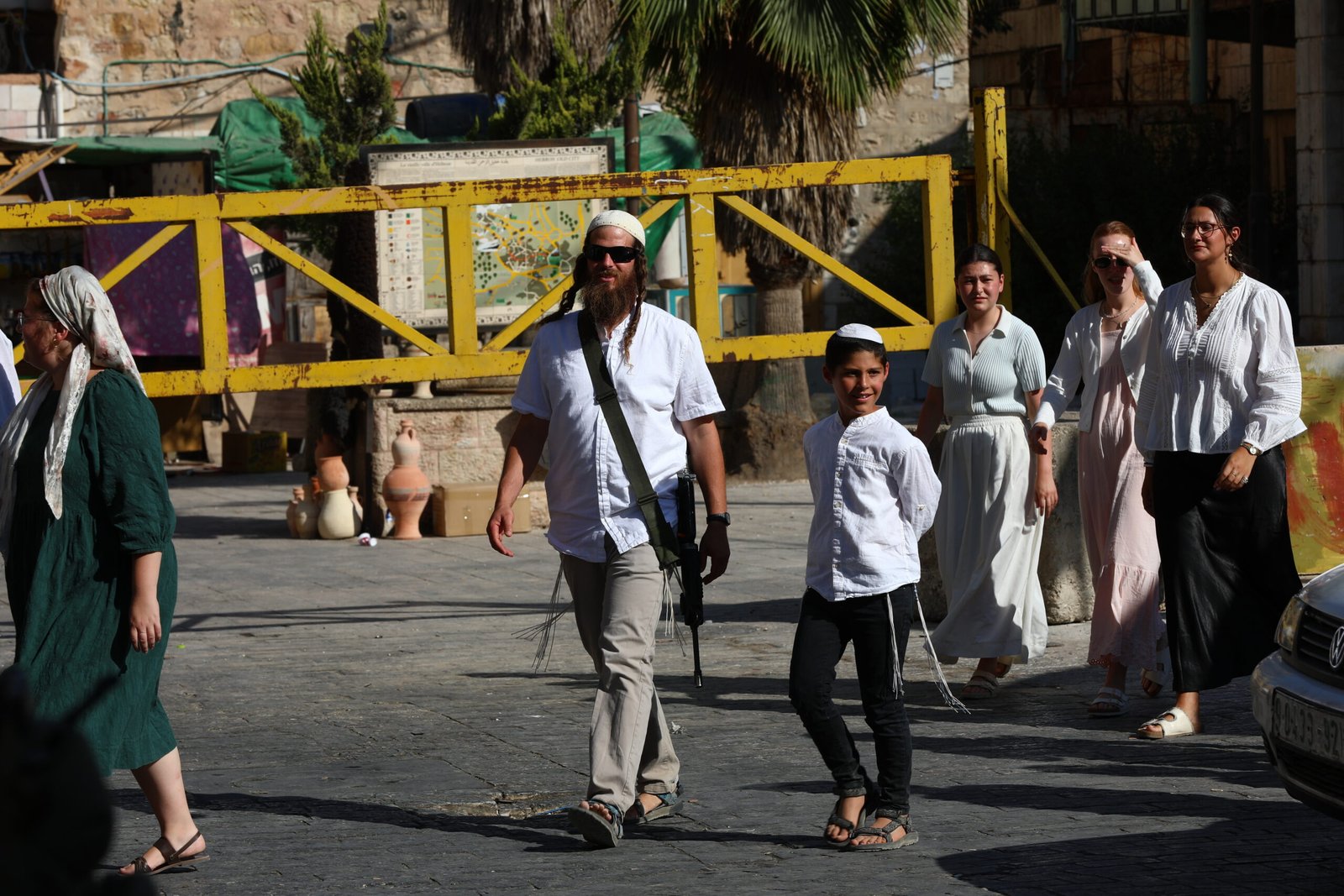
This article is adapted from the introduction to a new edition of Creating Facts: Israel, Palestinians and the West Bank, published by the Institute for Palestine Studies.
The maximalist agenda of Israel’s settlement movement has been energized by the calamity of the Second War for Palestine.
The “Conquest” of Gaza, the “Expulsion” of its 2.1 million residents, followed by the “Settlement” of the Gaza Strip are the unabashed objectives of the ideological vanguard of Israel’s twenty-first century settlement movement. This movement traces its roots, and indeed even its current leaders, to the Park Hotel that marked the inauguration of Jewish (re)settlement in Hebron more than half a century ago and Gush Emunim’s “pioneering” outposts in Samaria, where Minister of Finance Bezalel Smotrich was raised in the aftermath of the shocking setbacks that marked the October 1973 war.
The massive death and destruction visited upon Gaza in response to the unprecedented October 2023 Palestinian assault—unique even in the bloody history of Palestine—is far removed from what was once widely praised as Israel’s “liberal occupation.”
Although unacceptable as a description of Israel’s post-1967 policies, when compared to the catastrophe now visited upon Gazans, and increasingly throughout the West Bank itself, the first two decades of Israeli rule were indeed—as Ramonda Tawil once wistfully remarked to me in an eerily silent Gaza restaurant in the darkest days of the Second Intifada—the “golden years of occupation.”
Israel’s objectives in the occupied territories have always been marked by tactical flexibility in pursuit of the strategic objective of assuring Israel’s ability to rule and settle.
Under the direction of Moshe Dayan, Israel in the early postwar years adopted the hallmarks of “liberal occupation,” characterized by unfettered Palestinian access to Israel, even for those crossing to the West Bank from Jordan every summer. Tel Aviv and Jerusalem were open cities, and a battered membership card to Jerusalem’s newly constructed Cinematheque in what was formerly no-man’s land could serve young Palestinians as an adequate hawiyya. As a young student, I often travelled by service to Birzeit or Nablus from Damascus Gate, seamlessly and without obstruction—trips that have long been impossible. Even as Israel waged war in Lebanon in the summer of 1982, Defense Minister Ariel Sharon removed the two sleepy soldiers overseeing passage on the main road from Israel to the Gaza Strip. On Saturdays, Gaza was chock-a-block with Israelis eating at seaside fish restaurants or having their cars repaired along the road to Gaza City.
The infrastructure for massive settlement was then in its infancy, and Israel’s High Court found solace in the assertion that settlements were “temporary.” Settlers were then only a noisy but miserable minority.
Yet even when Israel’s settler population was 50,000, including fewer than 10,000 in the West Bank and Gaza, did Menachem Begin offer a bald hint of Israel’s strategic intentions when he promised “autonomy for the people but not the land” during short-circuited “autonomy talks”.
Land was the currency in which Israel and the settlers traded: “Another goat, another dunam, and the Land [of Israel] will be ours.”
By 1980, the settler population, building upon the infrastructure pioneered by the Labor governments ousted by Begin in 1977, had doubled to almost 100,000.
The first intifada, which exploded in Gaza’s now-obliterated Jabaliya camp in December 1987, forever ripped the mask off the pretense of a benevolent occupation. Rabin’s admonition to “break their bones” betrayed the true, essential spirit of occupation and settlement. The fiction that massive settlement throughout the West Bank could proceed at no cost to Palestinian personal and national existence—a fact of which Palestinians and Israelis alike were only too aware—had become untenable.
The inexorable increase in settlers and settlements transformed the settlement movement from its original role as an aggressive supplicant to the army and the politicians into what we see today: a dynamic engine of settlement and dispossession that the army and the politicians defy at their peril.
The Oslo process supercharged this development. What was not prohibited was condoned and encouraged. The settler population in 1993—120,000 in the West Bank and an equal number in East Jerusalem—is now a half-million and 230,000 respectively.
As always, the never-ending expansion of settlement and the accompanying administrative, legal, and security framework proved, then as now, to be the best and most accurate barometer of Israel’s intentions. Settlement was, and remains, Israel’s instrument for “creating facts” that diplomacy will have no choice but to accommodate.
The “peace process” led by the United States has proved unequal to the task of constraining, let alone reversing, the expansion of settlements throughout the West Bank. In its stead Sharon, as prime minister, and notwithstanding promises to Washington, exhorted a new generation of settlers to “grab and settle”—claiming strategic hilltops throughout the central spine of the West Bank that continues to this day.
During the bleakest days of the Second Intifada, sitting around a pale kerosene fire in the depths of the Balatta refugee camp outside Nablus, a young member of the al-Aqsa Martyrs’ Brigade confided his rationale for the organization’s existence. The Palestinian police, he said, were unable to confront the settlers or the army. Someone had to protect villagers from the depredations of settlers, who acted with impunity.
The Oslo process added a new and dynamic diplomatic superstructure to the settlement engine, one that enjoyed the effective endorsement of superpower patrons and indeed the PLO itself, which discovered to its unending chagrin that its tenuous rule in Areas A and B was being reduced rather than expanded by on-again-off-again diplomatic efforts and the inexorably expanding demands of the settler population.
The Second Intifada ended any prospect that Israel would willingly cede anything but nominal, conditional authority to the PLO anywhere in the West Bank. In the wake of Defensive Shield, waged by Sharon, who kept Yasser Arafat bottled up in the Muqata, the security understandings that informed the Oslo divisions of Area A, B and C, and that were the heart of the historic rapprochement, were no longer honored.
The moribund Oslo framework has long been superseded by Israel’s relationship with Gaza and Hamas.
For a moment during the first Palestine war, Ben Gurion considered annexing Gaza to Israel, only to reject this option when apprised of the large number of refugees there. After 1967, Israelis settled large swaths of the Strip proximate to the coast, but in numbers (17 settlements with 7,500 residents) never significant enough to challenge overwhelming Palestinian demographic preeminence.
Gaza, particularly in the wake of progressively draconian movement restrictions inaugurated during the First Gulf War, has always been the preeminent engine of Palestinian resistance to Israeli rule. Yitzhak Rabin campaigned for premier in 1992 with the promise to “Get Gaza out of Tel Aviv”—a promise that, a decade later, Ariel Sharon tried to realize.
Sharon’s “disengagement” from Gaza aspired to create a new security and diplomatic paradigm, in which the laws of war rather than those of occupation would inform Israeli policy—splitting the Gaza Strip from the West Bank, dividing the PLO/Fateh from Hamas, pushing Gaza into reluctant Egyptian arms—all with support from Washington.
In removing the IDF from Gaza, Sharon sought to break the tie between settlement and security that has dominated Israel’s history. Israel, he argued against his many skeptics, would be safer without settlements and the army in Gaza. And when the next war came, as he knew it would, Israel would enjoy the benefit of fighting according to the laws of war rather than those that hobbled an occupying power.
Yet having gone this far, Sharon was unable to go further. His own foreign ministry argued that Israel, even after its disengagement, still retained “effective control” of Gaza and thus could not escape its internationally mandated responsibilities there.
His solution was to strangle Gaza. Borders that were once open to commerce and movement would be locked down.
In 2006, following the election of Hamas and the imposition of the blockade on Gaza, Sharon’s advisor Dov Weisglas described the policy: “The idea is to put the Palestinians on a diet, but not to make them die of hunger.”
In the aftermath of Hamas’s unprecedented October 2023 assault, which has shaken Israel to its foundations, the government of Benjamin Netanyahu felt no such constraint.
Indeed, Britain’s Prime Minister Keir Starmer, among many others, acknowledged “a catastrophic failure” to deliver aid to Gaza: “We see starving babies, children too weak to stand, images that will stay with us for a lifetime.”
From the earliest days of Israel’s rule, there was always resistance to occupation, especially in the impoverished refugee camps in Gaza, where Ariel Sharon bulldozed security roads throughout Jabalia, Nuseirat, and Bureij camps in the 1970s, in counterinsurgency operations that turned out to be a prelude to the unfathomable destruction that marks Israel’s current campaign in Gaza.
Beyond retribution, the scale of today’s destruction reflects a purposeful intent. Viewed through the prism of more than a century of conflict, Israel’s conduct of the war reflects an intention to exact an extraordinary territorial price for Hamas’ unprecedented act of terror and resistance to Jewish sovereignty, unmatched in its destruction and impact.
According to the latest geospatial assessments by the Food and Agriculture Organization, 75 percent of fields once used to grow crops in the Gaza Strip were damaged or destroyed as of December 31, 2024. Furthermore, over half of greenhouses and about 67 percent of water wells were damaged (mostly in Gaza governorate). Livestock losses reached 96 percent, with only 1 percent of poultry still alive, and the important fishing sector was on the brink of collapse.
Israel, in the words of a senior Palestinian security official, considers the entire Gaza salient as akin to Area B—the (Oslo-era) designation for West Bank territory under preeminent Israeli security control.
In addition, a new postwar zone is being constructed within the Gaza Strip—comprising close to 70 percent of the Gaza salient—as an area of exclusive Israeli security control that parallels the border and includes the Philadelphi Line with Egypt. Unlike the map of settlement and control implemented in the 1967–2005 period, the current Yellow Line includes a significant Palestinian population and avoids formerly sought-after and settled lands along the coast.
The IDF will move to clear areas “of terrorists and infrastructure and capture extensive territory that will be added to the State of Israel’s security areas,” explained Israel’s Defense Minister Israel Katz.
If past is prologue, settlers can be expected to mobilize in support of renewed settlement in Gaza’s security zone. Public demonstrations in support have already appeared. Given the extraordinary successes of the settlement movement in the past half century—settlement achievements that once seemed no less outlandish than a renewal of settlement in Gaza today—one must view this prospect, however improbable, seriously.
Above all else, the settlement enterprise aims to remove the territorial foundations vital for the exercise of Palestinian sovereignty west of the Jordan River.
Subscribe Today
Get daily emails in your inbox
For more than half a century, efforts to challenge this policy have come up short. Today, and in contrast to the Oslo era, there is virtually no opposition among Israelis to the proposition that Palestinians be denied the prospect of a truly sovereign existence anywhere in Palestine. Political support in the Knesset for Palestinian sovereignty west of the Jordan River has all but disappeared. The war in Gaza has only fortified this national consensus.
Settlement continues to be the essential foundation of Israel’s policy of politicide, that is, policies that aim to fortify an Israeli—and indeed international consensus opposing the creation of a sovereign Palestinian—national existence. The cost of such policies has always been high, but not until the continuing battle in Gaza was Israel’s pursuit of a policy of politicide considered a prelude to genocide.
“Conquest, Expulsion, Settlement”—the triumvirate that defines the contours of Israel’s continuing quest to create facts that diplomacy will have no choice but to accommodate.
