
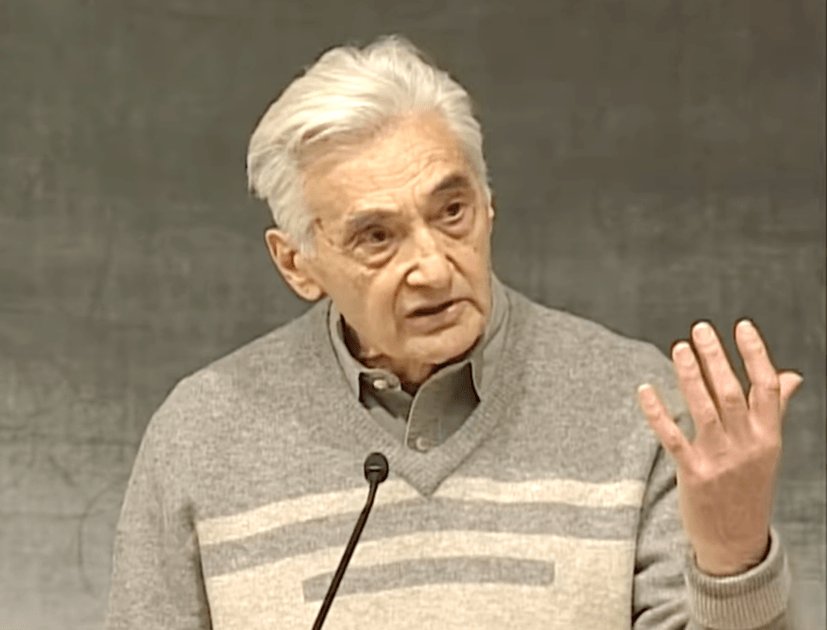
Howard Zinn giving a lecture at MIT on the Myth of American Exceptionalism. (Screen capture from video posted to YouTube.)
Even if he had sought it out, it seems unlikely that Howard Zinn ever thought he would achieve the fame that he came his way. This is one of the essential lessons taken from the new biography of Zinn by Dave Zirin titled The People’s Historian: The Outsized Life of Howard Zinn. Zirin, who spent time on the road with Zinn several years ago staging public conversations about history, imperialism, and more, provides an overview worthy of the energy which defined Zinn’s life. Naturally enough, the book begins with a survey of Zinn’s childhood as a child of immigrants living in a section of Brooklyn crowded with newcomers to the United States, most if not all of them working class and with little income beyond the meager wages paid by their employers. Zinn, while correctly perceiving the existence of economic and social inequality around him as the result of the political and economic system in place, pursued his dreams as best as he could.
Like many young men in the United States in the early 1940s, this meant he ended up in the military eager to fight fascism in Europe. His time as a bombardier in the United States Army Air Force convinced him that war—especially those between nations—was a bloodthirsty and inhumane exercise that should be eradicated from the human species. Zirin returns to one of the last, if not the last, bombing missions Zinn participated in. His unit was sent to bomb a peaceful French seaside town because the generals and their staff believed a few dozen Nazi troops remained in the village. As a result of the bombing raid, over three thousand French civilians—thankful for what they believed to be the end of the war—were killed.
The People’s Historian tells the story of Howard Zinn’s life by highlighting certain phases in it. Primarily a political biography, the author presents just enough of Zinn’s personal life—his family growing up and his wife and family as an adult—to remind the reader that politically active people also have personal lives. By providing this reminder, Zirin encourages the reader so inclined to become more politically involved; to risk particular comforts for a better world. After all, Zinn certainly did exactly that. Not to stray from where this paragraph began, let me mention a few of those parts of Zinn’s life that Zirin highlights and were arguably the moments in his life that informed Zinn’s politics and approach to organizing for radical change.
After gaining his first tenured teaching job at Spelman College, an all-women’s Black college in Atlanta, Professor Zinn and his family found themselves in the beginnings of a redirection of the movement against racial apartheid in the US South. The text describes various actions, organizations and individuals crucial to the movement at the time. It also emphasizes Zinn’s rejection of any “white savior” approach and any potential paternalism that too many allies of the movement for Black liberation fall into. Zirin writes explicitly of the role played by Zinn and his wife Roz as participants and organic intellectuals in the numerous direct actions, rallies and other manifestations at the time. As it turned out, Zinn would be terminated from the college; one assumes the administration thought the movement would die with his departure. It’s a testament to Zinn’s organizing approach that his firing made very little difference in terms of the movement’s growth and successes.
While reading theis, I was reminded of a piece of advice a friend of mine gave me during a period of organizing against the 1980s  US wars in Central America: “If you think the revolution can’t go on without you,” this one-time CPUSA member told me. “It’s time for you to leave the stage, refuse any more speaking engagements for a while and go distribute leaflets on the street.” In other words, drop the egocentrism. As the text continues to relate events in Zinn’s life, it becomes clear that this approach was one that Zinn tried to work inside his entire political life, even when his books were selling millions of copies. Speaking of those books, another of the life moments Zirin uses as a springboard to discuss his subject’s life and meaning is the success of Zinn’s People’s History of the United States. Almost any honest writer will tell you the meaning of such stratospheric success; it’s a curse and a challenge, but also genuinely rewarding to see one’s writing read by so many.
Zinn’s book titled Vietnam: The Logic of Withdrawal was published in 1967. Many groups and individuals in the growing movement against the US war in Vietnam were only beginning to call for a negotiated end to the US war—some were calling for a negotiated withdrawal while some were merely calling for a negotiated peace settlement that left the US-created state of South Vietnam intact. Zinn’s book went far beyond either of those, giving voice to a growing element of the antiwar movement—an element composed largely of young people, many of whom faced the reality of death in that war should the military draft catch up with them. Like so many others opposed to the war, when I read it in 1969 as a high school freshman, it became clear that the immediate withdrawal of all US forces from Southeast Asia was the only sane response. By 1972, George McGovern, the Democratic Party’s nominee for US president, had made a US withdrawal from the region within ninety days of his inauguration the primary focus of his campaign. Anyone who knows the history of that election knows we live in the destructive wake of the victory of McGovern’s opponent.
The People’s Historian is not a biography of a great man who made history; it’s a biography of a man who encouraged the people to make history. He did so in the classroom, the streets, meetings and more meetings, and in a life truly lived. In doing so, one could say he became a great man. Zirin, in his always erudite and always conversational fashion, brings that life alive, not just to bear witness, but to remind today’s readers and the readers of tomorrow that it’s people like them who make the history Howard Zinn wrote about.
