
[ad_1]
Austin Sarat ScheerPost
More than fifty years ago, New York’s Governor Nelson Rockefeller was accused of having an “edifice complex.” He pled guilty.
In an appearance in September 1970 at the construction site for the World Trade Center in Manhattan, as The New York Times reported, “Rockefeller told several hundred cheering workmen: ‘All right, so I have an edifice complex. I like to build things, and I like the jobs that provides.’” His “edifice complex” drove him to lead the charge for what would become the “Nelson A. Rockefeller Empire State Plaza, with its immense state office building, convention center and museum complex,” in Albany, the New York State Capital.
But with apologies to the late governor, he can’t hold a candle to President Trump in his desire to build, rebuild, and renovate existing structures. As Trump explained in December, “I have two jobs.” One is being president; the other is what he called “a construction job….”
Trump went on to say that construction “is really like relaxation for me because I have been doing it all my life.”
Last year, WMAU in Washington, D.C. noted that “Since returning to office, Trump has bathed the Oval Office in gold, paved the Rose Garden, added giant flagpoles on the north and south lawn, weighed in on a restoration project at the Federal Reserve, replaced tile in the Lincoln Bathroom with marble, overseen a major overhaul of the Kennedy Center and even brought Trump-style luxury to a small passthrough at the White House known as the Palm Room.”
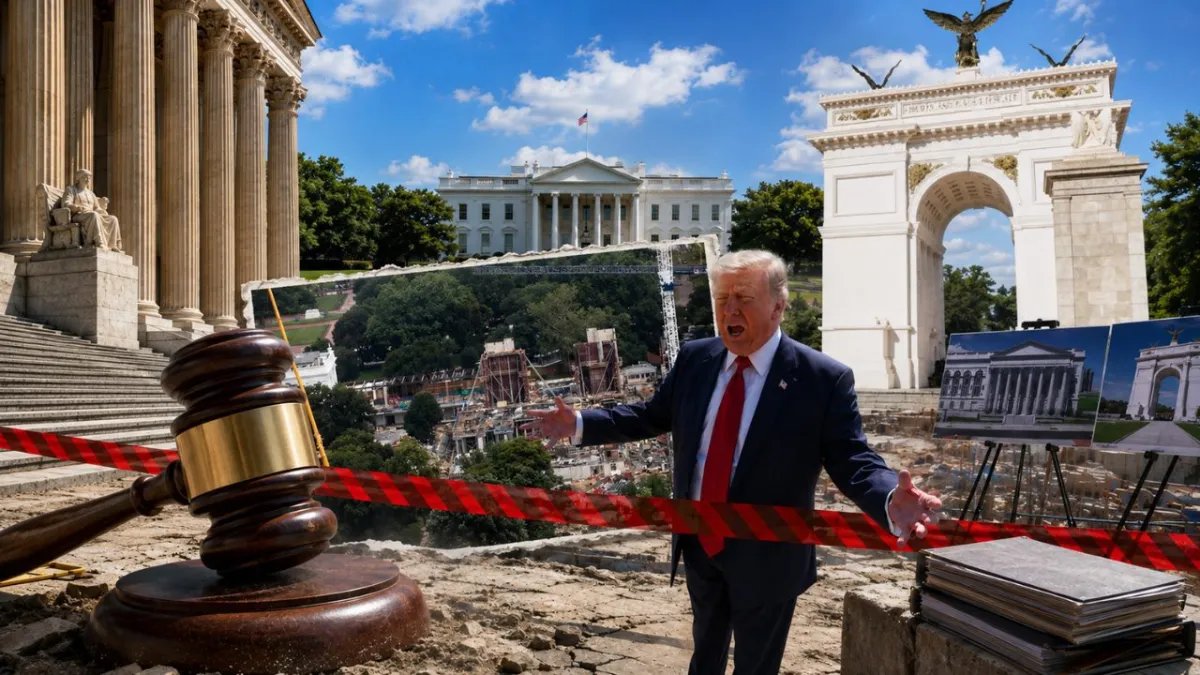
And then there is the White House Ballroom project and the 250-foot arch he wants to build near the entrance to Arlington National Cemetery.
It seems clear that Trump is determined to leave behind a distinctive architectural legacy and to do it his way, with little or no regard for the views of others. Most importantly, his ubiquitous construction efforts are taking place without authorization from Congress.
On August 7, the United States Court of Appeals for the D.C. Circuit threw a monkey wrench into Trump’s plans when it ordered the construction of the ballroom to stop until he gets authorization from Congress for the project. It was right to do so and to remind the president and the rest of us that neither the White House nor Washington, D.C., is his plaything to do with as he pleases.
Trump hated hearing that, just as he has hated any effort to hold him accountable to the Constitution. He denounced the court’s ruling, calling it “horrendous, politically motivated, and unlawful…”
He promised to appeal immediately to the United States Supreme Court. It will be up to the Court to hold the line, defend Congress’s constitutional prerogatives, and tell the president to do things the right way even when it comes to satisfying his own “edifice complex.”
Trump doesn’t seem to accept that the White House is federal property, under the jurisdiction of the National Park Service. Funds for its upkeep are provided through the congressional appropriations process.
A look at the history of the White House makes that clear.
In 1790, Congress passed the Residence Act. It authorized the creation of the federal capital (Washington, D.C.) and empowered president-appointed commissioners to oversee the layout and construction of government buildings, including the President’s House.
As Politico observes, “The original intention of the Residence Act was to use proceeds from selling lots in the District of Columbia to cover costs of constructing federal buildings in the new capital. However, too few people were interested in purchasing lots,” and Congress had to step in.
After the White House was destroyed during the War of 1812, Congress again appropriated public funds to finance the building’s reconstruction. Since then, Congress has approved and funded major construction projects at the White House, including the major renovation carried out during Harry Truman’s presidency and the 2008 modernization of the East and West Wings.
President Trump has tried to short-circuit the usual approval and funding process by raising private money. He contends that the White House has “been built and rebuilt, renovated and rerenovated, repaired and, simply, MADE BETTER, many times since 1792, and never needing the permission of Congress, or anyone else, to do so.”
The D.C. court made it clear just how wrong he is.
The majority opinion started with the simple assertion that “The White House is the People’s House, and under the Constitution’s Property Clause, Congress exercises plenary control over the building and its surrounding land.” It added that “The White House is also the centerpiece of President’s Park, a National Park stewarded by the National Park Service. According to the government, as the oldest public building in the District of Columbia, the White House is the crown jewel not just of President’s Park, but also of the Lafayette Square National Historic Landmark District, a site listed for preservation in the National Register of Historic Places. “
The court explained that “Each President is a temporary tenant, not the owner, of the White House and its Executive Residence. The President has no—and claims no—constitutionally assigned authority over that property, which is designed and maintained for the use of… all Presidents, current and future, and for the American people.”
It pointed out that “In 1912, Congress placed a statutory exclamation point on its exclusive powers by providing that ‘there shall not be erected on any reservation, park, or public grounds[] of the United States within the District of Columbia, any building or structure without express authority of Congress.’”
It noted, “We are aware of no instance in American history in which a President unilaterally and using privately collected funds demolished substantial portions of the White House that Congress authorized to be built and American taxpayers paid for. Until now.”
In the end, it upheld an injunction originally issued by a federal district court.
The president reacted quickly and pulled out a familiar playbook. “Two Judges, one appointed by Barack Hussein Obama, the other by Sleepy Joe Biden,” he posted on Truth Social, “said in a ruling on the desperately needed SECURE Ballroom/Military Complex, including a major DronePort on the roof, that ‘Each President is a temporary tenant…of the White House.’”
Trump continued, “We are not tenants, who pay rent and do all other things that a tenant must do, we are PRESIDENTS, elected by the people of the United States of America, and have many rights, including the right to fix, renovate, secure, protect, and beautify the White House grounds, which has been built and rebuilt, renovated and rerenovated, repaired and, simply, MADE BETTER, many times since 1792, and never needing the permission of Congress, or anyone else, to do so.”
“This decision, made after much of the work has been done and paid for, is a National Security Threat at the highest level. It is also a National Disgrace.”
Too bad the president didn’t study what Nelson Rockefeller did. As much as he loved building things and as clear as he was about the need to revitalize Albany, he went about the unglamorous work of trying to persuade local leaders and state legislators to support his vision. Whatever the merits of that vision, Rockefeller did what the rule of law demanded and recognized that he needed permission from the public’s representatives.
Since President Trump won’t follow that example, the courts have had to insist that he do so. We are all well served by their decisions.
Austin Sarat ScheerPost
Austin D. Sarat is the William Nelson Cromwell Professor of Jurisprudence and Political Science at Amherst College. He is an internationally renowned scholar whose interdisciplinary work examines law in relation to culture, violence, and the liberal arts. His academic foundation includes a B.A. from Providence College (1969), an M.A. (1970) and Ph.D. (1973) from the University of Wisconsin, and a J.D. from Yale Law School (1988). He has also received honorary degrees, including an LL.D. from Providence College (2008) and an A.M. from Amherst College (1984). Sarat has also been awarded the Jeffrey B. Ferguson Memorial Teaching Prize at Amherst in 2022 and the Ronald Pipkin Service Award as well as many others
Editor’s Note: At a moment when the once vaunted model of responsible journalism is overwhelmingly the play thing of self-serving billionaires and their corporate scribes, alternatives of integrity are desperately needed, and ScheerPost is one of them. Please support our independent journalism by contributing to our online donation platform, Network for Good, or send a check to our new PO Box. We can’t thank you enough, and promise to keep bringing you this kind of vital news.
You can also make a donation to our PayPal or subscribe to our Patreon.
Please share this story and help us grow our network!
[ad_2]
Source link
