
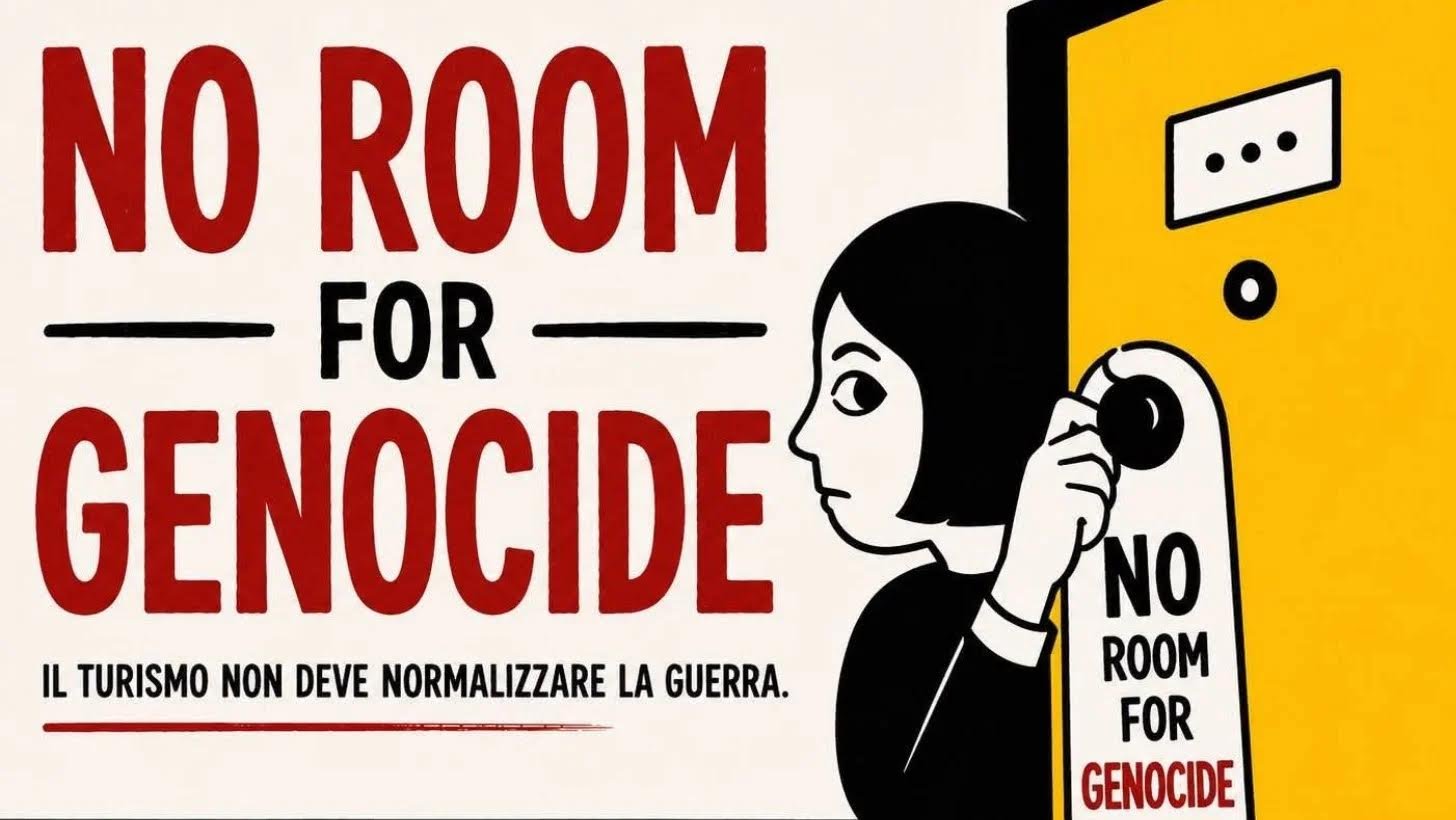
In the summer of 2026, a quiet act of conscience in a Naples hotel room triggered a familiar storm. An Israeli tourist booked a stay at the Decumani Hotel De Charme through Booking.com. She received the standard automated confirmation email. It contained a short paragraph: the property endorsed the “No Room for Genocide” https://bdsmovement.net/news/no-room-for-genocide campaign, respected the freedom and human rights of communities suffering racist, ethnic, and social harm, and warmly welcomed Palestinians, refugees, and all those peacefully resisting oppression in pursuit of their internationally recognized rights.
The tourist canceled. She told Israeli media she no longer felt safe. Within hours the hotel was under attack. Fake bookings flooded the system. Fake negative reviews appeared from people who had never stayed there. Attempts were made to damage the business. The owners were forced to issue public statements clarifying that the message went to every guest regardless of nationality, that they had never refused an Israeli client on the basis of passport or identity, and that they had in fact hosted Israeli guests throughout the previous year. BDS Italia issued a solidarity statement. The campaign of defamation continued.
This is what happens when small Italian hospitality businesses refuse complicity.
“No Room for Genocide” was launched in July 2025 by the Palestinian BDS National Committee (BNC), the largest coalition of Palestinian civil society and the leadership of the global Boycott, Divestment and Sanctions movement. It was quickly taken up with force by BDS Italia and solidarity groups worldwide. The campaign is a direct response to the ongoing genocide in Gaza, Israel’s entrenched system of settler-colonial apartheid, and the illegal occupation and annexation of Palestinian land. It also responds to what the BNC describes as the wilful negligence of third states that continue to offer visa-free entry and safe passage to those implicated in atrocity crimes while failing to uphold their clear obligations under international law.
International law requires states to end all forms of complicity in war crimes, crimes against humanity (including apartheid), and genocide. That includes the duty to deny war criminals passage or haven and, where possible, to prosecute them. With governments largely refusing to act, the BDS movement turned to civil society and to the hospitality sector itself. The campaign’s organizing toolkit invites hotels, B&Bs, agriturismi, restaurants, tour operators, and cultural spaces to take concrete steps: publicly endorse the principle that there is no room for genocide; discourage those credibly linked to war crimes from booking; challenge the complicity of platforms such as Booking.com and Airbnb that list properties in illegal settlements; and demand that states terminate visa-waiver agreements with Israel and institute effective border screenings. Participating businesses can also join the related “Sanctuaries of Peace” initiative, declaring their spaces places of ethical hospitality grounded in human rights rather than neutrality in the face of mass atrocity.
The campaign does not call for the exclusion of Jews or Israelis as such. It targets participation in and support for a regime of systematic violence. That distinction is repeatedly erased by those who respond with accusations of antisemitism, the oldest and most effective weapon used to shield Israel from accountability.
In Naples the same refusal has strong local roots. Nives Monda, owner of Taverna a Santa Chiara and now a recognized local leader within the BDS movement, has become a reference point for the city’s hospitality sector. After her restaurant was targeted in a high-profile confrontation over its public adherence to Spazi Liberi dall’Apartheid Israeliana, she continued to organize and speak out. In a message inviting other businesses and cultural associations to join the campaigns, she stated clearly: “It is our duty to take a stance and do what we can to end all chains of complicity that enable Israel’s genocide in Gaza.” That sense of duty — practical, public, and grounded in everyday work — runs through the Italian network of spaces that have chosen not to remain neutral.
In Tuscany the pattern repeated. In May 2026 an Israeli woman booked an agriturismo, “Le Cantine,” in Poggibonsi. The owner, Pietro Del Zanna, wrote to her before arrival. He stated he was not antisemitic, but he could no longer pretend that nothing was happening in Gaza. He asked her position on the policies of the Netanyahu government. If she disagreed with those policies she was welcome. If she supported them, she knew his view, and he would cancel without penalty. She canceled, publicized the exchange, and filed a complaint. Del Zanna faced online attacks and calls to boycott his business. He also received many messages of solidarity, including from Israelis sickened by their government’s actions.
Nearby, in the Chianti hills, the owner of Villa Moris, a B&B, displayed a Palestinian flag and materials linked to the related campaign of Spazi Liberi dall’Apartheid Israeliana (SPLAI — Spaces Free from Israeli Apartheid). A Swedish couple left a one-star review attacking her as a left-wing pro-Palestinian activist. She replied with a powerful public rebuttal: her Jewish grandfather had lived through the Shoah and descendents of hers had been killed in the holocaust; the values of her household were freedom, democracy, equality, and antifascism; she had joined SPLAI out of those same principles; and she reserved the right to refuse potential war criminals. The review was an attempt to punish political speech and to weaponize Jewish identity against solidarity with Palestine. Her response refused that blackmail and reclaimed the moral ground.
These are not isolated incidents. SPLAI — Spaces Free from Israeli Apartheid — is the Italian expression of the international Apartheid Free Zones campaign, itself inspired by the global movement that helped isolate South African apartheid. Promoted by BDS Italia, it invites commercial, cultural, social, and sporting spaces to declare themselves free of complicity with Israel’s regime of occupation, colonization, and apartheid. Members commit not to purchase or sell products and services of companies, Israeli or international, implicated in violations of Palestinian rights, and not to host or participate in cultural, academic, or sporting events financed or sponsored by Israel or involving its official representatives. By mid-2025 the network had surpassed five hundred adherents across Italy — bars, restaurants, bookshops, ARCI clubs (with national ARCI endorsement), cultural centers, unions, and lodging houses — forming a grassroots infrastructure of everyday refusal. “No Room for Genocide” extends that principle into the intimate space of hospitality. It asks a simple question: must a bed be offered to those who have participated in or actively supported the destruction of Gaza and the ongoing project of Greater Israel?
The tourism industry is not neutral. Platforms that list settlement villas and hotels profit from the dispossession of Palestinians. Airlines and cruise lines that bring settlers and soldiers on leave help sustain the occupation. When Italian owners of modest hotels and farmhouses refuse that economy of complicity, they are attacked with the full force of organized Zionist pressure: coordinated negative reviews, false accusations of discrimination, social-media storms, and economic sabotage. The goal is intimidation. The method is the deliberate conflation of criticism of a state and its military with hatred of a people.
Italy’s government under Giorgia Meloni has offered no protection. On the contrary, it has deepened military and political ties with Israel while criminalizing forms of solidarity at home. In that climate, the courage of small proprietors in Naples, Tuscany, and elsewhere becomes a form of resistance. They are not powerful. They do not control ministries or media. They simply refuse to pretend that genocide is a private matter or that hospitality requires moral blindness.
The broader BDS movement has always insisted that ordinary people and institutions have both the right and the responsibility to withdraw support from systems of oppression. “No Room for Genocide” is that principle applied to the bedroom and the breakfast table. It is non-violent. It is precise. It is grounded in the legal obligation of third parties not to aid or assist in the commission of international crimes. That it provokes such fury is evidence of its effectiveness.
The hotels, BnBs, and agriturismi that have joined are not closing their doors to Jews or to Israelis who reject the policies of their government. They are declaring that there is no room — in their houses, in their businesses, in their ethics, in their understanding of human dignity — for the perpetrators and enablers of genocide and apartheid. The campaign of harassment directed against them is an attempt to reimpose silence and complicity. It will not succeed for as long as people of conscience continue to answer, quietly and firmly: not here.
