
[ad_1]
By allowing the U.S. nuclear posture to shift away from deterrence toward warfighting, all we guarantee is that eventually there will be a warfighting scenario that uses nuclear weapons. And then we all die.
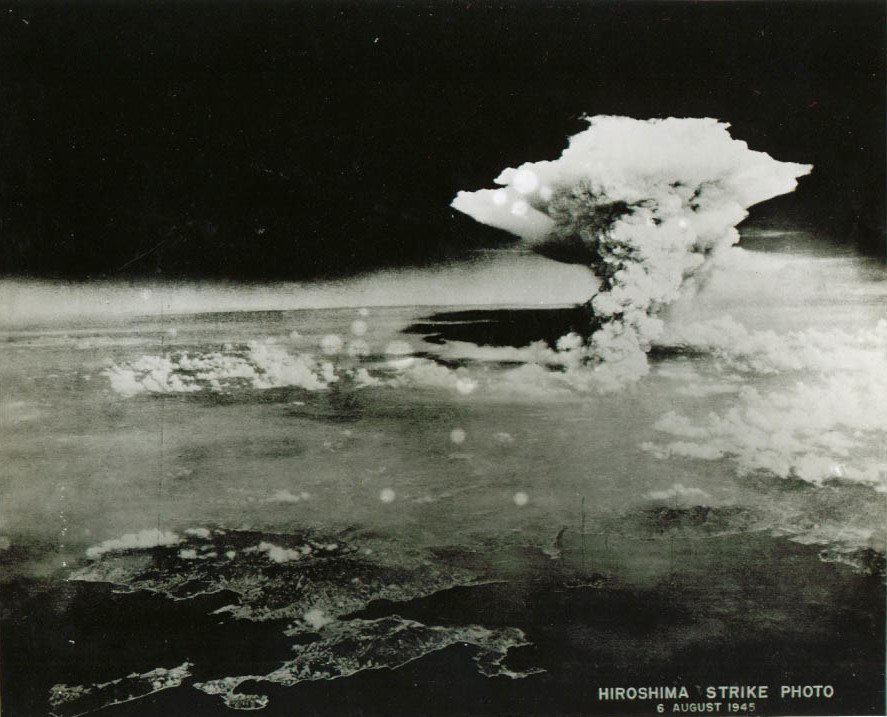
The pyrocumulonimbus cloud over Hiroshima around noon, Aug. 6, 1945, some four hours after the Little Boy bomb was dropped. (U.S. Military photo)
By Scott Ritter
Special to Consortium News
 The United States is currently in the process of redesigning its nuclear posture to make the employment of tactical nuclear weapons during the early stages of conflict official doctrine. This is a bad idea. Today is the 81st anniversary of the U.S. atomic attack on Hiroshima. Let Hiroshima be the reminder of just how bad of an idea this is.
Almost two years to the day Consortium News published an article I had authored entitled, “On a Highway to Hell.” In this article I warned about the dangers that arise when the United States changes its nuclear posture away from a purely defensive character to one where the precepts of nuclear preemption are openly espoused. I also noted that the dangers inherent in this transition were exponentially increased in a world void of the constraints of meaningful arms control.
I wrote at the time:
“By allowing the U.S. nuclear posture to shift away from deterrence toward warfighting, all we guarantee is that eventually there will be a warfighting scenario where the U.S. will end up using nuclear weapons. And then we all die. We are, literally, on a ‘Highway to Hell.’”
Today, on the 81st anniversary of America dropping an atomic bomb on the Japanese city of Hiroshima, it is critical that we collectively revisit this issue.
Arms Control is Dead
At the time I wrote the original article, we lived in a world populated by certain assumptions, number one being that the United States possessed sufficient conventional military power to forestall the temptation of nuclear pre-emption at the tactical levels of conflict. In short, the United States could — as it had done nearly continuously since the end of the Second World War — initiate a conventional war with the nations of the world and, even though it might suffer a political defeat (i.e., Vietnam and Afghanistan), it would retain sufficient conventional military power to forestall the consequences of an existential military defeat.
As such, when one spoke of nuclear war, one spoke in terms of great power conflict—between the United States and Russia or China. Even if such a conflict was to break out, it as always hoped that the consequences of any such potentially existential engagement would be so horrific that rational actors on both sides of the conflict would seek to limit the scope and scale of the engagement, avoiding the almost certain fatal results of escalation.
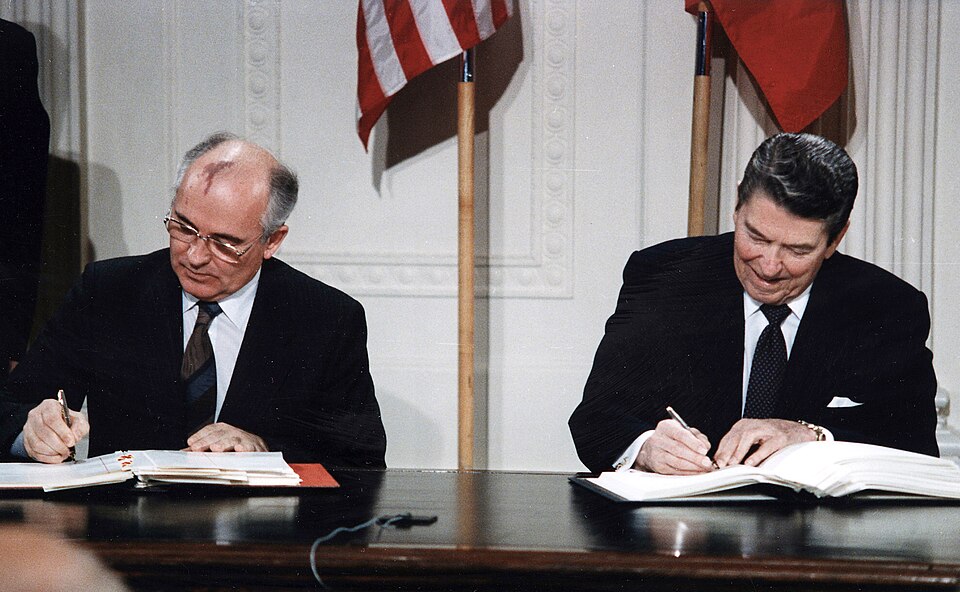
U.S. President Ronald Reagan and Soviet leader Mikhail Gorbachev signing the INF treaty at the White House, Dec. 8, 1987. (White House Photographic Office)
Two years ago, one also had the façade of arms control, a corroded framework of agreements which, while faltering, at least offered the prospect of hope in so far as one could envision new life being breathed into an old concept, driven by the urgency of the moment.
Today we are confronted by two harsh realities.
First, arms control is dead. There are no more legacy treaties in place upon which we could pin some sort of false hope for rational behavior on the part of our collective leadership. Moreover, there appears to be zero proclivity on the part of the world’s declared nuclear powers to reengage on the matter — the era of civilized nations seeking to reign in the basest consequences of technological development has ended. We have seemed to embrace the utility of nuclear war, without honestly acknowledging the consequences of such.
Let Hiroshima be the reminder.
Second, the era of American conventional military dominance is over. The failed war with Iran has driven this point home. Today the United States is forced to confront the reality that the military machine we built over the course of the past 35 years since the collapse of the Soviet Union — at great expense in terms of treasury and effort — is a literal Maginot Line, an overpriced edifice to a type of warfare that no longer exists.
We built a military premised on the notion of “shock and awe,” a technology-driven dinosaur intended to intimidate, not dominate. A literal flash in the pan. All Iran had to do was wait us out. To build a system capable of absorbing the destructive power of a self-limited “superpower” and hold on until the expensive machine of war so carefully created by American defense industrialists to maximize profit over performance ran out of steam.
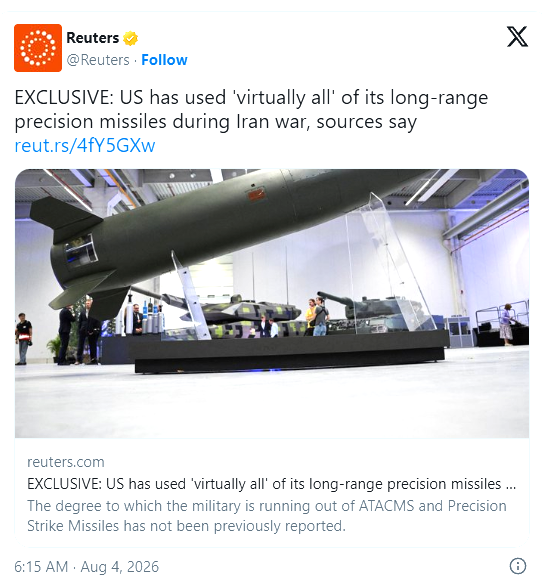
Reuters news report on the U.S. running out of long-range missiles, Aug. 4, 2026. (X Screenshot)
Or to be precise, ran out of ammunition. In order to sustain the façade of military viability, American war planners, driven by the narcistic urges of a man who placed sustainment of his cult of personality over the welfare of the nation he led, stripped bare the warfighting capabilities of U.S. forces in the Pacific (confronting China) and Europe (confronting Russia).
Today the United States is confronted by the reality that not only can it not sustain viable conventional military operations against Iran, but it is incapable of projecting any meaningful conventional military force against a prospective Chinese of Russian military threat. This at a time when U.S. policy leads us toward the probability of conflict with China over Taiwan, and the possibility of conflict with Russia over Ukraine.
Faced with the inevitability of conventional military defeat in either of these scenarios, the administration of President Donald Trump has undertaken a review of U.S. nuclear posture with an eye toward making it easier for the United States to employ tactical nuclear weapons in the early phases of any future war with either Russia or China. This is, of course, the exact opposite direction one should be taking under the current conditions.
Let Hiroshima be the reminder.
There is no greater need than the present moment for the soothing balm of nuclear arms control. The fact that the United States has willfully embarked on a Highway to Hell condemns the rest of the world—especially Russia and China—to join us.
If the great minds of America seem impervious to the inevitability of nuclear Armageddon, blinded as they are by the consequences of a failing Empire and a desire to hold on to power regardless of the consequence, then the source of new and novel thinking regarding arms control must come from elsewhere—from Russia and China.
Because there will be no victors in a nuclear war. The destination that the Highway to Hell arrives at will result in global catastrophe. Let Hiroshima be the reminder.
Scott Ritter is a former U.S. Marine Corps intelligence officer who served in the former Soviet Union implementing arms control treaties, in the Persian Gulf during Operation Desert Storm and in Iraq overseeing the disarmament of WMD. His most recent book is Highway to Hell, published by Clarity Press.
The views expressed are solely those of the author and may or may not reflect those of Consortium News.
Please Donate to
CN’s Summer
Fund Drive!


[ad_2]
Source link
