
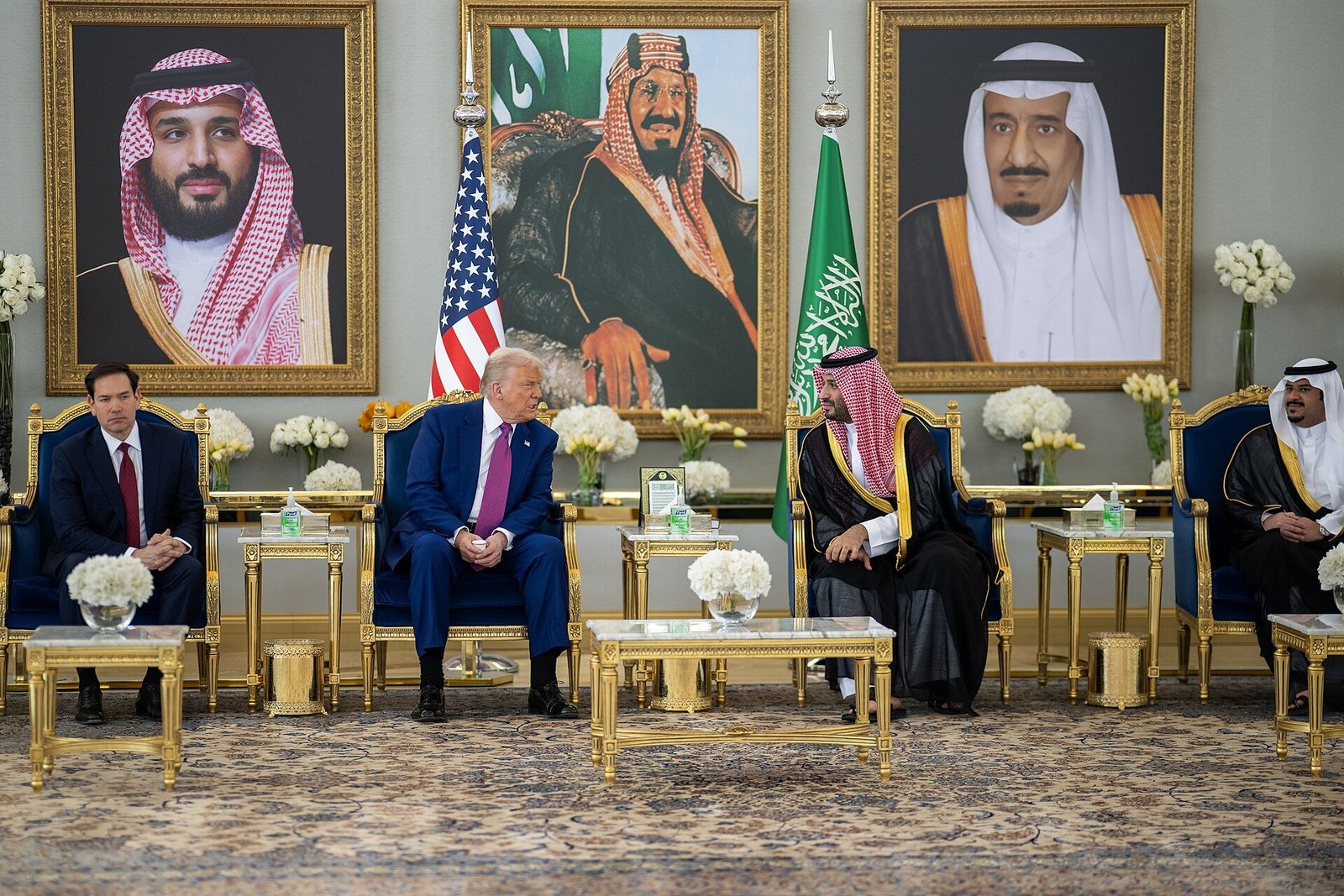
Photograph Source: The White House – Public Domain
A Deal Without Safeguards
The Trump administration has approved a deal with Saudi Arabia under which the US will provide the material and technical capacity for that country to build a nuclear power plant. The deal, said to last 30 years, gives US nuclear energy companies, specifically Westinghouse and its reactor, a unique role in providing for the civilian nuclear program. The next step would be to allow the Saudis to engage in nuclear enrichment while ensuring that they cannot build a bomb.
“The agreement could help revitalize the U.S. nuclear industry, strengthen U.S.-Saudi ties and deny Russia and China a strategically important role in the Saudi nuclear program,” said Robert Einhorn, a former senior State Department official who advised both Republican and Democratic administrations on nonproliferation issues. “But unless it contains adequate constraints, including on enrichment, it could increase nuclear proliferation risks in the Middle East and beyond,” Einhorn added.
Yes, “adequate constraints.” So far the administration has not been clear about technical constraints though, as I will mention shortly, it has belatedly imposed political conditions. Will Saudi Arabia be able to enrich uranium on its own? Trump said no, after the deal was signed, while administration officials who are privy to the agreement admitted it could happen. The Saudis may be thinking that since Iran insists on the sovereign right to enrich uranium, why shouldn’t we?
The Proliferation Danger
That leads to other questions. Will the Saudis sign and ratify the Nuclear Nonproliferation Treaty (NPT)? Will their nuclear facilities be subject to international inspection by the International Atomic Energy Agency? What is to stop Saudi Arabia from taking off on its own at some point and dispensing with safeguards in the name of national security? There are precedents for doing so. North Korea pulled out of the NPT in order to accelerate a nuclear weapons program in total secrecy. India, Israel, and Pakistan have nuclear weapons and no safeguards.
No matter how strong the safeguards on enrichment may be, if the deal goes through—it is subject to Congressional review—it is bound to lead other Middle East countries, such as Syria, to explore their nuclear options. And for Israel, the prospect of a Saudi bomb unconstrained by outside inspection would be a nightmare—essentially, another Iran. That might prompt Israel to increase its nuclear weapon arsenal, which currently stands at about 90 warheads, and change its nuclear doctrine in ways that further destabilize the Middle East strategic picture.
The Unlikely Quid Pro Quo
Not long ago, prospects for such a deal seemed remote since the US required that Saudi Arabia recognize Israel, and in return Palestinians would obtain a clear path to statehood. When Trump announced this deal, he said nothing about any requirement of the Saudis.
But after several members of Congress raised objections to the deal, Trump said the agreement was “totally subject to” Saudi Arabia establishing diplomatic relations with Israel under the 2020 Abraham Accords, which normalized Israel’s relations with four Arab countries: the UAE, Bahrain, Morocco, and Sudan. Was that an afterthought? Does “subject to” mean a legal or a political obligation? Israel wants Saudi recognition, but surely not a Saudi bomb or Palestinian statehood.
Karoline Leavitt, the administration’s spokesperson, said: “If they [Saudi Arabia] don’t join the Abraham Accords, the deal is off.” But she didn’t say that the US would pursue a path to Palestinian statehood as part of the deal—the very reason most Arab and Muslim nations have refused to join the Accords.
The Saudis have to be stunned by Trump’s turnabout. As reported by David Sanger in the New York Times, “Aaron David Miller, a former U.S. diplomat with long experience in the Mideast, said that Mr. Trump again ‘alienated the Saudis, delighted Benjamin Netanyahu and gave Iran strong talking points as to why cutting deals with the US is a fool’s errand, bound to be betrayed.’” They are not alone. As the Times is reporting, the UAE government, which has defense and economic ties with Israel, has lost some of its initial enthusiasm for the Abraham Accords it signed. “Uncertainty about the future of the accords points to how Trump’s decision to go to war with Iran has risked further undermining his signature policy achievement in the region. Across the region, his pledge in recent months to expand the accords, including trying to use them as a framework for a deal with Iran, have largely been met with incredulity.”
Scratch the Deal
Both Saudi Arabia and the UAE are pressing Trump to end the war. The US bases there have been among Iran’s main missile targets. The Houthis’ intervention has further complicated matters for the Saudis. They, the UAE, and other US partners in the region are baffled by Trump’s erratic swings between escalation and pauses, and his seeming inability to find an exit ramp. Even Iran’s leaders are said to “have become intensely pessimistic about what diplomacy with the Trump administration can achieve.” They have good reason, dating back to the 2015 nuclear deal, not to trust that Trump will actually fulfill the US part of any bargain.
Yet here is Trump pandering to the autocrat in Riyadh, Mohamad bin Salman, the man who authorized the murder of the Washington Post journalist Jamal Khashoggi, who only on occasion supports US energy policy, and who probably influenced Trump to start a bombing campaign against the Houthis in 2025. Why? Evidently in order to sell the Saudis more arms as well as nuclear technology—and, no doubt, stay in the monarchy’s good graces for future real estate deals.
Even putting aside this transaction between two unreliable and faithless leaders, providing Saudi Arabia with nuclear technology is a bad deal that should never have been offered. It is full of holes on enrichment, runs an unacceptable risk of nuclear proliferation, and while good for Israel, will do nothing to help the Palestinian people establish their own country. The deal demonstrates a deplorable lack of foresight by Trump and his advisers in their willingness to trade extraordinary policy and strategic gifts for nothing that is in the human interest.
