
[ad_1]
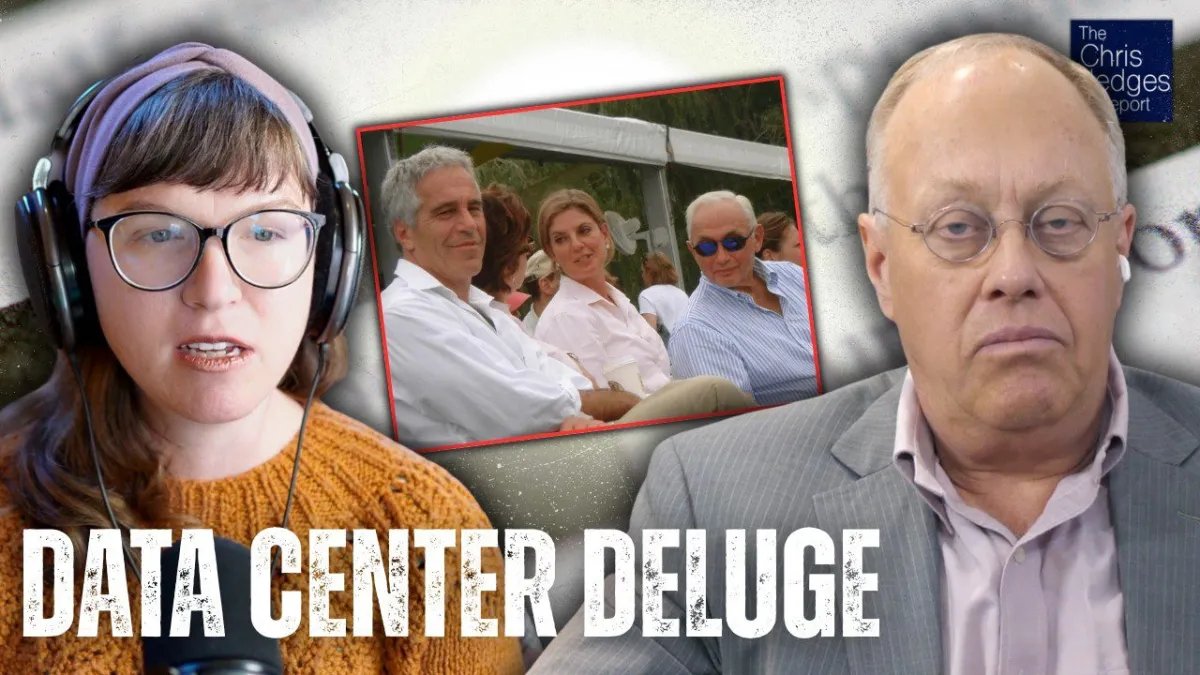
Whitney Webb explains how Leslie Wexner privatized Ohio’s state government, and is using his position between the markets and the state to help the Thielverse build out the ‘Silicon Heartland.’
Under the radar, the billionaire class is building the infrastructure and models necessary to create a dystopian future in which cities become billionaire fiefdoms – completely privatized, governed by dictatorial CEOs and financed by subservient taxpayers. The buildout of data centers is one essential part of the effort to construct a totalitarian capitalist society, which is already advancing.
In this episode of The Chris Hedges Report, Hedges interviews investigative journalist Whitney Webb, the author of “One Nation Under Blackmail,” who unravels the complex relationships between elected leaders, the National Security State, the state of Israel and Big Tech. Webb discusses the methods being used in the Silicon Heartland, the area around Columbus, Ohio, where Les Wexner, who has ties to organized crime and was Jeffrey Epstein’s most notable benefactor, and other powerful billionaires such as Peter Thiel of Palantir, have made significant headway in creating a privately-run city — New Albany. She describes their use of innocent-sounding front groups, such as Jobs Ohio, private development corporations and political bribery to enrich themselves and create what they are marketing as Smart Cities.
Hedges and Webb expose the connections between the billionaires behind this effort and the State of Israel. Webb argues that Israeli startups have been promoted to Big Tech “so that US technological infrastructure on multiple levels would be so intimately enmeshed with Israeli interests that they could never meaningfully boycott Israel.” The same technological infrastructure is also being fused with the National Security State – intelligence and the military – to also make it dependent on the private sector.
The ideology underlying this new model of feudalism originates from the Neo-Reactionary Movement. Beyond that, Webb explains, the billionaires involved believe fervently in a transhumanist future where “the end goal of humanity is to have humanity merge with AI in some capacity” such that there are two classes, the wealthy and a large underclass that is either exploitable or expendable, and obedience is enforced through technology. There is still time to prevent further development of this dystopian future by, among other actions, unplugging from the very technology being employed to create it.
Host
Chris Hedges
Executive Producer:
Max Jones
Intro:
Margaret Flowers
Transcript:
Margaret Flowers
Crew:
Diego Ramos
Chris Hedges: The proliferation of data centers built to process immense amounts of data sets and train AI models has spawned widespread grassroots backlash by a diverse coalition of Americans across the country. The people behind these industrial behemoths and the legislative infrastructure that has laid the path to their development, however, are scarcely understood. In a recent article for Unlimited Hangout, Whitney Webb investigates the Silicon Heartland or the part of the Columbus metropolitan area that is being rapidly developed into a major hub for technological development, hosting big tech campuses, semiconductor production facilities, and massive data centers. Webb reveals that at the center of this technological development drive is Jeffrey Epstein’s most prominent benefactor, Les Wexner, the billionaire founder of Bath and Body Works with ties to organized crime, who co-founded the Mega Group, a cohort of Jewish entrepreneurs who once met twice a year to discuss where to target their philanthropic investments. Birthright Israel was one of the most prominent initiatives spun out of the group.
Through a dizzying array of public-private partnerships and alleged shell companies, Wexner has gained control of key real estate that is now being utilized by military-contracting big tech companies, enriching himself and the corporations he’s lured to the Silicon Heartland along the way. But it is how Wexner has accumulated this leverage that illuminates the dark inner workings of our political system. These public-private partnerships, Webb reveals, despite the banality of their name, function as a way for oligarchs to funnel taxpayer money into privately developed business projects. These agreements also enmesh the money, objectives, and players of the private sector so deeply into the legislative process that they empower the private end of these partnerships to take de facto control of their government collaborators. In doing so, these oligarchs facilitate a quasilegal corporatization of government.
Inevitably, as data centers increasingly become a key component of the nation’s surveillance infrastructure, other centers of power enter the mix as well, with national security actors – defense executives, Israeli business interests, Vivek Ramaswamy, Peter Thiel allies, and Vice President J.D. Vance lingering on the peripheries of the public-private framework advancing this data center deluge.
Joining me to discuss the legal infrastructure and networks behind some of our modern surveillance state is investigative journalist and author of “One Nation Under Blackmail,” Whitney Webb. So, let’s begin with Wexner, who he is, and perhaps, he has close ties to Epstein, you can speak about that as well.
Whitney Webb: Sure. Thanks so much for having me back on, Chris. So yes, Leslie Wexner, probably best known for one of two things, either being the richest man in the state of Ohio or being the most well-known benefactor of Jeffrey Epstein, at least on paper. So, Leslie Wexner created what is now a large conglomerate of companies, now under the parent company L Brands, but some of the best-known companies that he has been behind are longtime staples of American malls, Bath and Body Works being one, Abercrombie and Fitch, The Limited, Limited Two, etc. etc.
Some of my reporting on him in conjunction with Epstein has focused on things like his organized crime connections, which were alleged by Columbus local police as they were investigating the death of one of his lawyers, or one of the lawyers rather, of The Limited, named Arthur Shapiro in the 1980s, who was deemed to have been murdered in what was referred to as a mob-style hit back in, I believe, 1985 or so. And he, Wexner, and his close associate, John Kessler, were named as suspects and their ties to organized crime were detailed in a report that was heavily censored by the Columbus police chief at the time and ended up being revealed inadvertently through a Freedom of Information Act request filed by local journalist Bob Fitrakis in the late 90s. And so, we have a record of that and the various organized crime connections that were alleged too, a record of that now.
Notably Kessler is the person that created with Leslie Wexner something called the New Albany Company, which is this private company that has essentially taken control of this what was once a very small suburb outside of Columbus, Ohio, called New Albany. And through a series of efforts to drastically alter not just local law, but also state law, the New Albany Company was able to become the de facto local government of the town of New Albany by entering into a public-private partnership with the local government of New Albany. But in some of these law changes they lobbied for, including at the state level, allowed the New Albany company created by Wexner and Kessler to do unprecedented things for a private company, like tax local residents and issue bonds and all sorts of things that are normally meant to be the business of local governments. And Kessler, for example, has said that basically the New Albany local government in their partnership is extremely pro-development and adheres to a master plan that was developed by the New Albany Company.
So, this is one of Wexner’s other endeavors, aside from, of course, his association with Jeffrey Epstein and longtime partnership there, and his corporate behemoth, L brands, that he runs and that made him a billionaire. But this is one of the other things that he has been developing for some time, the town of New Albany, which now obviously is part of the broader Columbus region, home to the vast majority of Ohio’s data centers. So, Ohio is currently, I believe, fourth in the United States for having the most data centers behind Virginia, Texas and California, I believe. But they have about 193 data centers currently, I believe, and 121 of those are in and around New Albany.
Chris Hedges: Your article shows that Wexner and various public-private partnerships that he’s spirited are serving as a key node in the development of this data center in Ohio, the Silicon Heartland, but there’s a much broader coalition of people and institutions that are driving the data center push, wrapping Big Tech, the US government, elements of the military-industrial complex in the mix. What’s the objective and why data centers?
Whitney Webb: Do you mean in Ohio or in general?
Chris Hedges: Nationally. Well, both, I mean, because Ohio is kind of your case study.
Whitney Webb: Right, sure. So obviously it’s fair to say that the network behind the data center push is extremely large and influential, obviously spearheaded by big tech companies that, at this point, have, for all intents and purposes, fused with the National Security State. And this has been ongoing for some time. So, a good example is to look back at the 2018 National Security Commission on AI that was chaired by Eric Schmidt, the former Google CEO, and a close associate of Schmidt, who had previously held a top position at what is now the Department of War. And basically, everyone on that commission was either a major executive at one of these big tech companies that is behind the data center push or figures that had previously worked for the military to establish, basically, the US roadmap on AI and what needed to be done for “national security purposes.” And it’s fair to say that even beyond that, you can see how these two groups have become so intertwined by the fact that the intelligence community, as well as the military and other major aspects of the federal government, contract extensively with these same big tech companies and are arguably largely dependent on them. While at the same time, a lot of these big tech oligarchs are major donors to our politicians.
So, on various levels, they have much more influence than arguably any other group right now. And I think as a very visual example that people will be familiar with that’s a testament to this, is after Trump’s inauguration or during Trump’s inauguration last year, behind him was a line of Who’s Who of Big Tech CEOs like Jeff Bezos and other figures like him, a testament to their role and importance in getting him elected for a second term. And he has obviously, so far, been generously repaying their patronage.
But there’s important people to look at too in the buildout of the data center deluge, as you called it, that aren’t such public figures at this point. So, there’s a lot of AI infrastructure companies that are becoming increasingly important to this, but they largely stay out of the news. So, one good example, I think, for this would be a company called Crusoe AI, which is, for example, building the Stargate project for Open AI and Larry Ellison’s Oracle, which was announced in the early days, I think one of the first announcements actually, of Trump soon after his inauguration this time around. And they’re basically building a lot of the data centers and working as a sort of a middleman between these big tech companies and the actual creation and infrastructure that they rely on. And so, those companies are an important part of this constellation of actors as well.
And it’s also something that’s happening well beyond the US. So, one of the founders of Crusoe AI, for example, is named Cully Cavness, and he accompanied Peter Thiel, the co-founder of Palantir, on his recent trip to Argentina to meet with Javier Milei. Later, they also met with Chilean politicians, apparently including the president of Chile, though it wasn’t publicly announced, and also the president of Paraguay. And, not long after that, at least in the case of Milei, there have been these proposals of allowing companies with no human employees that are run by AI to operate in the country, an announcement of Stargate Argentina on behalf of OpenAI, run by Sam Altman, who’s closely affiliated with Peter Thiel.
So, these people are looking to build data centers really all over the world. And why are they doing it? Why data centers? It’s essential to basically their various plans for AI, which include not just their plans for AI-related businesses, but also a lot of these people subscribe to specific ideologies that see that extreme investments in AI and AI compute capability are necessary in order to further the development of what they call ‘Artificial General Intelligence’ or an AI superintelligence, and some of them hold an almost religious fervor, you could say, for having that come to fruition and are openly transhumanist and think that the end goal of humanity is to have humanity merge with AI in some capacity. So, they have not just the economic incentive, they also have this, I would call it, quasi-religious incentive as well, which may help propel this along even when the economics of it don’t necessarily make sense. And at the end of the day, I think it’s a testament to how we’re sort of living in an era of, this is the importance to them, of computing power over people. And so, people that are negatively affected by them, apparently their concerns don’t matter and there’s a coordinated effort to sort of paint any pushback as being propelled by China, for example, and various different narratives are being fielded right now to try and manage local anger at an increasing cost of living crisis, many of which have been linked to data centers, particularly their power usage and their water usage.
And some of these Thiel-linked outlets, like Pirate Wires, for example, have tried to push against those claims, but using the data on the books about water usage and some other people in some other claims, but in states like California, most data centers aren’t required to report how much water they use. So, how accurate is the data we have on it anyway? And a lot of data centers are moving into areas that have water issues or are having droughts already and so obviously local concern about that is quite reasonable but for the big tech oligarchs, they’re not really interested in hearing those concerns. They have a dedicated mission to improving AI for, as I mentioned, various purposes and moving the United States further into an AI-powered economy.
Chris Hedges: So, could you explain what people like Wexner and Thiel, what is their political and social vision? What are they trying to create and how will these data centers and AI help them achieve this vision?
Whitney Webb: So, essentially what Wexner has done in the state of Ohio, and what I detail, is that he has privatized major aspects of local and state government through first, in the example I gave earlier of New Albany and then extending beyond that to first the Columbus region and then really the state in its entirety, focusing mainly on the Department of Economic Development, and where that essentially intersects with people like Peter Thiel is his professed interest in the writings of people like Curtis Yarvin in the Neoreactionary Movement, who posit that the answer to current problems with our government is to privatize the state entirely and place in charge of it a CEO that would essentially operate as a dictator. So, both men quite clearly have an interest in privatizing major aspects, if not all, of the US government. And so, ultimately from that, what does that mean? And up until this point, the way to achieve that in a practical sense has been to expand and grow the power of public-private partnerships, where almost always the public sector is subservient to its private sector partner. And it’s used to enrich the private sector partner and the public sector, ostensibly working as a watchdog here on private sector power, does not end up functioning that way. And so ultimately, this is what we’re seeing, I think, especially with the ascendence of oligarchs like Thiel and people close to him in the halls of political power, for example. The best example, obviously, being current vice president JD Vance, is to further this so we go beyond the public-private partnership model that’s predominated for several decades now and move into this more extreme privatization, which may happen gradually or suddenly, depending on how they think it could best be implemented to suit their interests.
Chris Hedges: One of the points you make in the article is that they seize, I think, they took control of the liquor tax in Ohio, but one of the points you make is that once this public money pours into their hands, there’s no accountability. Nobody knows where it goes.
Whitney Webb: Yeah, so what I was talking about in that specific example is this organization that was created as essentially the privatized version of the State Economic Development Authority, and it’s called Jobs Ohio. And so, Jobs Ohio was allowed to purchase rights to the Ohio liquor tax for, I think, $1.4 billion, which it made back extremely quickly, and because they are a private company, they are not required to show how they use the funds they take in from the liquor tax and are essentially referred to as a ‘dark money organization’. They claim, of course, to be creating lots of jobs by offering taxpayer-funded, through the liquor tax and other means, incentives packages to a lot of these large data center companies and other corporations that are in the same sphere that have moved in like Palmer Luckey’s Anduril, which is backed by Peter Thiel.
But Jobs Ohio has been able to, supposedly, they claim that these incentive packages help attract all of these businesses to the state and if they didn’t exist, those companies would go elsewhere. But studies show that’s only true in maybe 25% of cases. And it’s unclear how many jobs Jobs Ohio has actually created since it came into existence in 2011. And if you’re looking at data centers, a lot has been said about how many jobs they’re going to create, but most of the jobs they create are temporary. They’re construction jobs, and so once the data center is built, most of them employ maybe 20 to 30 people per data center, which is not very much. And so, if you consider the amount of money, which is often millions, poured into these incentive packages, which also include in Ohio sales and property tax exemptions, is it really worth it for 20 to 30 jobs per center when the losses to the Ohio taxpayer number in the millions?
Chris Hedges: And this was money, if I remember correctly from your article, that that was used to fund education, I mean to fund basic services. Once they took it, that money is gone.
Whitney Webb: Yeah, so if you look at Governor Mike DeWine, for example, he pushed through a recent spending bill that gutted all of those services. And there was efforts at the state level to push through legislation that would curb some of these tax exemptions for data centers, and Mike DeWine vetoed that but Mike DeWine and some of the people that work under him, their political careers have been very related to the fortunes of Leslie Wexner, who count among their biggest donors. Of course, it’s fair to say also that Wexner donates to both parties, but the vast majority of his patronage in the state has gone to Ohio Republicans, Mike DeWine being no exception. And his predecessor, John Kasich, was heavily funded by Wexner as well, which seems to have resulted, in part, in the creation of Jobs Ohio, which ended up being used to scale the model that Wexner implemented in Columbus via the Columbus Partnership.
Chris Hedges: At the beginning of the article, you write about how Wexner helped create a network of public-private partnerships, and of course, as you mentioned, use billions of dollars of Ohio taxpayer money to finance a massive welfare system for corporations. Can you detail how the public-private partnerships are put together, how they work, and how Wexner used them to create this vast data center development?
Whitney Webb: Yeah, so the culmination of that effort is the company that we just discussed called Jobs Ohio, but it started off in the region of Columbus. So, as I mentioned earlier, Wexner successfully privatized the town of New Albany, which is close to Columbus and sits within the Columbus region, and in the early 2000s, Wexner and Kessler, who created the New Albany Company that took over that town, created something called the Columbus Partnership, which basically became the de facto Economic Development Authority. And the Columbus Partnership then spawned something that is now called One Columbus, that is the Columbus Region’s Economic Development Authority. And it is a public-private partnership that the private sector donors to One Columbus include Wexner’s companies but also include very large companies that have a large presence in the state, like JP Morgan, for example, and ones that have large data centers in the state and the Columbus area specifically, like Amazon. And so not surprisingly, One Columbus, as they say, is “aggressively focused on achieving the economic development goals of its private sector partners,” which includes the build out of data centers. And so, to facilitate that and subsidize that with taxpayer money, that is what these public-private partnerships are essentially doing. And as I said earlier, there’s no proof that these are necessary to bring the vast majority of these companies to the region or to the state, but it is a way to use taxpayer money to subsidize the buildout of AI infrastructure on a massive scale.
And they continue to foot the bill in other ways via higher power bills, for example, which in the Columbus region, in particular, have exploded as the data center boom in the state has continued to grow. And as I mentioned earlier, the vast majority of data centers in the state are in that area. And so, after the success of the Columbus Partnership, various other replicas, you could say, were spawned in various other parts of the state – Cleveland, Cincinnati, and so on – until it was basically, I think, in about five or six, maybe seven chunks. And then Jobs Ohio is created and then partners with every single one.
So basically, Wexner and Kessler created the model in Columbus, and then it’s replicated in every other major metropolitan area in Ohio, and then connecting all of them is the 2011-created Jobs Ohio, which John Kashich, as I mentioned earlier, the year before Jobs Ohio was created, declared receiving 35 ‘gifts’ from Wexner, but declined to disclose what the gifts were and what their monetary value was. And another interesting point there is that the venture capitalist from Sequoia Capital, Mark Kvamme, also donated, I think, several million dollars to Kasich right before he created Jobs Ohio. And then after creating it, Kasich put Kvamme in charge of Jobs Ohio.
Chris Hedges: Can you talk about the ties with Israel? I know Compass data centers, you mentioned, has Israeli ties. And I’m wondering whether the pairing between Wexner and Compass illustrate a network driving the development of Big Tech in the AI boom that has deep Israeli roots.
Whitney Webb: Well, looking at a lot of the tech companies and data center companies that have installed themselves in New Albany in particular, the vast majority of them have significant subsidiaries that operate in the state of Israel. And Wexner, of course, is intimately related to the State of Israel through his own activities. For example, I think several decades ago, he was sort of acting as a middleman in some business capacities between Israel and China and also working on establishing Israeli businesses and helping them establish themselves in the occupied Golan Heights, among other things. And that’s to say nothing of his links to the Mega Group, for example, which, as you noted in your introduction, created Birthright Israel, and also Jeffrey Epstein, who at this point is quite known for his ties to former Israeli politicians and the Israeli state.
But I think it also speaks to sort of a broader issue, to have a lot of this infrastructure of technology in the US be intimately intermingled and connected to Israel. And this was actually something that was furthered and actually developed in conjunction with Netanyahu and the so-called vulture capitalist and significant donor to neoconservative causes, Paul Singer, who explicitly created a company called Startup Nation Central with the explicit purpose of making it impossible for the US to ever significantly support the BDS movement or the Boycott Divest Sanctions movement. And the goal was to basically market Israeli startups to US big tech firms so that they would acquire a lot of those startups in unprecedented numbers and also contract with them so that US technological infrastructure on multiple levels would be so intimately enmeshed with Israeli interests that they could never meaningfully boycott Israel, no matter what happened, essentially. And a lot of these startups, of course, if you’ve ever looked into the Israeli startup scene, are intimately related to Israeli intelligence and Israeli military operations. They’re staffed by veterans of one or the other. And at the same time, coincidentally, that Startup Nations Central was created, the Israeli government developed an explicit policy where these startups would be used to conduct operations that previously had been conducted in-house by Mossad and Unit 8200 and other parts of the Israeli intelligence system. So, for lack of a better word, they have an explicit policy of using them as front companies for intelligence. And so basically by having all of these big tech companies absorb them, the goal is to have a a major economic lever of power over the tech industry in particular that would prevent US policy from ever meaningfully challenging Israel, even at this point in time when they have actively been conducting a genocidal war for years in Palestine.
Chris Hedges: So, let me ask about Anduril. Can you explain what that is and its importance?
Whitney Webb: Yeah, so Anduril is a company that was created by Palmer Luckey and Trae Stephens. Palmer Luckey was a Thiel fellow. He created Oculus Rift, and later it was sold to Facebook when Peter Thiel was on the board of Facebook. And Luckey’s subsequent venture, Anduril, was funded in large part by Thiel. And then Trey Stevens is a former veteran of the intelligence community that went to work for Palantir, which of course is a Peter Thiel-created company, and then later joined Founders Fund and decided to create Anduril with Luckey at a time when he was also more or less advising the Trump administration Pentagon, its transition team, during Trump’s first term as president. And so, they in particular specialize in autonomous weaponry, mainly drones. And so, they have moved into the Columbus area as well.
Palmer Luckey credits Jobs Ohio with their decision to establish themselves there for this factory called Arsenal One, which is due to be producing an extensive amount of autonomous lethal drones, really any day now at this point. And nearby, there’s an effort by Howard Lutnick’s company, Cantor Fitzgerald, to find the next Anduril to fill that particular space. So, Cantor Fitzgerald, of course, being Howard Lutnick, the current commerce secretary with a lot of ties to Epstein in particular. So, it’s kind of interesting to see that coalesce in the region that has essentially become Leslie Wexner’s fiefdom. And aside from that, it’s worth noting that another venture of Palmer Luckey as well, that’s also more or less linked to Peter Thiel and other figures in and around Palantir, like Joe Lonsdale, is this effort to create a Stable Coin bank called Erebor, which Luckey nominally created, but it’s going to be run by other people. But it’s going to be based in Columbus. And so, this is an effort to increase dollar hegemony through dollar Stable Coins.
And I think recently they were fielded as a choice to restructure Venezuela’s sovereign debt, or particularly the debt of their state oil company, following the kidnapping of Nicolas Maduro and during a time when Trump, at least, claims that he is “running the country.” So that’s worth keeping in mind, as is the fact that Erebor was explicitly created to replace Silicon Valley Bank, which you may remember collapsing a few years ago. And if you paid attention to reporting about the collapse, the collapse of the bank was largely created by a run on the bank that was orchestrated by none other than Peter Thiel. How interesting. So, just an example of how this this particular network operates in one sense and also the fact that they have extensively sought to include Ohio in a lot of their plans.
Chris Hedges: Just to close, I wonder if you can describe Smart Columbus and how it’s kind of functioning as a test city for other smart cities in the US. It’s clearly, I think you make the point, part of a broader nationwide trend.
Whitney Webb: Yes. So, Smart Columbus is an initiative that was created by the Columbus Partnership, which as I mentioned earlier, was created in the early 2000s by Wexner and his henchman – I don’t know what else to call him – John Kessler. And essentially, it was created to yes, make Columbus a test case for smart city technologies and the implementation of various smart city programs, one of which is aimed at eliminating the use of private cars within the city of Columbus and moving sort of to these fleets of ride-sharing vehicles, Ubers essentially, and potentially in the future, Waymo’s and things like that. And oddly enough, this directly intersects with an entity that I mentioned earlier, the US National Security Commission on Artificial Intelligence, which was led by Eric Schmidt, and one of the goals of that commission, though not in their final report, but in documents of theirs that were obtained by Freedom of Information Request, was their belief that in order for the US to compete with China in artificial intelligence, which of course to them was of prime national security importance, it was essential that private car ownership be phased out and replaced with these ride-sharing fleets of Ubers essentially or eventually autonomous ride-sharing vehicles as necessary to train and improve AI in order to compete with China. And so essentially Smart Columbus was a test case for that or is looking to promote those types of initiatives, which they’ve done quite gradually. It obviously hasn’t gotten to that point in Columbus, but essentially the goal of this other Columbus partnership-connected entity is to have those kinds of things happen in Columbus specifically and basically use it as a beta test for these technologies that are designed by Silicon Valley or, in the case of the US and NSCI military-related figures as well to have that essentially be beta tested in Columbus without the people of Columbus really having any input into that process at all.
Chris Hedges: What they’re building is a kind of totalitarian capitalism, isn’t it?
Whitney Webb: You could say that in a way. It’s interesting to point out that a lot of these oligarchs that swim in these same circles as Peter Thiel, take Mark Andreessen, for example, is the author of a document that he calls “The Techno-optimist Manifesto”, and one of the main influences he says for that paper is a “philosopher” by the name of Nick Land, who’s quite popular also in the Neo-Reactionary Movement.
And Nick Land argues that capitalism is a type of AI, and that capitalism is also God, and thus AI is God. And Mark Andreessen kind of reflects those ideas in his writings. And these ideas are pretty much very popular with the same people who are interested in Curtis Yarvin’s ideas of privatizing the state and having it be led by a CEO dictator, which, as I mentioned earlier, is of interest to Peter Thiel and some of his allies, which include Andreessen. So essentially, like I said earlier, I think they’re building it out of the sense that they’re essentially creating, I guess, a new model of feudalism, but enforced by technology, where basically there’s an upper class and then a large underclass and having that be enforced by technology. And one of the favorite historians of these big tech oligarchs that they’ve done interviews with, sit-downs with him, like one with Mark Zuckerberg, for example, is Yuval Noah Harari and he has argued that in this era of AI and the data center push and all of this that we’re living now, but he said this several years ago that in contrast to the industrial revolution of times past where it was the unexploited versus the exploited, now for the vast majority of people, it will be exploited versus expendable, and it’s better to be exploited than expendable. And so, as AI is taking jobs from regular people and all of this, being led by organizations that, it must be a sick joke to call it Jobs Ohio.
We are basically living in an era where these people are attempting to build a very anti-human future, and they see capital as the most important thing to support and guide and nurture. People, and humanity in general, are secondary to the progression of AI, which a lot of these people, as I mentioned earlier, see as directly connected to capital and is essentially deified by these people. And so, we certainly cannot live in a world like that. Some of them have written books about how the goal is to basically have like brains in vats and robots basically conduct economic activity and have a perpetual growth economy with no humans involved at all, that our future is essentially that.
So, this is obviously a future that people that don’t want something insanely dystopian like that should reject. And the best way to do that is to not use their products and to basically divest yourself as much as possible from big tech devices and services and the products they offer because, for example, in the data center push, in this paradigm where they say anyway that data is the new oil, data centers are sort of like the oil pipelines in previous decades. And if you look at examples like the Keystone Pipeline and how the government managed that backlash and things like that and furthered their development through things like eminent domain, we may see a lot of that happen in the future with data centers. But the best thing we can do is not use their products. It’s a little different than oil, where you have to fill up gas in your car to get by. We don’t need to use AI chatbots and ask them all these mundane things or use them if we’re really against what the data centers are doing. And as this becomes a progressively more pertinent issue for people in the United States, in particular, if you want to stop the data center push and backlash, they have a lot prepared to prevent any sort of direct action or even in-person protests so the best thing we can do is just boycott and divest ourselves from their products as much as possible because they can’t really justify a data center build out if no one is using their algorithms and in chatbots. So, we absolutely do have a way to keep this from going as far as they would like it to go and to prevent them from pumping up everyone’s water and raising electricity prices and basically doing a lot of things that are going to make regular life people’s lives increasingly harder. It’s already hard and we have time now to develop something independent of these companies that are basically taking control of our government that have very nefarious agendas not just for the United States, but for the natural world, and humanity in general. And I think really the best way forward, the nonviolent approach is best, and it is to divest, and not use their stuff as much as possible.
Chris Hedges: Great, thanks, Whitney. I want to thank Max, Thomas, Diego, and Nawell who produced the show. You can find me at ChrisHedges.substack.com.
Editor’s Note: At a moment when the once vaunted model of responsible journalism is overwhelmingly the play thing of self-serving billionaires and their corporate scribes, alternatives of integrity are desperately needed, and ScheerPost is one of them. Please support our independent journalism by contributing to our online donation platform, Network for Good, or send a check to our new PO Box. We can’t thank you enough, and promise to keep bringing you this kind of vital news.
You can also make a donation to our PayPal or subscribe to our Patreon.
Please share this story and help us grow our network!
[ad_2]
Source link
