
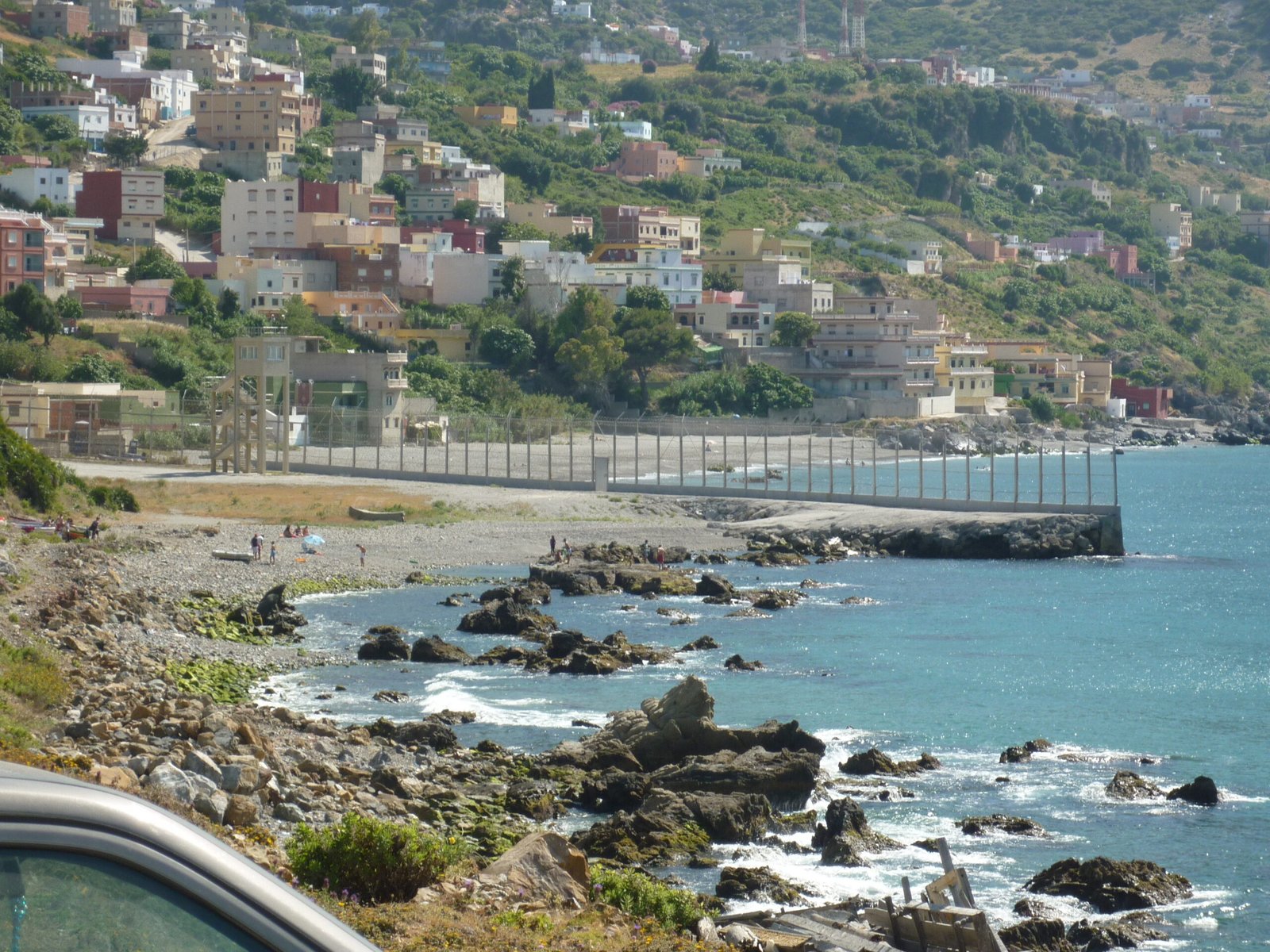
Photograph Source: Mario Sánchez Bueno from Ceuta, España – CC BY-SA 2.0
The political reaction to the Ceuta migration crisis showed just how quickly border events become vehicles for much broader themes. At a time when some Europeans have grown weary of Donald Trump, Elon Musk and JD Vance dismissing or belittling Europe, it was easy to interpret the episode as another attempt to portray European governments as weak and divided on migration.
That made the response from parts of Europe particularly striking. Italy, Denmark and Greece were surprisingly quick to criticise Spain during what increasingly appeared to be a migration crisis with a far more complex backstory than headlines initially suggested. Italy’s intervention was especially disingenuous given that Italy has borne the greatest burden of Mediterranean migration for years, receiving far larger numbers of arrivals. Political divisions deepened sufficiently for the European Union to gather together an emergency meeting of interior ministers, while Commission President Ursula von der Leyen publicly defended Spain and stressed European solidarity.
Within forty-eight hours, most of the estimated 60,000 migrants had reportedly returned to Morocco, many voluntarily and others escorted by Spanish authorities. The “invasion”, as the European right described it, proved considerably less dramatic than early political rhetoric suggested. Nevertheless, dozens died during the episode, making it a profound human tragedy. Spain has since reinforced the border with an additional floating sea barrier.
The circumstances remain contested. Some officials, analysts and media reports began suggesting Moroccan authorities had relaxed border enforcement or quietly encouraged movement towards Ceuta, something Rabat has rejected. Several migrants interviewed by international media claimed police directed them towards the frontier.
The impression left across much of Europe was that the crisis had rapidly become politicised. Whatever its immediate causes, political actors had quickly crowbarred the story into pre-existing narratives. Reform UK’s Zia Yusuf travelled to Ceuta, claiming excitedly that he had already spoken to Moroccan migrants hoping ultimately to reach Britain—a remark that reflected how rapidly the episode had been woven into others’ migration debates.
Numerous explanations emerged. Some reflected genuine diplomatic tensions between Spain and Morocco. Others circulated primarily through social media, alleging Israeli retaliation over Spain’s support for Palestine, American pressure following disagreements with Madrid, or Moroccan anger over Spain’s expanding relationship with Algeria. Some suggested these interests had converged.
Each contained enough plausibility to attract attention. Yet the importance of distinguishing genuine conspiracies from conspiracy theories remained. States can play the darkest of games, but suspicion alone does not evidence make.
A fully satisfied Trump argued that Europe was finally experiencing the consequences of migration policies he had long criticised. Across Europe’s far right, politicians blamed Pedro Sánchez’s allegedly permissive immigration policies. Sánchez instead argued that organised trafficking networks had lured migrants with false promises that they would be allowed to remain in Spanish territory. Throughout the crisis he was careful to avoid publicly accusing Morocco despite the obvious diplomatic strain.
The geography of the crisis seemed widely misunderstood. Ceuta has remained under Portuguese and subsequently Spanish sovereignty since 1415, remaining with Spain after Portugal regained independence in the seventeenth century. Although part of both Spain and the European Union, Ceuta occupies a unique legal position. Entry into the enclave does not provide unrestricted access to mainland Spain, and those who entered had neither crossed the Strait of Gibraltar nor acquired any realistic prospect of reaching continental Europe.
One intriguing intervention came from Michael Rubin, a senior fellow at the American Enterprise Institute. During March 2026 he published a series of striking opinion pieces urging Secretary of State Marco Rubio and President Trump to reconsider longstanding American policy towards Ceuta and Melilla. Rubin argued that Washington should recognise the enclaves as occupied territory and later suggested Morocco could replicate elements of the 1975 Green March strategy, while questioning whether NATO’s Article 6 protections would necessarily apply. Although Rubin was writing in a personal capacity rather than articulating official policy, Moroccan media portrayed his articles as evidence that figures close to Rubio were advocating a significant shift in Washington’s position.
Around the same time, Congressman Thomas Massie highlighted language contained not in legislation itself but in the accompanying House Appropriations Committee report describing Ceuta and Melilla as territories “under the illegal claim” of Morocco. Massie argued this reflected congressional support for reconsidering American policy, although others noted that committee report language neither alters US foreign policy nor binds the executive branch. Even so, the episode showed that questions surrounding the Spanish enclaves had begun surfacing in parts of Washington where they had rarely surfaced before.
The images also jarred with Morocco’s efforts to project itself as a confident, modernising country. Previous research I conducted on Morocco highlighted the restlessness of many younger Moroccans, particularly those associated with the ‘Gen Z 212’ movement, while also illustrating how cautiously even well-informed observers discussed King Mohammed VI.
Online, considerably broader interpretations continued to proliferate. Some social-media users alleged increasingly coordinated pressure involving the United States, Israel, Morocco and elements of Europe’s far right designed to destabilise Spain’s Socialist government, while others connected the episode to domestic legal challenges facing Sánchez’s family. These claims gained traction online but remained unsupported with evidence.
Other commentators focused instead on Spain’s deteriorating relations with Israel and Washington, pointing again to Madrid’s recognition of the State of Palestine, its heavy criticism of Israeli military operations, restrictions on arms shipments through Spanish ports and reported disagreements over the use of American military facilities.
Others placed the Strait of Gibraltar at the heart of the story. Around ten per cent of global maritime trade passes through this strategic choke point. Some commentators argued, in an age of new choke points, that strengthening Moroccan strategic capabilities could ultimately shift the regional balance of influence around the Strait of Gibraltar.
In January 2026, Israel and Morocco signed a joint military action plan. According to defence industry reporting, Israel has become Morocco’s largest defence supplier, while Morocco is significantly expanding its domestic drone industry with Israeli assistance. Reports suggest that a joint maritime surveillance centre is being developed on Morocco’s northern coast.
Morocco is also emerging as an important player in discussions surrounding Israel’s post-war plans for Gaza. Reports have suggested that it could host training for a proposed multinational force of around 20,000 personnel, although both the force and Morocco’s role remain speculative.
The Ceuta crisis illustrated just how migration has become inseparable from wider geopolitical competition. Border incidents are no longer interpreted simply as humanitarian or security events. They are rapidly absorbed into competing narratives about national identity and strategic influence. As with the US-Mexico border, Ceuta became a stage on which domestic politics and information warfare crisscrossed.
Whether the crisis resulted primarily from Moroccan policy, organised smuggling networks, diplomatic tensions or a darker combination of factors remains under debate. What is beyond doubt is that the migration itself became only one part of the story. Far more revealing was the speed with which governments, commentators and online activists transformed a local border emergency into a proxy battle over Europe’s future, transatlantic relations and the emerging balance of power in the western Mediterranean.
