
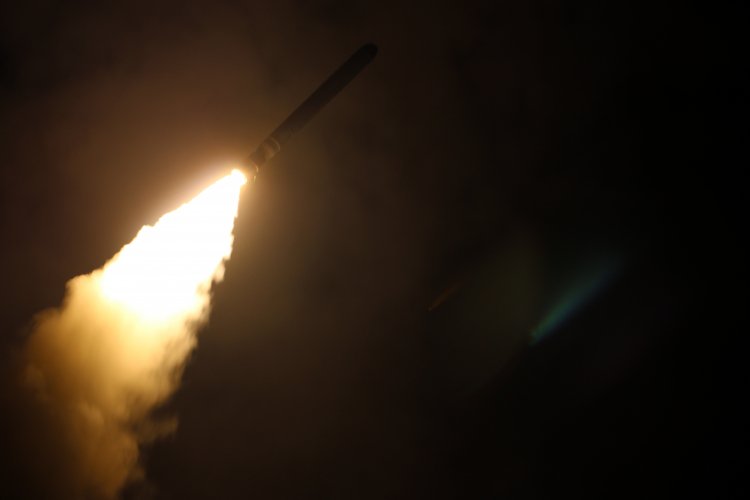
The United States seems stuck in another cycle of promised diplomatic solutions that forestall looming strikes on strategic targets in Iran. On the verge of imminent military activity against energy and logistical targets this past weekend, President Donald Trump discovered another off-ramp to avoid escalation. It’s a cycle we’ve seen before as the U.S. struggles to achieve its objectives.
Shrinking munitions stockpiles, both offensive and defensive, have become a growing part of the U.S. strategic calculus. Just last week, reports indicated that Adm. Bradley Cooper recommended pausing strikes because of a dwindling target list and critical weapon shortages. Gen. Alexus Grynkewich similarly warned about serious shortfalls that are increasing risk in defending Israel. From their positions leading U.S. Central Command and U.S. European Command, their warnings provide a gravity to the situation that must play a major role in U.S. strategic considerations.
The strategic quandary faced by the United States today goes back to the beginning of the conflict. It points for the need to properly consider resource allocation as a fundamental element of effective and sustainable strategy. It also highlights the necessity of a proper strategic design from the outset that understands the important truth that proper weapon utilization is a key to strategic success.
The chairman of the Joint Chiefs of Staff, Gen. Dan Caine, is not responsible for execution of the war in the Middle East. That’s the role of the commander of U.S. Central Command. Yet, as the president’s primary military advisor, Gen. Caine’s advice to the president is vital. Maybe more critical is the chairman’s understanding of global military responsibilities.
The chairman must properly allocate weapons and military manpower to meet objectives not just in the Middle East, but around the world. He must also provide the strong buffer to prevent the natural temptation to overallocate in one theater to the detriment of all others. As numbers indicate, the U.S. has overutilized weapons in Iran as a shortcoming of our sustainable strategy there and to the detriment of our force posture around the world.
But what strategy led the United States to an excess of weapons used during the conflict with Iran? Part of the answer lies in the emphasis provided by the Pentagon.
As judged by press conferences and press releases, the Pentagon has been enamored by quantity. Talking points have emphasized the number of targets and the number of sorties, each day greater than the previous. While the military successes have been dazzling, the impressive numbers haven’t linked to strategic objectives. As a result, the United States has expended a lot without yet accomplishing what mattered most. Meanwhile, offensive munitions stockpiles kept shrinking.
As the war drags on, 50,000 American military members remain in harm’s way. The sustained threat requires a constant, vigilant defensive posture to protect our nation’s best. The longevity of the need for such protections has depleted defensive munitions which are diminishing alongside their offensive counterparts.
The solution now, as it was way back in March, is to finish the job. But how?
The American military has not yet unleashed the power of strategic interdiction against the Iranian regime. The president has threatened it, but has never enacted it.
A strategic interdiction campaign would strike at the heart of a regime, hitting its sources of power and strength, and what it values most. It is not an attack on the population, and should go out of its way to avoid human suffering. Instead, it would carefully map each target to its impact on the regime, and only the greatest impacts would warrant the use of our dwindling stockpile of munitions. Strikes on Kharg Island, the dominant source of resourcing for the regime, would top the list. Anything else suboptimizes the use of force and uses up weapons that are already running in short supply.
Would such a campaign topple the regime? That’s unclear. Yet, by strangling and neutering the regime, it would prevent it from having the resources it needs to threaten and repress. The remaining regime would be transformed into yet another authoritarian structure that retains its hatred of the west without the ability to do anything about it. That would be a strategic win for the United States and for the rest of humanity.
Meanwhile, the reconstitution of our military-related industrial capacity and the replenishment of weapons stockpiles must be an urgent and essential priority. A true arsenal of freedom is essential for global deterrence and strategic advantage. Turbocharging American industry is long overdue.
The solution in Iran is not more targets. It never has been.
The right way to achieve America’s strategic objectives is by actually striking fewer targets that are the right targets. Destroying a smaller number of impactful targets uses fewer weapons while achieving strategic objectives and protecting the stockpile for global responsibilities. It’s a strategic design that the United States should have implemented from the beginning.
