
[ad_1]
Kit Klarenberg· The Grayzzone
Leaked emails reviewed by The Grayzone show both a current and former MI5 director secretly lobbied for the British government’s move to label the IRGC a terrorist entity as well as the UK’s adoption of the draconian National Security Act.
The correspondence reviewed here offers extraordinary insight into how the MI5 influences Downing Street and manipulates public perceptions of dubious or non-existent threats.
On July 13, the government of former Prime Minister Keir Starmer officially listed the IRGC as a terrorist organization, citing supposed kidnapping and assassination plots by the Iranian military branch. Now, merely publishing Iranian-supplied casualty figures could be categorized as “terrorism,” potentially landing British citizens in prison for up to 14 years.
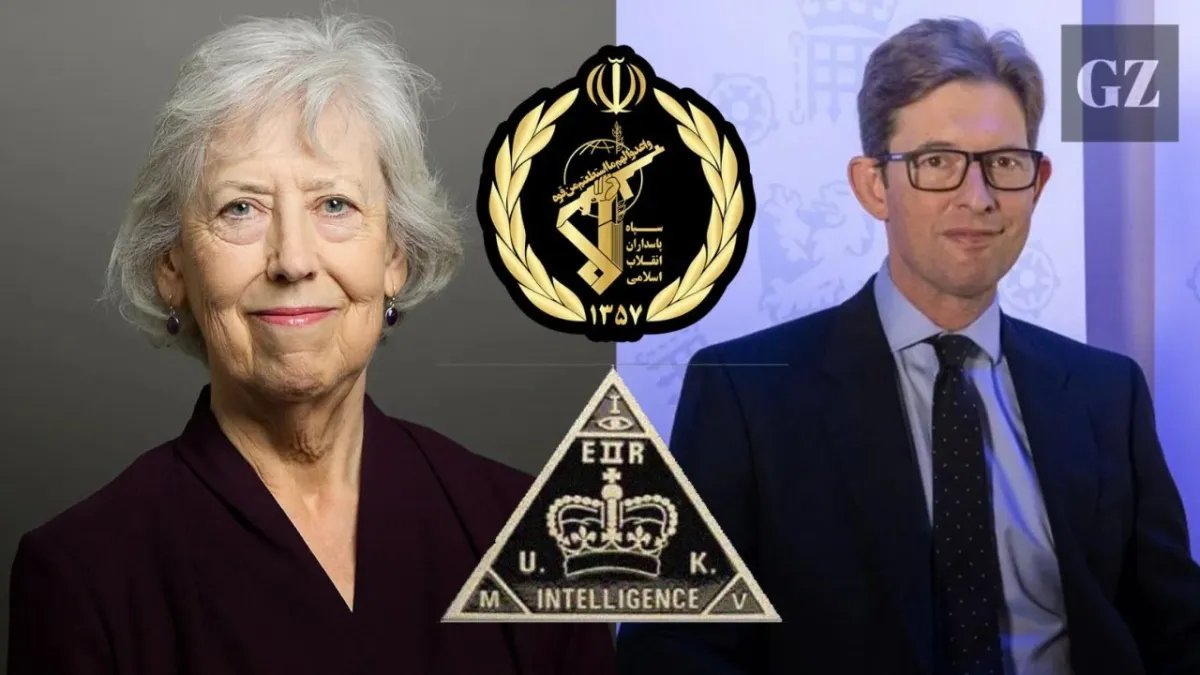
Leaked correspondence reviewed by The Grayzone reveals that when first proposed in 2023, the push to proscribe the Iranian military branch was coordinated among the former heads of British intelligence agency MI5. Those plotting the designation included the MI5’s current Director General Ken McCallum and previous Director General Baroness Eliza Manningham-Buller – who was privately credited with the passage of Britain’s draconian National Security Act.
The spymasters appeared to view Labour’s then-Shadow Home Secretary Yvette Cooper as a key ally in constricting civil liberties and convincing government officials to formally designate the IRGC a terrorist entity.
In private discussions, McCallum acknowledged the “direct operational benefit” of proscribing the IRGC was likely to be “modest.” The MI5 chief nonetheless considered it “sensible to contemplate” such powers, and potentially extend them to include a ban on supposedly state-affiliated factions such as the now-defunct Russian private military company Wagner.
McCallum’s behind-the-scenes lobbying of Cooper and Starmer was the culmination of a wider effort by veteran MI5 officials who’d sought to “help the opposition to be ready to govern” once they took office in July 2024.
Starmer and his shadow cabinet proved highly receptive to clandestine approaches from McCallum and his veteran MI5 forebears. Meanwhile, McCallum’s scaremongering about the supposed threat of China, Iran and Russia – frequently coordinated Manningham-Buller – has justified ever-greater budgets and powers for the spy agency, whose ultimate targets appear to be domestic dissidents.
Keir Starmer ‘realises he needs to understand more about Whitehall’
British intelligence’s infiltration of Starmer’s administration can be traced back to a January 2023 email in which Labour’s former long-serving Cabinet Secretary Gus O’Donnell emailed Manningham-Buller, informing her he was “thinking hard about how we help the opposition to be ready to govern if they win the next election.”
O’Donnell lamented that Starmer’s office was “full of people who are, understandably, totally focussed [sic] on how to win the next election,” rather than collaborating with British intelligence officers. However, O’Donnell wrote that the Labour leader realized “he needs to understand more about how Whitehall operates” in advance of attaining power.

“I hope they have reached out to you already but if not would you mind me suggesting that they do?” O’Donnell enquired.
Manningham-Buller promptly forwarded his query to her latest successor as MI5 Director-General, Ken McCallum, who responded that “funnily enough,” he’d made a similar suggestion to then-shadow Home Secretary Yvette Cooper when they’d last met privately. “I was conscious they’d doubtless be starting to get their heads around governing/structures etc.,” McCallum explained, before declaring “there might be some value” in O’Donnell “nudging” Labour’s leadership to “approach” either the current or former MI5 top spy.

Subsequent emails between the pair reveal the extent to which the former MI5 chiefs coordinated privately to shape the outcomes of their meetings with leading British politicians. A message by McCallum regarding a planned conversation between Manningham-Buller and Cooper shows the current MI5 leader asking his predecessor: “any sense of what she might be thinking/prioritising in my space?”

In an email sent July 3rd, 2023, the former MI5 chief asked her predecessor, McCallum, to “let me know what you might like me to mention” in her conversation with Labour’s shadow Home Secretary. A day later, Manningham-Buller would again ask MI5’s current Director General for his input, in an email titled “Any steer for [Yvette Cooper] on Thursday?”
McCallum noted that he’d “had what felt like a pretty good conversation” with Cooper, “surveying our threat landscape, drawing out the big trends etc.” They also conducted “a deeper dive on the proposed reform of the Investigatory Powers Act,” a sinister mass surveillance law which was under review at the time. Cooper reportedly pushed back, apparently believing “we needed a much sharper political/public narrative to convince sceptics that any dialling-down of safeguards was desirable/necessary.”
The Investigatory Powers Act reform under consideration introduced what was billed as a “lighter touch” framework for bulk data collection by GCHQ, compelling tech giants to coordinate with the British government to ensure uninhibited “lawful access” to select user data, and effectively ending encryption for specific content. The highly controversial amendments finally came into effect in April 2024.
According to McCallum, the future Home Secretary was decidedly more receptive to other MI5 initiatives, however. Cooper, he wrote, “showed particular interest” in “IRGC proscription” – even as he acknowledged it was a “genuinely difficult choice” whose “direct operational benefit” was “likely modest.”

At the time, debate was raging in Britain over whether to deem the Iranian military branch an official terrorist threat, spurred largely by McCallum’s questionable public claims that the IRGC had sought to assassinate 10 British citizens in 2022. In January 2023, McCallum’s dubious allegation led the UK’s House of Commons to unanimously vote to urge the Crown to slap the Iranian military group with a terror label. But the government was apparently unconvinced, perhaps worried that such an action would lead to a complete breakdown in diplomatic relations between London and Tehran.
In her meeting with McCallum, Cooper was also curious as to whether MI5 was constructing a “convincing” system for dealing with “state threats,” in the vein of the British government’s CONTEST counter-terrorism strategy.
The MI5 chief wrote that he told Cooper “it would be good for her and I to spend a bit more time together over the next year, for obvious reasons,” and “she seemed amenable.” McCallum revealed to his aging predecessor that he’d conveniently neglected to mention he would be seeking an extension of his contract in 2024. “Depending on election timing,” the question of whether to keep McCallum in post “may be an early decision facing [Cooper] should she become [Home Secretary]” – one which he no doubt hoped to influence in his favor.
McCallum concluded by celebrating the newly-approved National Security Act and personally crediting Manningham-Buller with its passage. “Many thanks for your support (and stamina) in getting the NS Act over the line,” McCallum wrote, adding: “Phew!”
The highly controversial legislation is explicitly designed to prevent and deter “unauthorised disclosures” of British state secrets. In parliamentary debates on the National Security Act, MPs openly stated their objective was to prevent “WikiLeaks-type” disclosures of grave crimes committed at home and abroad by the British state. One senior Conservative lawmaker fulminated, “none of us [in Parliament] wants to see Julian Assange and his type carry sway here.” British press association lawyers involved in drafting the legislation themselves have openly stated it’s “inevitable” that the Act will have a “chilling effect” on legitimate journalistic activity.
MI5 chief stokes Iran threat to boost agency budget
The strangely intimate relationship between the former and current MI5 chiefs would continue to develop for years to come. In October 2024, Manningham-Buller emailed McCallum with the subject line: “Very proud of you.” She referred to a widely-publicized “threat update” recently given by the MI5 chief, in which he made a number of breathless declarations about alleged dangers posed to Britain by China, Iran and Russia. He accused the Islamic Republic of orchestrating “plot after plot… at an unprecedented pace and scale” since January 2022. McCallum claimed 20 separate “potentially lethal” Iranian schemes had been foiled by his agency during this time.
McCallum thanked his dear mentor, stating he was “feeling the benefit of having done a few years in the job now,” which he wrote had granted him “inner confidence and externally-perceived authority.”
Commenting with approval on the unquestioning coverage his “threat update” had received among mainstream media outlets, Manningham-Buller gushed, “You couldn’t have hoped for fuller coverage. Hope it helps with SR,” she wrote, referring to the government’s next spending review. As desired, six months later Starmer increased Britain’s domestic and foreign spying budget by seven percent.

Lurid allegations of supposed “Iranian state aggression” against Britain became a staple of McCallum’s public speeches thereafter. In October 2025, the MI5 Director General gave another “threat update” in which he bombastically claimed “MI5 and the police have disrupted 19 late-stage attack plots” and forestalled “many hundreds of developing threats” since 2020. McCallum asserted that over the past year, the number of individuals under investigation by MI5 for “state threat activity” had increased 35%, while 20 further “potentially lethal Iran-backed plots” were allegedly busted.
These dramatic figures once again reinforced a core justification for legislation designed to rein in British civil liberties – this time, the National Security (State Threats) Act. An official factsheet accompanying the legislation referred to his October 2025 speech, as did a House of Lords briefing paper on the legislation. Yet, despite McCallum publicly professing MI5 has “one hell of a job on its hands” battling apparently relentless “Iranian state aggression,” basic details of these cases, let alone prosecutions of alleged perpetrators, have failed to publicly materialize.
In his 2024 “threat update,” McCallum sought to cement his narrative of a Tehran-directed terror campaign on British soil by claiming that the previous December, “a man was jailed for reconnaissance he had carried out against the then-headquarters of the Iran International media organisation.” A Chechen with Austrian citizenship was indeed convicted for taking photos of the London offices of Iran International, a shady Saudi and Israeli-funded propaganda outlet that openly supports anti-Islamic Republic Sunni Arab extremist militants tied to ISIS.
However, the prosecution was unable to present any evidence whatsoever the individual had any connections or contacts with anyone or anything Iranian. The claim that he was an agent of Tehran hinged entirely on the state’s insistence that as a Chechen, he was probably acting on Iran’s behalf due to the country’s geopolitical alliance with Russia. One can only speculate as to whether this feeble narrative was cooked up specifically to lend credence to McCallum’s otherwise unsubstantiated claims of ubiquitous “Iranian state aggression” against Britain.
Ex-MI5 chief on Peter Mandelson’s appointment: “Never let a good crisis go to waste”
As the push to label the IRGC a terrorist group once again gained traction, the current and former MI5 leaders were well-prepared. On January 13, 2026, Manningham-Buller tipped off McCallum, who was due to privately brief members of the House of Lords, telling him in an email: “when you come and talk expect questions on banning social media for those under 16, [and] proscription of IRGC and Chinese Embassy.”

When the House of Lords debated proscribing the IRGC, members unanimously supported the ban, with one Lord directly citing MI5’s supposed “revelation of more than 20 potentially lethal Iran-backed plots.”
Other leaked correspondence strongly suggests Manningham-Buller has abused her privileged position as chair of the House of Lords conduct committee, to the benefit of MI5. In early February, she boasted to McCallum how she was exploiting the chaos created by disgraced Labour political honcho and House of Lords member Peter Mandelson being appointed Starmer’s US ambassador, despite British security and intelligence services raising grave concerns about his suitability for the role. His close personal relationship with Jeffrey Epstein loomed large in their considerations. “Never let a good crisis [go to waste],” she crowed.
Manningham-Buler revealed the Mandelson fracas meant she was “pressing to change the law” so her Lords’ Conduct Committee “can recommend… eviction” of members who have fallen victim to scandal, or behaved improperly. “I have a list,” she bragged to McCallum, ominously.
Manningham-Buler concluded that at least parliament’s Intelligence and Security Committee (ISC) “will be out of your hair for a bit.”

The ISC had been tasked with conducting a wide-ranging investigation into Mandelson’s appointment. Its attention, she wrote, would thus be distracted from MI5’s activities.
At that stage, ISC chair Lord Beamish had spent much of the past year warning the Committee’s work was underfunded, and its work “being undermined by continued interference by the Cabinet Office” – the British government’s most powerful component, within which the ISC is based, but also meant to scrutinize. While Rishi Sunak’s Conservative government promised an “emergency uplift” in ISC funding, Starmer’s administration had “declined to implement it” following their landslide victory in July 2024.
In a shock public intervention, Beamish cautioned how the “extraordinary rate” at which British spying services had grown in recent years meant “around £3 billion of public money” was being spent on GCHQ, MI5, and MI6 operations “for which there is no oversight capability.” Since then, the ISC’s budgetary woes have continued, but so has the expansion of financing and special powers for British intelligence agencies
As the files show, even after MI5’s preferred policies are adopted, the agency retains assets within government departments and parliament to ensure the passage of repressive laws without opposition. In one leaked email to Manningham-Buller, McCallum referred to “the scale and complexity” of what MI5 “need to do” on China.
Even if the war on Iran subsides, the exchange suggests the MI5 still retains ample sources of fear-mongering. As Manningham-Buller counseled, the agency must “never let a good crisis go to waste.”
Editor’s Note: At a moment when the once vaunted model of responsible journalism is overwhelmingly the play thing of self-serving billionaires and their corporate scribes, alternatives of integrity are desperately needed, and ScheerPost is one of them. Please support our independent journalism by contributing to our online donation platform, Network for Good, or send a check to our new PO Box. We can’t thank you enough, and promise to keep bringing you this kind of vital news.
You can also make a donation to our PayPal or subscribe to our Patreon.
Please share this story and help us grow our network!
[ad_2]
Source link
