
[ad_1]
“In Congress, July 4, 1776.”
For 250 years, Americans have been innocently misled by the first line on the Declaration of Independence.
Though adopted by the Continental Congress on that famous date, the revered parchment now lying in the National Archives was not signed until Aug. 2, a process that took weeks, if not months. The stirring image of the delegates to Congress lining up to put their names on the document on July 4 is just one of the many myths wrapped around our founding document.
Yet once John Hancock boldly put his oversize signature on the parchment, the material life of America’s most famous relic began. After some decades of neglect, Americans embraced the Declaration, most often not as a disembodied set of beliefs, but as a physical object, reverentially displayed in various settings and reproduced in hundreds of different versions. Fascinated with the names of the Signers, enchanted by the delicate calligraphy of the scroll, generations of Americans have been inspired by the document, keeping it in their minds and hearts.
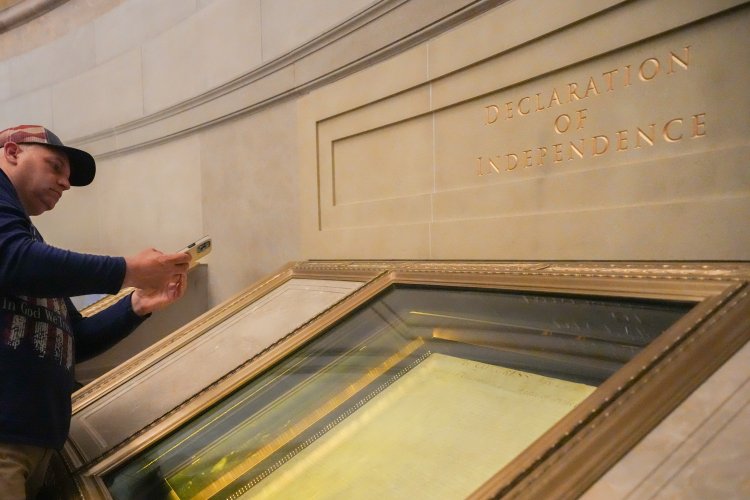
Today the Declaration is an object of near veneration, a “People’s Declaration,” housed since 1952 in the National Archives’ neoclassical Rotunda in downtown Washington, D.C. But the Declaration did not always have pride of place in the pantheon of American symbols. Indeed, for long periods, it was either ignored or locked away for preservation purposes. At other times, it was on display amongst a myriad of “curiosities,” as when it was hung in the Old Patent Office, as part of the National Museum. There, though a popular attraction, it also seemed to be just one more piece of the past slowly fading away. Only in 1924 did the Declaration become a hallowed exhibit in the Library of Congress and assume its current exalted status.
***
Much of the physical history of the Declaration’s early years remains sketchy and, even more, little known by Americans. Though we celebrate July 4, independence actually was voted on July 2, the day that John Adams initially thought would be celebrated as the “the most memorable Epoca, in the History of America.”
As for the famous inscribed parchment, Congress did not even think to have it copied in a formal, ceremonial form until a month later. What did exist were “broadsides” hastily printed on the night of July 4 by Philadelphia printer John Dunlap and distributed throughout the colonies, followed soon by reprintings of the text in various regional newspapers. Not until early August was the Declaration we know today “engrossed” on parchment, by the Philadelphian Timothy Matlack, and then signed by members of the Continental Congress.
Yet even then, no Americans knew it existed. No one outside of officials saw this official Declaration, and once signed, it was rolled up and kept in the possession of Charles Thomson, the long-serving secretary of the Congress, along with other critical documents of state.
For the next 13 years, the Declaration was held by Thomson, moving peripatetically with Congress during the Revolutionary War and among the young country’s early capitals. In July of 1789, Thomson finally retired and handed it over to the new Department of State. It was no small irony that the first secretary of state, arriving to take up his position in March 1790, was Thomas Jefferson, author of the Declaration.
Once in the custody of the State Department, the Declaration largely disappeared from view for the next half-century, shown to dignitaries and inquirers, but not to the public at large. It moved with the government to Washington City in 1800 but again was stored in the State Department’s library (or possibly even the attic).
Yet once word spread of the Declaration’s dramatic rescue from the burning of Washington in 1814 by the British, interest in the old document began to rise. A combination of civic pride and commercial calculation led to the creation of the first artistic reproductions of the Declaration, by Benjamin Owen Tyler in 1818 and John Binns in 1819. (Binns had the idea first, but was beaten to the punch by Tyler.) These were sold widely through subscription, adorning walls in homes and taverns across America. They were joined in 1823 by the Stone Engraving, commissioned by Secretary of State John Quincy Adams as the most exact facsimile of the Declaration. At the same time, John Trumbull’s magnificent painting of the moment when Thomas Jefferson and the Committee of Five handed their draft over to the Continental Congress became the most famous representation of the moment of our founding document’s birth. Trumbull’s image sold thousands of copies, from expensive engravings to cheap reprintings, and helped spark an enduring interest in the Signers who had pledged their lives, fortunes, and sacred honor to the cause of liberty.
Now more visible as an object in daily life, the engrossed Declaration became an object of fascination in its own right. After half a century in the library of the State Department, it went on public display in 1841, by order of Secretary of State Daniel Webster. It was hung on a wall in the Patent Office (now the National Portrait Gallery), among the collections of the nascent National Museum. There, exposed to sunlight and humidity, it continued to deteriorate, the once-bold iron gall ink fading. It was a popular object, but just one among hundreds of curiosities, little distinguished by its surroundings.
After 35 years in the Patent Office, the Declaration was brought back to the city of its birth for the Nation’s Centennial in 1876. Once the celebrations in Philadelphia were finished, the document did not return to the National Museum, but was moved to the new State, War, and Navy Building, next to the White House (now the Eisenhower Executive Office Building). The argument that the Declaration would be better protected in the massive, French Second Empire-style building than in the Patent Office was prescient: A major fire raced through the Patent Office in 1877. Now, in State’s new library, the document was largely kept from the public, though it was displayed in an open cabinet from 1877 through 1894 for visitors to the State Department, after which it was again locked away in a steel case, in an attempt to prevent further deterioration.
During these years, images of the Declaration continued to circulate, thanks to dozens of different facsimiles and reproductions, some fanciful, some artistic, and some faithful. At the turn of the 20th century, the Stone Engraving, the most exact ever made, finally became widely available, reprinted in newspapers and distributed as promotions by companies such as the John Hancock Mutual Life Insurance Company. A few decades later, a Philadelphia chemist named Charles Promislo accidentally discovered a process to make paper look “antique.” At the New York World’s Fair in 1939, Promislo began selling his crinkly, golden-brown copies of the Stone Engraving of the Declaration, which soon went up on children’s bedroom walls and in schoolrooms across America.
***
It was only after its transfer to the Library of Congress that the Declaration’s modern era began. After 130 years of State Department custody, the parchment, along with the Constitution, was sent to the Library in 1921 by Secretary of State Charles Evans Hughes, with the approval of President Warren G. Harding. Librarian of Congress Herbert Putnam understood that the Declaration no longer should be hidden from the people, but rather permanently displayed for their benefit. In fact, as soon as he received the transfer order from Hughes on Sept. 29, 1921, he rushed in the Library’s mail truck to the State Department, where the two priceless documents in their frames were cushioned on leather mail sacks and driven to the Library.
Though preservation was offered as one justification for transferring the Declaration to the Library of Congress, Putnam knew exactly how he wanted to highlight the document and turn it into the Library’s greatest treasure. He commissioned a “sort of ‘shrine,’” as he described it, built on the second floor gallery of the Library’s Great Hall. Made of domestic and foreign marble, inside a case protected by double-paned glass with a gelatin film in between and secured by gold-plated bronze doors, the shrine cost $12,000. On Feb. 28, 1924, the shrine was dedicated in the presence of President Calvin Coolidge and other dignitaries. Putnam himself inserted the Declaration and Constitution into their protective cases.
There, protected by armed guards, the Declaration for the first time since 1876 was open to viewing by sightseers, schoolchildren, and foreign visitors. Over the next 27 years, except for two years during World War II, when the Declaration was stored in Fort Knox for safekeeping, it was viewed by millions, becoming one of the highlights of those visiting Washington, D.C., especially school children.
Putnam and other leaders understood that the time was right for making the Declaration a people’s document. The Populist and Progressive eras spanned the decades when massive immigration from Eastern Europe and other regions was dramatically changing America’s demographic profile, when universal secondary education was creating a newly informed class of citizens, when America had sent her sons to fight in Europe during the Great War, when urbanization was forever transforming society and the way of life for millions, and when the country built the world’s most powerful economy. Taken together, these great changes sweeping through the United States threatened to sever Americans from what had been their shared experience (an experience, it goes without saying, that was dramatically and tragically different for black Americans or American Indians).
Creating new Americans out of immigrants and maintaining a link to the past brought forth various efforts to promote patriotism, from mandatory civics classes in high schools to recitation of the Pledge of Allegiance (first written in 1892 by Francis Bellamy). Bestselling books like James Truslow Adams’ “The Epic of America” (1932) patriotically portrayed American history, while at the same time urging further reform and development, with Adams’ particular contribution being the enduring concept of the “American Dream.” In its shrine in the Library of Congress, elevated to near holy status, the Declaration of Independence played a central role in this era of society-building.
After 27 years in the Library, the Declaration was transferred to an even grander shrine, in the National Archives, in December 1952. The solemn transfer ceremony, attended by military honor guards, and the new enshrinement, dedicated by President Harry Truman, testified to the sanctified status the Declaration had achieved. It had most recently served as the inspiration in the civilizational fight against fascism. Now, with a new “cold” war well underway, the Declaration, along with the Constitution and Bill of Rights, became an even more important symbol in the generational struggle against communism, as well as during the Civil Rights Movement. Mass-produced replicas of the Declaration during the Cold War were sold by Charles Promislo, the National Archives, and other vendors, reaching millions of Americans. All ensured that Cold War Americans would have a personal, physical connection to the ethos that defined the nation.
***
In bringing the Declaration of Independence directly to the American people, Herbert Putnam and the Library of Congress changed the very nature of the relationship between Americans and their founding document. In its marble shrine in the Library of Congress, and later in the National Archives, what some scholars have dismissed as a musty relic was instead shared with every American, not something hidden or far off, but very near, in American hearts.
For a century, the Declaration has served as a tangible symbol of “a more perfect union” just over the horizon and has become an indelible part of our civic culture. Debate and discussion over the shortcomings of American government and society, civilly conducted, are an American birthright, and the Declaration has figured prominently in them, as it did back in 1776.
After recent years of increasingly bitter political disputes, and without minimizing the differences that divide Americans, a return to civics education and a dispassionate study of American history is more needed than ever. The good news is, there are groups committed to just this mission, including the Hoover Institution’s Center for Revitalizing American Institutions, the University of Texas’ Civitas Institute, the Jack Miller Center, the Liberty Fund, as well as new programs and schools at universities in Florida, Texas, and Arizona, among others.
The Declaration of Independence has long had a central role in both inspiring Americans to create a better future and informing them about their origins. Its philosophy and soaring phrases have imprinted themselves on the hearts and in the minds of Americans and people around the world, in no small part because it has been a tangibly visible object. Uniquely among national artifacts and philosophical treatises, we have brought the Declaration into our homes, schools, and churches. We celebrate it, even as we commoditize it on plates, coins, baseball caps, and T-shirts. Such is not a crude exploitation of the Declaration, but rather an acknowledgment of its continued hold over us.
After 250 years, that role is perhaps more vital than ever, or at least as vital as it was two centuries ago, when John Binns first had the idea to make a reproduction of the Declaration to sell to ordinary Americans, and a century later, when Herbert Putnam had a vision to make the Declaration a vital element in America’s civic life. The physical survival of the fragile parchment intertwines with its enduring philosophy and vision, its ongoing challenge to create a more perfect union, and a hope that animates not only the American Dream, but aspirations around the globe.
Note: This essay is adapted from the author’s National Treasure: How the Declaration of Independence Made America (Avid Reader Press/Simon & Schuster, 2026), and appeared in different form at LibertyFund.org.
Michael Auslin is a historian at Stanford’s Hoover Institution and the author of The Patowmack Packet on Substack.
[ad_2]
Source link
