
[ad_1]
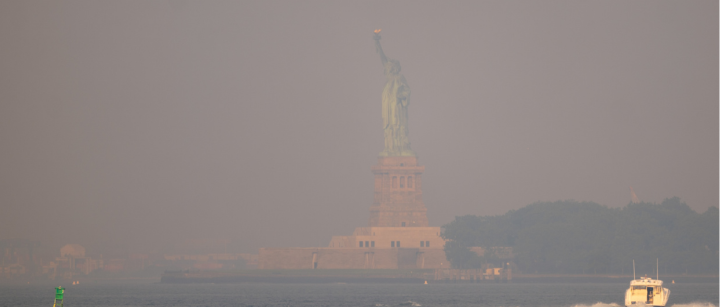
President Donald Trump has blamed improper forest management for Canadian wildfires whose smoke drifted into the Midwestern and Northeastern U.S. earlier this month. But climate change — and not a lack of “Debris Removal,” as Trump suggested — is the main factor leading to worsening Canadian wildfires and smoke pollution, experts from both sides of the border told us.
Large-scale strategies to manage Canada’s vast boreal forest — part of the belt of high-latitude forests circling the North Pole — would be both infeasible and likely ineffective at solving the problem, they said.
Trump claimed in a July 17 Truth Social post that Canada is “not properly maintaining their Forests, and Brush therein, and the United States is being unnecessarily invaded by filthy, polluted, and unhealthy air, the quality of which is dangerous, and totally unacceptable!”

“Canada has refused to engage in basic Forest Management and Debris Removal, knowing that such refusal will lead to exactly this result,” he continued. “This is Willful Negligence, and becoming a yearly occurrence,” he added, threatening to add the cost of the pollution to tariffs on Canadian goods.
The president, who has in the past called climate change a “hoax” and “the greatest con job ever perpetrated on the world,” did not mention a role for the warming climate in worsening the fires.
On July 19, Trump again blamed the fires on Canada’s “forest management” while telling members of the press that “if you go back four or five years, I don’t remember ever having a problem like this.”
Speaking of Canada, he told the press on July 21: “If they managed their forests, they wouldn’t have the fires.”
Experts told us it would be neither possible nor desirable to eliminate fires in the boreal forest, which is the primary forest type in Canada and the main source of the smoke.
“This forest is built to burn,” Jen Beverly, an associate professor of wildland fire at the University of Alberta, told us, explaining that in most parts of the boreal forest, fires return every 100 to 150 years. It’s an “ecosystem that thrives and is resilient and persists with regular disturbance,” she said. “The problem is human-induced climate warming that’s making it easier for those forests to burn.”
It is unclear what exactly Trump was suggesting Canada should do to better manage its forests, and the White House did not reply to our email asking for more information. In some contexts, so-called fuel treatment strategies that reduce flammable vegetation, such as thinning trees or prescribed burns, can help mitigate fires or make it easier to defend communities.
However, Beverly and others said the boreal forest’s fundamental characteristics make any sort of extensive fuel management impractical.
“The boreal forest in Canada is a large, near contiguous forest ecosystem. The largest in the world,” Cordy Tymstra, a consultant and formerly a wildfire science coordinator for the province of Alberta, told us via email. “It is not possible to manage this ecosystem at scale,” he said, adding that climate change is the “primary cause” of the increased fires.
“I don’t think the evidence supports the notion that forest management in infrequent, high intensity fire regimes in remote locations is a silver bullet for smoke or even feasible at scale,” Matthew Thompson, a Colorado-based wildfire risk consultant who formerly worked for the U.S. Forest Service, told us. “And the evidence does support the notion that climate change is making hotter and drier conditions where these forests are more receptive to burning.”
Researchers also criticized the logic behind blaming Canada for the smoke.
Carbon emissions from burning fossil fuels are driving climate change, Peter Frumhoff, a lecturer at Harvard University and senior science policy adviser at the nonprofit Woodwell Climate Research Center, told us via email. “As the historically largest emitter of these emissions, the US has distinctive responsibility for the warming that is driving increases in Canadian wildfires and the increased smoke and harms to public health that are resulting from them.”
Moreover, “smoke doesn’t respect boundaries” and travels both ways over the border, said Beverly, who formerly worked as the leader of a helicopter crew fighting wildfires, including traveling to help fight fires in the U.S. She spoke to us last week while on a camping trip in British Columbia as smoke from wildfires in Washington and Oregon drifted across the border into the province. “The U.S. right now is sending smoke into Canada,” she said. “I’m breathing it.”
Tymstra pointed out that four “large fires in Minnesota contributed to smoke as well” during the recent smoke event Trump was referencing.
Fire in the Boreal Forest
Trump has a long history of blaming wildfires in his own country on poor forest management. During his prior administration, he suggested “raking and cleaning” forest floors and that authorities “do burns and cut fire stoppers,” while also falsely implying that it’s possible to eliminate fires from California.
As we wrote previously, forest management strategies such as thinning trees and prescribed burns can be helpful in mitigating fires in certain areas of the American West. But even within the U.S., Trump has often applied this idea to regions or situations where this would likely not help, while omitting a role for climate change or other factors in worsening fires.
In now applying these comments to fires in Canada’s boreal forest, Trump is again off base, wildfire scientists said.
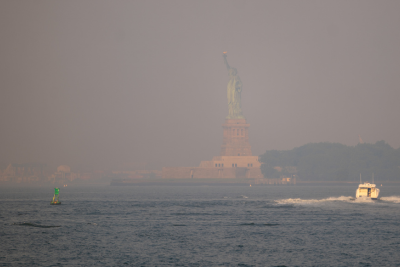
The smoke Trump was referencing mainly came from northwestern Ontario, Beverly said. On July 20, Ontario Premier Doug Ford reported that fires in the province covered 735,000 hectares, or more than 2,800 square miles. Overall, 2.8 million hectares had burned in Canada this year as of mid-July, on pace for a slightly higher-than-typical but not record-setting fire year, according to the blog the Climate Brink.
Compared with the dry forests in parts of British Columbia and the U.S, boreal forests naturally burn less frequently but more intensely, Beverly said.
Forests in the boreal regions, which make up 75% of Canada’s forests, “are born of fire and they die of fire,” she explained.
The trees there “evolved to be a fuel ladder,” with branches starting near the ground that bring fire up to the canopy, Carly Phillips, a senior research scientist at the nonprofit advocacy group the Union of Concerned Scientists who has studied boreal forest fires, said.
The tendency toward such high-intensity crown fires means “prescribed burning in the boreal is not really an option” in most cases, Beverly said, since people have “little control” over such fires once started.
Speaking from the U.S. context, Thompson explained that a goal of forest management is to reduce density and prevent crown fires. This can include removing some trees, followed by burning so-called residual fuels like cut branches, brush or grass, he said.
These strategies are effective in dry forests in the U.S. and southern British Columbia because the trees there evolved to survive low-intensity fire, Beverly said. “The natural regime is a softer kind of a fire that comes through and kind of just maintains the clean forest floor,” she said.
Beverly said she has seen tree thinning strategies fail in the boreal forest. A black spruce forest, for instance, has “small, stick-like” trees, with branches going down to the ground, that grow close together, she said. After they are thinned, the trees “just die and fall over, and now you’ve got an even worse mess from a fire and fuel perspective,” she said.
And of course, even if one did want to try to thin the trees in the boreal forest, “the sheer scope of it is staggering in terms of how vast an area it is,” Beverly said.
“Land management is really important,” Tianjia Liu, an assistant professor at the University of British Columbia who studies remote sensing of wildfires and fire-related air quality, told us. “But we also have to consider the sheer scale of the number of fires and how they’re spread out all across Canada, and especially in these very remote areas where people don’t live.”
Part of the logic for fuel treatment in certain areas is that fires were successfully fought and suppressed over long periods and fuels built up to unnatural levels, leading to more intense fires, Thompson said.
Beverly said this logic does not apply in the boreal forest. “If fire is supposed to come back every 15, 20, 25 years, and you put fire out for 60 or 70 years, you’re creating an ecosystem that’s now outside of its natural structure,” she said. But the effects of suppressing fires are less significant when a forest’s normal cycle of burning is very long, she said, particularly under extreme weather conditions.
Furthermore, in remote northern areas of the boreal forest without timber harvesting and with few people, “they don’t actively suppress fire because it’s not even possible to,” Beverly said. “There hasn’t been suppression, and there’s still lots of fire there.”
Canada’s Efforts to Manage Forests and Fires
Despite Trump’s claim that “Canada has refused to engage in basic Forest Management and Debris Removal,” various groups in Canada do engage in forest management practices. These include fuel treatments, prescribed fires and cultural burning — or burning as part of historical practices of Indigenous peoples.
However, these activities are concentrated in more populated areas, and not in remote stretches of the boreal forest.
A spokesperson for Natural Resources Canada told us the government agency was “unable to comment on political commentary” but sent us several links to government websites with information on wildfire, climate change and forest management.
“Preventing and reducing the risk of wildland fire is a key component of climate change adaptation,” one page said. “Equally important is reducing [greenhouse gas] emissions, which contribute to climate change. Proactive forest management has the potential to decrease fire intensity and/or fire risk by altering fuel load type and quantity.”
Fuel management strategies are especially part of the conversation in southern British Columbia and the more densely populated regions of Canada near the U.S. border, Phillips said.
“In terms of fuel management and land management, Canada is doing some — mostly in areas where people are living because those are the priority areas,” Liu said. “But it’s really impossible to do fuel treatments in the far north in the boreal forest, where it’s very remote and hard to access.”
“The fires that may be most problematic from a broader regional — if not international — public health perspective are not necessarily coinciding with the locations where we would want to actively do forest management,” Thompson explained.
There is evidence that Indigenous people in the boreal forest have done burns in the “shoulder seasons, particularly in the spring, to kind of clear brush to protect a community,” Phillips said, or to increase food production or access to certain animals. But these sorts of smaller-scale community efforts are different from attempting to manage the boreal forest at scale. “I am not aware of any evidence that suggests fuel treatments of any type could be used to reduce fire severity in boreal forests,” she said.
Boreal communities in some cases clear areas and make fuel breaks, which firefighters can use while fighting fires, Phillips said, giving people time to evacuate. The goal is to “help humans stay safe and give firefighters a fighting chance,” she said.
Climate Change Worsens Fires and Smoke
Trump’s perception that large fires and major smoke events have become more common is based in reality. But a warming climate is driving this change.
“Wildfire in northern boreal forests is natural and important,” Harvard and Woodwell Climate Research Center’s Frumhoff said. “But climate change is lengthening fire seasons, and increasing temperatures, causing fuels to dry out more intensely than in the past. Climate change is also increasing lightning strikes, the main ignition source for these wildfires. As a result, wildfires in boreal Canada (and also Alaska) are more frequent and severe.”
These intensifying fires are a “key driver of the very high levels of wildfire smoke that we’ve been seeing this summer and in other recent years, notably 2023,” he said.
Liu said that areas at higher latitudes are warming faster than the world on average. “In the Arctic boreal, it’s warming about four times faster than the global average,” she said. “So, you can imagine how temperatures are increasing much more rapidly in those regions and contributing to these fire weather days that we see.” She also said that with warmer nights, fires are now “burning through the night,” rather than stopping or slowing with cooler conditions as they used to.
Climate change makes fuel management even more challenging, researchers said.
The windows where conditions to do prescribed burns are safe are “rapidly narrowing” due to climate change, Phillips said. “And again, that would not be feasible or appropriate in a boreal forest.”
Climate change also makes thinning less effective, Beverly said. “Fires under the explosive conditions that they’re burning under these days — and that’s due to climate change, that’s due to weather — they burn right through” recently harvested areas of the forest or areas that have been thinned, she said. “If there’s any kind of fuel, it becomes available to burn when you’ve got extended drought,” she said. “It doesn’t matter if they’re spaced out.”
She added that climate change is challenging a natural feature of the boreal forest that has historically limited the size of fires. The periodic fires in the forest have created a patchwork, with trees of varying ages in different areas, including areas of younger trees that are less liable to burn.
“That patchwork is sort of acknowledged as a constraining factor for large fires,” she said. “But here’s the thing: Under extreme weather, fires burn through regardless of the age.” Climate change is causing more of these extreme conditions. “When you have drought, when you have really hot, dry, windy conditions, fires are burning young stands just as much as they’re burning older stands,” Beverly said.
Large forest fires in the boreal regions are a source of carbon, both from the burning trees themselves and from stored carbon released from the soil, Phillips said. This creates a positive feedback loop, with more warming leading to more of these fires and more fires leading to more warming.
Unlike in regions with more frequent fires, increasing fire suppression in the boreal forest could help return fires to their historical, infrequent patterns, some researchers have suggested. In a 2022 paper, Phillips, Frumhoff and their colleagues calculated the costs of stepping up fire suppression in the boreal forest, finding that this might be cost-effective compared with other climate mitigation strategies.
However, Phillips said that these conclusions were based on Alaska, and not the boreal forest of Canada. “Alaska is obviously huge, but to my knowledge, is very different from the vast boreal forest in the northern part of Canada,” she said. And even in Alaska, the suggestion has raised questions about whether it would divert limited resources from communities needing protection, she said.
“California and Canada have around the same amount of population, the same number of people,” Liu said. “But in terms of land area, Canada has about 25 times the land area. And so it’s a lot to ask for, suppressing all of the fires, and there’s not enough manpower to do that.”
Other potentially helpful developments for fighting fires include a wildfire-monitoring satellite Canada plans to launch in 2029, Liu said.
But the root causes of the increasing fire and smoke come back to climate change.
“In terms of climate change, we all know that fossil fuel usage has to slow down,” Liu said. “Otherwise, with the kind of temperature changes in especially the Arctic boreal region, if this continues, we’re going to see more fires, and then also more fires moving into higher latitudes as well. It becomes even harder to control.”
Editor’s note: FactCheck.org does not accept advertising. We rely on grants and individual donations from people like you. Please consider a donation. Credit card donations may be made through our “Donate” page. If you prefer to give by check, send to: FactCheck.org, Annenberg Public Policy Center, P.O. Box 58100, Philadelphia, PA 19102.
[ad_2]
Source link
