
If you want to discover how people feel about the way the world is going, don’t look to language to tell you, not to articles like this one, or even those of the most informed and articulate. I’ve run out of words to say. But keep using them, which makes the words even more impotent. Language always fails. It can’t express the inexpressible and when it tries to do so, language leads us astray, into wrong turns and cul-de-sacs that are hard to find our way out of. As Bill Evans said, “Words are the children of reason and, therefore, can’t explain it. They really can’t translate feeling because they’re not part of it.” What doesn’t lead us astray is music, especially improvised music, played in the moment, as a true expression of feeling in real time.
The act of listening to “jazz,” for lack of a better word, can be just as improvisational as the music itself. The music doesn’t instruct you how you should feel about the feelings it expresses or how you should respond to it. In that sense, it’s liberated from the restrictions imposed by language. And those impressions, to use Coltrane’s word, almost certainly change over time; they become new again with each new hearing. For Charles Mingus “Jazz is, or was, a language of the emotions.” True, but it’s also a language of the intellect, and there were few deeper intellects than Mingus, played out in notes and chords and progressions and changes and spaces. Often, the key is to be found in the negative spaces of the music.
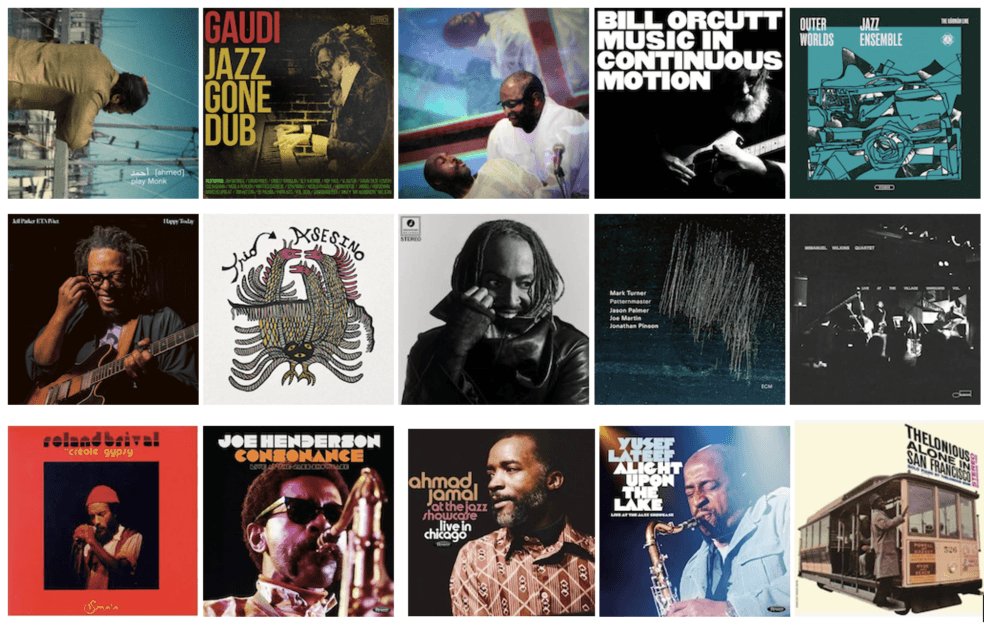
Jazz is a word that doesn’t fully capture the music we call “jazz.” Many of the black musicians who played music marketed as “jazz” in the 60s, especially, refused to use the term. I understand what they were getting at, beyond the implied racism of the word. The title of Gaudi’s “Jazz Gone Dub” highlights the contradiction and then the music tears it asunder. How can Monk still speak to us with urgency seven decades later? Because the Monk we’re hearing has been transported across time and place and cultures to the now by the way Ahmed feels and plays the music. So Ahmed’s recording isn’t a retreat to the past but an assertion into the future. Monk’s music defies stasis and gains new immediacy through Ahmed’s playing.
Even Monk’s own live recording from a 1959 solo gig in San Francisco’s Fugazi Hall sounds current, played in the moment, as in the improvised blues of “Round Lights” and “Bluehawk.” Unlike language, Monk claimed that “the piano ain’t got any wrong notes.” There’s nothing to mediate between you and the notes. Nothing to mislead you as to its meaning. The meaning is buried in how you experience it and how you feel about it. And how you hear “Pannonica” today won’t be the way you hear it next week and the way Monk played it on this night in San Francisco won’t be the same way he played it before or ever again.
Music therefore can reach us without conditions, without expectations or contrived limits. It seeps through the boundaries of accepted discourse and hits us in the gut and the head and heart at the same time. And can only dispute the message if you play the sax, which has rarely, if ever, been an instrument of fascism. Jazz has other advantages in times of autocracy. It can express radical, even revolutionary, ideas and sentiments without falling under the censor’s lash. Bill Orcutt’s Music in Continuous Time may well be a call for sedition against the regime, but good luck to Todd Blanche proving it or even understanding it.
So in that spirit of subversion, I offer here my Francis Davis Jazz Critics Mid-Year Poll ballot for the best new jazz and reissues so far in the enervating year of 2026. The full results from more than 120 other music writers can be found on Tom Hull’s site, which is essential reading for music fans, and on Arts Fuse.
NEW JAZZ ALBUMS
أحمد [Ahmed]
Play Monk
(Otoroku)
Gaudi
Jazz Gone Dub
(Dubmission)
Marquis Hill
(Beautifulism) Sweet Surrender
(Black Unlimited)
Bill Orcutt
Music in Continuous Motion
(Palilalia)
Outer Worlds Jazz Ensemble
The Kármán Line
(ATA)
Jeff Parker ETA IVtet
Happy Today
(International Anthem/Nonesuch)
Adrian Quesada
Trio Asesino
(ATO)
Thundercat
Distracted
(Brainfeeder)
Mark Turner
Patternmaster
(ECM)
Immanuel Wilkins Quartet
Live at the Village Vanguard
(Blue Note)
RARA AVIS (REISSUES/ARCHIVAL)
Roland Brival
Créole Gypsy
(1980, Soundway)
Joe Henderson
Consonance: Live at the Jazz Showcase
(1978, Resonance)
Ahmad Jamal
At the Jazz Showcase: Live in Chicago
(1976, Resonance)
Yusef Lateef
Alight Upon the Lake: Live at the Jazz Showcase
(1975, Resonance)
Thelonious Monk
Alone in San Francisco
(1959, Craft)
