
[ad_1]
A proposal from the Trump-chaired Board of Peace seeks to replace the U.N. agency that touches every aspect of Palestinian life, sparking fear among Gaza residents
Hassan Abo Qamar Prism
A U.S.-backed proposal to dismantle the U.N. Relief and Works Agency for Palestine Refugees (UNRWA) is sparking fear in Gaza about the future of the agency that has shaped every aspect of refugee life for nearly eight decades.
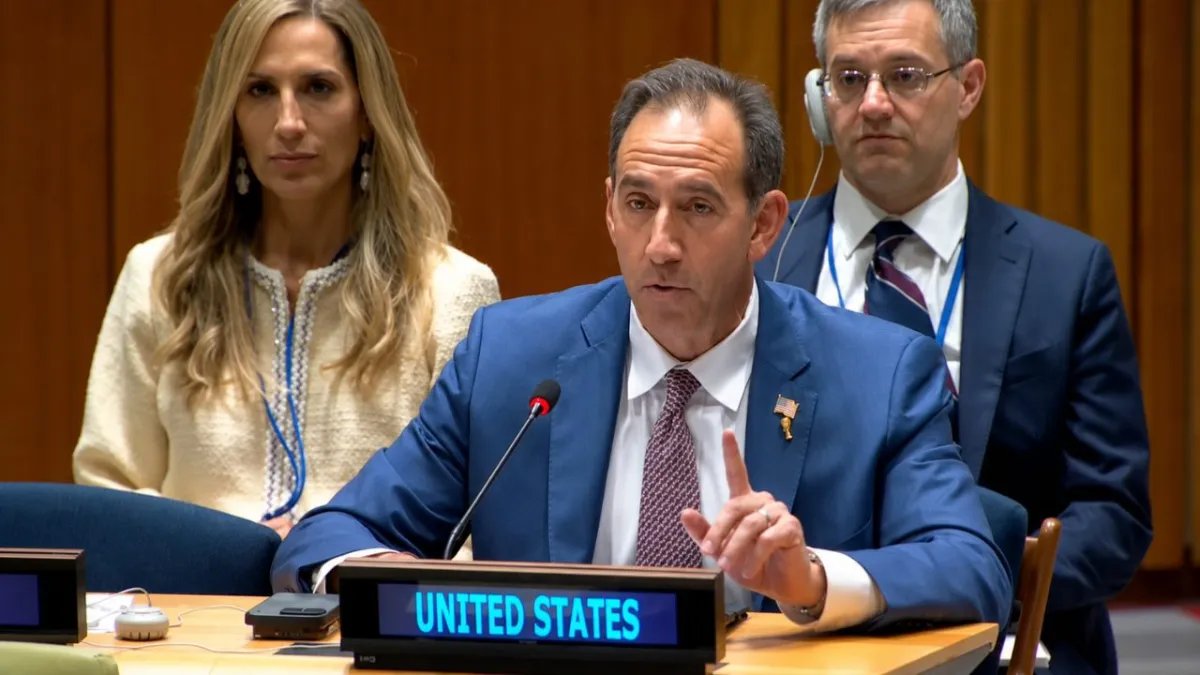
Earlier this month, the Board of Peace, chaired by President Donald Trump, reposted on its X account a June 30 speech by Jeff Bartos at the annual UNRWA Pledging Conference, where he urged donors to redirect their funding. “You can choose to fund incitement, terrorism, and stagnation, or you can choose to fund the Board of Peace, giving Gazans a path to peace, prosperity, and real, durable change,” Bartos said.
“UNRWA has no place in the new Gaza. We are turning the page on the complex of perpetual aid dependency & conflict. The people of Gaza deserve better,” the Board of Peace wrote it in its post.
The Board of Peace proposal to replace the U.N. agency includes plans for what it describes as a “humanitarian and governance zone” under Israeli military control where Palestinians could be relocated.
“I reject replacing UNRWA completely,” said Hanan Abu Muslam, a Gaza resident. “It was established by the U.N. after the Nakba to provide services to Palestinian refugees and preserve their rights. I grew up in UNRWA schools, and whenever I became ill, I went to its health centers.”
To many in Gaza, UNRWA is one of the few humanitarian institutions that has managed to build a functioning system of education, healthcare, and relief over generations. They fear that replacing it with a new mechanism would mean dismantling an institution with infrastructure, staff, and community trust that have been built over decades. Those fears have only deepened after the rollout of the U.S.-led Gaza Humanitarian Foundation, which Palestinians in Gaza view as a model that has undermined their dignity and fundamental rights, rather than providing humanitarian relief.
In a statement at the Pledging Conference, UNRWA Commissioner-General Ad Interim Christian Saunders said staff are “clearly and unequivocally prohibited” from participating in militant or armed groups.
“In Gaza—where more than 390 of our colleagues have paid the ultimate price and thousands more have been injured or suffered abuse and ill-treatment—UNRWA remains the largest humanitarian actor and most capable of providing services at scale,” Saunders said.
Established in 1949 after the Nakba, when Israel expelled hundreds of thousands of Palestinians from their homes, UNRWA was created to support the displaced. Today it serves around 5.9 million registered Palestinian refugees across Gaza, the occupied West Bank, Jordan, Lebanon, and Syria.
Long before Israel’s genocide in Gaza, the agency had become deeply woven into everyday life, operating schools, healthcare centers, food distribution programs, social services, and emergency assistance while employing thousands of Palestinians.
When the genocide began, Abu Muslam said, UNRWA remained central to people’s daily survival.
“It organized shelters, distributed food parcels, hygiene kits, and others. It distributed flour and helped ease the famine,” she said.
UNRWA also continues to provide education to hundreds of thousands of children who have been largely deprived of that right for over two years because of the genocide.
“UNRWA is an inseparable part of the Palestinian people. No one has the right to decide to erase it,” Abu Muslam said.
She also rejected accusations against the agency, saying they ignore the role it has played in Palestinian lives for generations.
“UNRWA is a humanitarian organization that helps children continue their education,” she said. “No one should make false accusations against it simply to push forward their own plans.”
Like many families, Iktimal Abu Matar, a displaced resident of Gaza, said her family relies heavily on UNRWA food distributions.
“When a family receives flour, rice, or sugar, they can at least secure their basic needs. Today, many people survive on this assistance. Without it, obtaining daily food would become incredibly difficult,” she said.
Her dependence extends beyond food. Living with diabetes, high blood pressure, and asthma, Abu Matar receives medication free of charge through UNRWA clinics.
“If I had to buy these medicines every month, I simply couldn’t afford them,” she said. “Without [UNRWA], the suffering would be far worse.”
UNRWA delivers food and medical assistance to people in Gaza, provides psychosocial support to 730,000 displaced people, and supplies potable water to 860,000 people daily, according to its reports. “States that deliberately obstruct such humanitarian aid violate international law,” according to Human Rights Watch.
The Board of Peace has also alarmed Palestinians with its proposal for internationally supervised humanitarian zones where Palestinians would be concentrated while reconstruction proceeds elsewhere.
“We are exhausted by life in displacement,” Abu Matar said. “We’re tired of the unbearable heat, the mosquitoes, the fleas, and these impossible living conditions.”
Like hundreds of thousands of displaced Palestinians, she dreams of returning to Rafah.
“We hope to return today before tomorrow. But we want everyone to return safely and with dignity—without discrimination, inspections, militias, or conditions imposed on us,” Abu Matar said. “We want to go back to our homes the way we left them, not to live inside what feels like a prison camp where the occupation decides who may enter or leave our own land.”
Abu Matar also rejected the idea of dividing Palestinians into different areas under such a plan.
“All of Gaza belongs to us. Dividing people—sending some to one area and keeping others in different zones—is completely unacceptable,” she said. “Most of my family members are from the central area of the Gaza Strip. How would they return or live under a plan that separates people and decides where they can go?”
Several human rights organizations also criticized the Board of Peace proposal to dismantle UNRWA.
The Euro-Med Human Rights Monitor called the board’s X statement “extremely concerning.”
“Discussing ‘turning the page’ on conflict by excluding UNRWA essentially ignores that the core issues, such as displacement, occupation, and the denial of the right of return and self-determination, still persist,” the group wrote in a July 2 statement. “Removing the U.N.’s role as a witness to the refugee situation does not resolve the conflict; instead, it worsens the underlying causes and solidifies injustice.”
Editorial Team:
Sahar Fatima, Lead Editor
Lara Witt, Top Editor
Stephanie Harris, Copy Editor
Hassan Abo Qamar is a Palestinian writer, programmer, and entrepreneur from Gaza, focusing on documenting the humanitarian situation in Gaza, as distinct from traditional political narratives.
Editor’s Note: At a moment when the once vaunted model of responsible journalism is overwhelmingly the play thing of self-serving billionaires and their corporate scribes, alternatives of integrity are desperately needed, and ScheerPost is one of them. Please support our independent journalism by contributing to our online donation platform, Network for Good, or send a check to our new PO Box. We can’t thank you enough, and promise to keep bringing you this kind of vital news.
You can also make a donation to our PayPal or subscribe to our Patreon.
Please share this story and help us grow our network!
[ad_2]
Source link
