
[ad_1]
The state has discovered that the most efficient way to manage what you believe is to reach you before you know you are being reached.
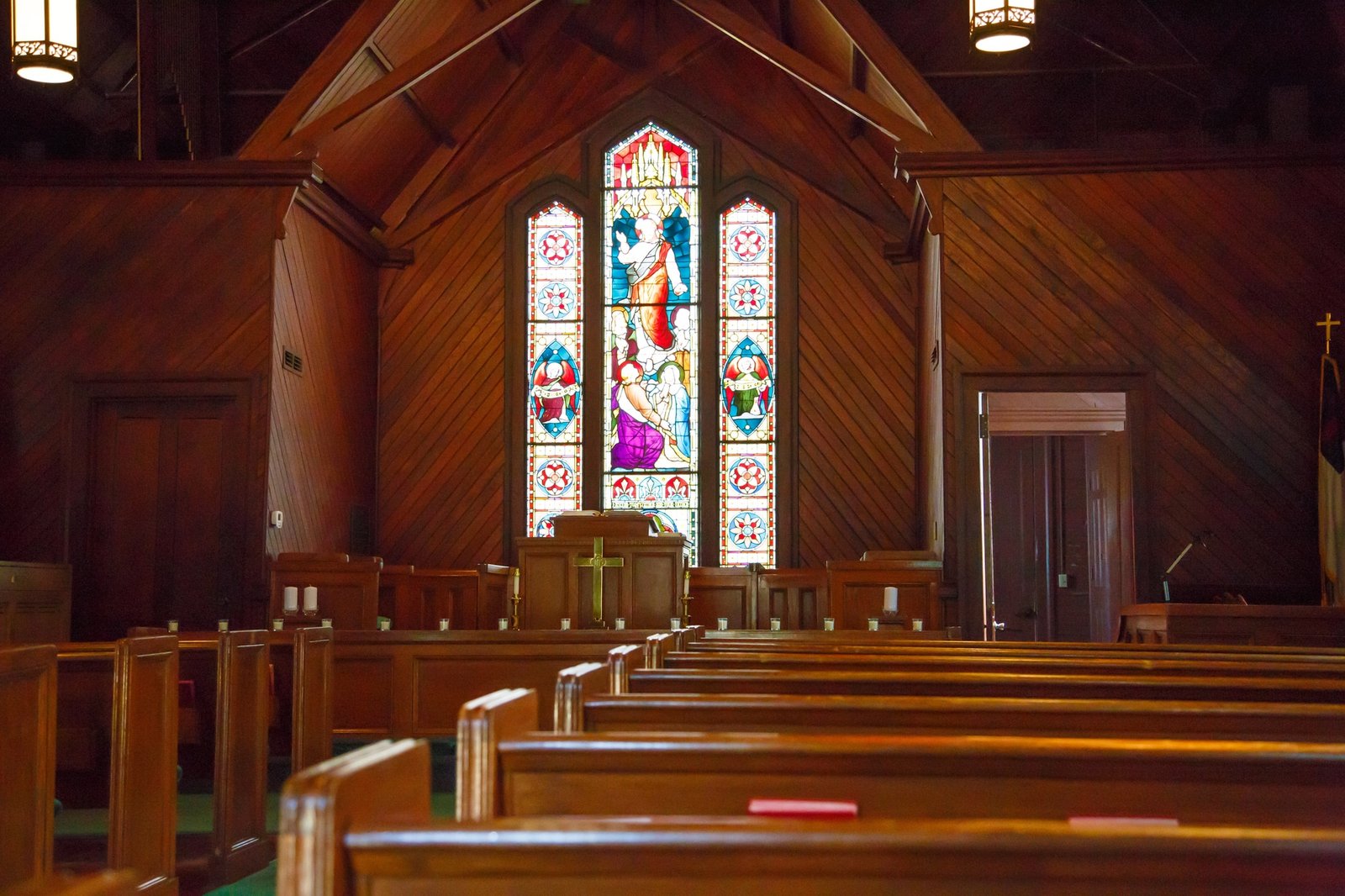
Consider a man walking into a church in Prescott, Arizona on a Sunday morning. He carries a phone, as everyone does. He does not know that the building has been wrapped inside an invisible digital boundary, that his device will be logged the instant he crosses it, and that for days afterward his screen will fill with political advertising paid for by a foreign government. He never consented. He was never asked. He was not told. His own pastor, in most cases, had no idea either.
In late September 2025, a San Diego firm called Show Faith by Works, LLC registered with the Justice Department as a foreign agent of the State of Israel. The filing it submitted under the Foreign Agents Registration Act laid out, in its own promotional language, the largest Christian Church Geofencing Campaign in U.S. history: a plan to draw digital perimeters around every major church in California, Arizona, Nevada and Colorado during worship hours, and around Christian colleges on weekdays, then to track attendees and hit their phones with ads. The contract ran to roughly $3.2 million, with a ceiling reported as high as $4.1 million. The money came not from Jerusalem directly but laundered through Havas Media Germany, with a first payment of about $325,881.
The content was to be explicitly pro-Israel and anti-Palestinian. A trailer outfitted with a touchscreen, virtual-reality headsets, and strobe lights would tour parking lots as an October 7th Experience. And the pastors themselves were to be paid to produce favorable material, valued in the filing not as ministers but as gate-openers to their own congregations.
When the reporting broke, the firm’s principal, Chad Schnitger, said the coverage was sensationalized. Geofencing, he insisted, was an ordinary commercial tool, a 1-way ad push. Months later he said the geofencing portion was scrapped. Both statements belong on the record.
But watch the trick, because it is the whole game. The defense is not that the tracking did not happen. The defense is that the tracking is normal. And he is right that it is normal, which is exactly the problem. A practice that would have been called surveillance a decade ago is now called marketing, and the relabeling is doing all the work. Megan Iorio, senior counsel at the Electronic Privacy Information Center, called it a privacy nightmare precisely because it is incredibly invasive and has become routine. Data brokers vacuum location signals out of ordinary apps and sell access to whoever wants to reach a particular body in a particular place. The phone in your pocket has been turned into an informant against you, and the law shrugs because you clicked “accept” on a permissions dialog you never read.
There is an older word for reaching into a man’s private space without his knowledge or consent. The Fourth Amendment was written to forbid the government from doing it. The Founders did not anticipate that the surveillance could be outsourced to a private data broker, funded by a foreign ministry, and rebranded as an ad campaign, but the principle they were defending is the one being dismantled. A church listed in a target document was never informed and never asked for consent. Neither were its members. A man in Colorado Springs who found seven local churches on the list read the filing and saw it plainly: the document treats Christians as targets to be manipulated. That, he said, is warfare language. He was right, and the language was no accident.
The deepest libertarian objection here is not about Israel. It is about the individual conscience, and what it means to operate on it from the outside without its owner’s awareness.
A free person is one who can weigh an argument, see who is making it, judge the source, and decide. Covert influence is designed to strip out every one of those steps. It does not persuade a man; it arranges the conditions around him so that he persuades himself, and then leaves him believing the conclusion was his own. It targets him in a moment of openness, of communal feeling, of faith, when his defenses are lowest, and it never identifies itself. This is not the marketplace of ideas. It is the quiet abolition of the marketplace, replaced by a managed feed in which the buyer never learns who the seller was.
And the church campaign is not an isolated stunt. It is one prong of a far larger machine, funded by a $150 million budget that Israel’s foreign minister, Gideon Sa’ar, secured in late 2024, roughly twenty times the prior spend, and described in the language of consciousness warfare. A second prong, the influencer operation code-named the Esther Project, routed through the same German intermediary, paid American social-media personalities to post pro-Israel content—reportedly around $7,000 per post—without disclosing that a government was footing the bill, which is why Public Citizen and the Quincy Institute filed a FARA complaint. A third prong, run by former Trump campaign manager Brad Parscale, took a reported $1.5 million a month to flood the zone with ads and to shape what GPT chatbots say when an unsuspecting user asks about the conflict. One structure runs through all three: find a population, reach it through a channel it trusts, and hide the hand doing the reaching.
I want to be careful about what I am claiming. There is no evidence NATO had anything to do with tracking American churchgoers. But the alliance has spent years openly developing a doctrine it calls cognitive warfare—the deliberate management of a population’s beliefs and behavior, explicitly including a state’s own civilians, conducted by design beneath the threshold of their awareness. The Israeli minister’s “consciousness warfare” and the NATO theorists’ “cognitive warfare” were not copied from one another. They arrived at the same destination independently, which is worse. When separate state apparatuses converge on the idea that the human mind is terrain to be operated upon rather than a citizen to be addressed, the convergence is the warning.
None of this began with churches, and the libertarian who is tempted to file it under “foreign meddling in evangelical politics” should look at where the same tool has already been pointed. In 2015, a data broker was hired to geofence abortion clinics and push ads to women in the waiting rooms. Senator Ron Wyden (D-OR) later disclosed that another broker harvested the location data of visitors to nearly six hundred reproductive clinics across forty-eight states, without consent, and sold it. A surveillance tool called Locate X let users trace a single phone as its owner drove across state lines to a clinic. The pattern never changes: a sensitive place, a vulnerable moment, a body logged without its owner’s knowledge, a message engineered to land when resistance is lowest. Church or clinic, evangelical or otherwise—the apparatus does not care about your politics. It cares about your coordinates.
The standard reply is that none of this is illegal. That is the symptom, not the defense. A few states have begun to notice: Washington now bars tracking of phones inside healthcare facilities, and California, Illinois and Massachusetts have moved toward consent requirements. The Baptist General Convention of Texas saw the constitutional stakes clearly, warning the U.S. Attorney General that letting a foreign government track and message worshippers on church grounds would entangle houses of worship with state-approved foreign campaigns and cast a chilling effect over the freedoms of worship and assembly. A sanctuary that can be silently mapped, entered, and worked upon is no longer a sanctuary.
Whether this specific campaign is live, scrapped, or quietly running under a new name barely matters. The filings are public. The budget was real. The technique is proven, cheap, legal across most of the country, and spreading. What a foreign ministry tried against American Christians this year, any government—including your own—can try against any congregation, clinic, campus, or neighborhood next year, behind the same flat assurance that it is only advertising.
The man walking into church in Prescott will feel nothing. That is the design. The most alarming fact about the operation built to reach him is that it was engineered, from the start, so that he would never know it had. A free people can fight a propagandist it can see. It is defenseless against one it has been arranged not to notice. The only remedy available to the man in the pew is the one his neighbor in Colorado Springs reached for when he started knocking on doors: refuse the laundering, name the thing, and demand to be told when the boundary is drawn around you.
[ad_2]
Source link
