
Chances are good that the Republican nominee for president in 2028 will be named either J.D. Vance or Marco Rubio (as I write, the prediction markets put the odds at around 70 percent).
Yet we are still a long way from the first primary, and much could change. Republicans might get clobbered worse than expected in the midterms. Perhaps the AI bubble will burst and crash the economy—or maybe it won’t, and the robots will take our jobs ahead of schedule.
But whatever the situation, neither the vice president nor the secretary of state will cruise to victory completely unopposed. Other Republicans are sure to throw their hats in the ring, even if the prospect of victory is slim; some will run without expecting anything more than a boost to their profiles or a cabinet nod down the road.
Whence might such challengers come? Governorships are a good guess; it is a natural jump from running a state—particularly an important state (say, Florida)—to running the country. We could also see some candidates from less conventional backgrounds (broadcast journalism, anyone?).
One place, however, is almost guaranteed to supply a few contenders: the United States Senate. Our august upper chamber has served as the nursery of 17 presidents so far, and there is no reason to believe this role—which, given the body’s apparently incurable legislative sclerosis, may well be its most important modern function—has ended.
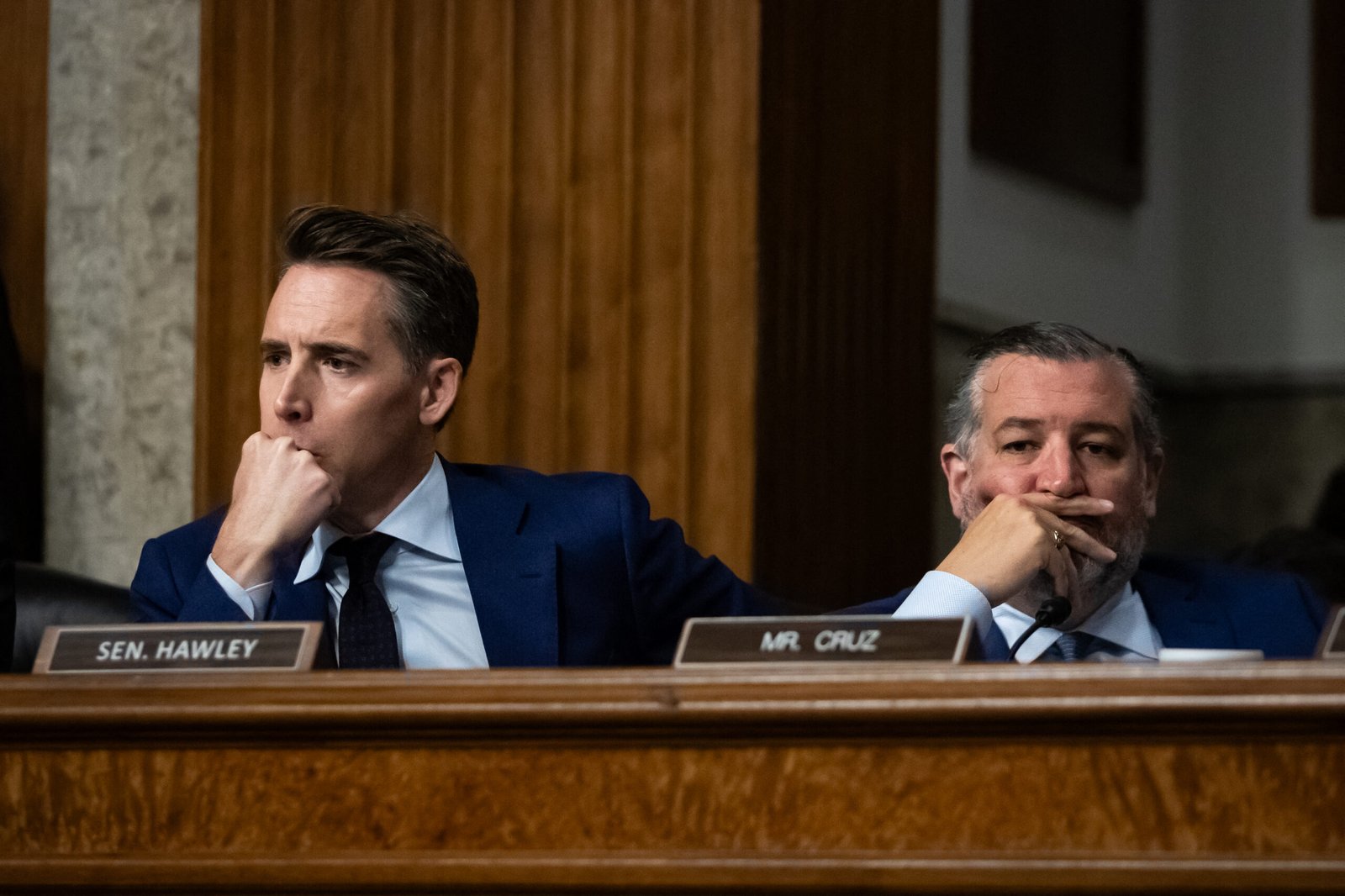
In the Senate today, there are three Republicans who are widely believed to be mulling 2028 bids. Senators Ted Cruz of Texas, Josh Hawley of Missouri, and Rand Paul of Kentucky each have the name recognition, command of the issues, and sheer chutzpah necessary for a credible go at the nomination. And each appeals to a distinct part of the conservative coalition.
Of the three, Cruz has done the most so far to further his presidential ambitions. He has maintained a big public profile and kept a fair amount of buzz going. While loudly backing the president on most issues, he has also broken from the White House in some key areas—notably tariffs and free speech—and gotten directly involved in a few Republican primaries (even endorsing opponents of Trump-supported candidates in Georgia and South Carolina). He has launched strident attacks on what you might call the “America First” wing of the party, picking public fights with Tucker Carlson and offering private criticism of his rival J.D. Vance. He has even been spotted in Iowa. It’s fair to conclude, as Texas’ other senator noted last month, that “Ted wants to be the next president.”
In both style and substance, a Cruz presidency would look like a restoration of the pre-Trump GOP. It would be the Bourbons reclaiming the throne after Napoleon, a turning back of the clock to those pre-lapsarian days when tariffs were unambiguously bad, Israel was unambiguously good, and the party hymned in unison before the smiling icon of St. Ronald Reagan. Cruz is the candidate of what used to be called fusionism: interventionism abroad and a blend of free-market economics and social conservatism at home. Although Trumpism (to the extent one can still speak of such a thing) represents a repudiation of one-and-a-half legs of this “three-legged stool” and the base appears to have mostly moved on, fusionism is still the creed of a large part of the GOP’s donor class. Particularly if Vance is the guy to beat, this creates a clear lane (Rubio, of course, would pose greater difficulties).
On a personal level, Cruz’s prospects would be helped by his clear intelligence, keen political instincts, and experience with a previous presidential run. But his likability needs work; House Speaker John Boehner’s memorable description of him as “Lucifer in the flesh” has been echoed over the years by other congressional confreres, and it is hard to shake the impression that retail politics may not be his strong suit.
Next, there is the senior senator from Missouri (full disclosure: I worked for Josh Hawley from April 2025 until last month). Hawley has been less obvious about 2028, and it is far from certain that he will run. Still, the speculation swirls. And Hawley has done a few things to fuel such conjectures, including setting up a new group to push pro-life causes, zeroing in on hot-button issues like AI that escape the attention of his less supple colleagues, and speaking at venues ranging from the Teamsters’ convention to the Southern Baptist Theological Seminary.
While broadly supportive of the president, Hawley has worked hard to create an independent image and separate himself from the GOP mainstream (indeed, in the Senate he has a reputation as something of a lone wolf). His basic commitments are a hardcore social conservatism, a zealous economic populism—including an embrace of organized labor that makes him an outlier among Senate Republicans—and a broadly non-interventionist foreign policy. In an important sense, then, Hawley offers Trumpism without Trump—which seems like something the base could go for, at least abstractly. He also brings to the table (relative) youth and a talent for soaring oratory, along with a squeaky-clean evangelical background and serious intellectual chops.
But he has liabilities of his own. Hawley would have a hard time gaining traction if Vance is the heir apparent, since the vice president occupies the same “articulate populist under the age of 50” lane. The emphasis Hawley lays on abortion—he is perhaps the most committed pro-lifer in the Senate—and his intense evangelical Christianity could turn off a post-Dobbs electorate. He has been basically absent from the Iran War debate, despite his otherwise strong realist credentials. And although the potency has obviously faded, his pseudo-cancellation after January 6 could come back to haunt him.
Finally, we have Rand Paul. Paul, who also vied for the 2016 nomination, has publicly mused about a bid, telling CBS earlier this year he was “50-50” on running. And if he ran, Paul emphasized to his interviewer, it would be because “we need to have a free market [and] free trade wing of the party, one that’s not eager for war.” Here, then, is the choice for the GOP’s individualist, small-government contingent; Paul offers a libertarianism more moderate and respectable than can be procured from the likes of Jo Jorgensen & co.
And unlike another Kentucky libertarian, Paul has recently made it a point to play nice with the White House. As chair of the Senate’s Homeland Security and Governmental Affairs Committee (HSGAC), he swallowed his fiscal hawkishness and dutifully shepherded the president’s second reconciliation request—which contained more than $70 billion in new government spending—through markup. He has also used his committee gavel to go after high-value targets like Anthony Fauci, who comes before HSGAC this week for a grilling on his Covid conduct.
Subscribe Today
Get daily emails in your inbox
But Paul’s constituency, though passionate, is small. And his 2016 campaign fizzled out early after a fifth place finish in Iowa. It remains far from clear that he could improve upon that performance.
To return to the observation with which this column opened, by far the most likely scenario is Vance or Rubio at the head of the ticket. Yet it is more than idle speculation to contemplate other contenders.
In fusionism, populism, and libertarianism, we see three broad visions for American conservatism. Whether the senatorial champions of these tendencies run in ’28—and how well they perform—could tell us much about where the right will go after Trump makes his exit.
