
[ad_1]
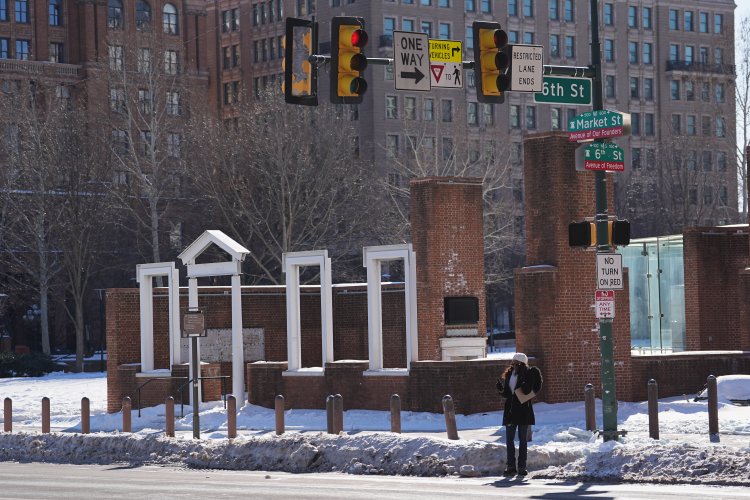
On July 15, the National Park Service hung new interpretive signs at the President’s House Site in Independence Park, where George Washington lived as president while Philadelphia was the nation’s capital. This is a major development in the battle between those who want to portray America’s history in a traditional manner and woke activists who depict our history as one of oppressors versus the oppressed, recasting most American heroes as oppressors.
The site’s previous exhibit, opened during the Obama administration, was spurred by leftist activists like the Avenging the Ancestors Coalition. As ATAC (pronounced “attack”) said in an amicus brief filed in federal court, it “embedded” itself in the site’s “development.” ATAC has sponsored “Anti-July Fourth Day” events, while its founder, Michael Coard, says that “July Fourth is a celebration of … rapes, castrations, lynchings, and enslavement,” and those who celebrate it are “traitors” who “embrace whiteness” and “the 1776 birth of the racist American nation.”
The White House’s recent report on the Smithsonian Institution says that its National Museum of American History should have an entrance sign saying, “Warning: the exhibits in this museum were prepared by people who don’t want you to love your country.” That was certainly true of the old exhibit at the President’s House Site.
Largely destroyed in 1832 (only its ruins remain), the President’s House is where Washington and John Adams served during most of the Constitution’s crucial first decade of existence. Yet because Washington brought several slaves north with him as president, the prior exhibit focused almost exclusively on slavery. As then-New York Times critic at large Edward Rothstein said when it opened, the signs portrayed the house “almost as if it were the Slave Market of Charleston.”
The new signs suffer under no such illusions. Instead, in the words of Third Circuit Court Judge Thomas Hardiman, “These new panels are full of historical context.”
But Americans should judge for themselves.
The old signs described Washington’s actions as “deplorable,” “profoundly disturbing,” and as having “mocked the nation’s pretense to be a beacon of liberty.” The new signs observe that Washington “often expressed discomfort” with slavery and “a desire to see it abolished,” yet “as a Virginia plantation owner, his wealth and livelihood were deeply tied to it.” They note that he “signed legislation that both upheld and limited slavery,” including banning it in the Northwest Territory (the current Midwest). They highlight that he “helped draft the Fairfax Resolves at Mount Vernon,” calling for putting “an entire Stop” to the “wicked” slave trade. They observe, “Among all of the Founders, Washington carried out the largest manumission of enslaved people” through his will.
The old signs essentially ignored the Civil War’s existence, even omitting it from a “Slavery Timeline.” As the new signs note, Abraham Lincoln said that most Americans, like the founders, viewed slavery as “a vast moral evil.” But it “took Lincoln and a bloody Civil War to finish the work that the Founders had begun and end slavery in the United States once and for all.”
The old signs criticized the Constitution for “allowing each enslaved person to be counted as 3/5 of an individual for population purposes,” suggesting slaves should have counted fully. The new signs observe, “Slave-holding delegates wanted enslaved people counted as whole persons to increase their political power.” In other words, the injustice was that slaves counted at all, thereby padding Southern representation, not that they didn’t count fully.
Like the old signs, the new ones name the slaves who lived in the house and provide brief bios.
Beyond slavery, the new signs discuss the house’s history. They note that British General William Howe made it his headquarters while Washington’s army suffered at Valley Forge. Benedict Arnold lived there a few months later while courting Loyalist Peggy Shippen. And Washington was Robert Morris’ guest there throughout the Constitutional Convention. The old signs mentioned none of this.
No one can reasonably say that the new signs neglect slavery, or lack nuance. For example, the signs note that slaves living there were at times “able to explore the city and sometimes even attend the theater, with Washington buying the tickets.” ATAC’s Coard finds this claim particularly objectionable, yet it’s true: Washington biographer Ron Chernow writes in “Washington: A Life” that slaves at the house enjoyed “a modicum of freedom to roam the city,” citing financial records: “Household accounts for June 1792 disclose expense money doled out for ‘Austin, Hercules & Oney to go to the play.’”
In truth, it is the woke left that eschews complexity in its telling of America’s history. By embracing nuance and accuracy at the President’s House Site, the Trump administration has done the American public – and George Washington – a great service.
[ad_2]
Source link
