
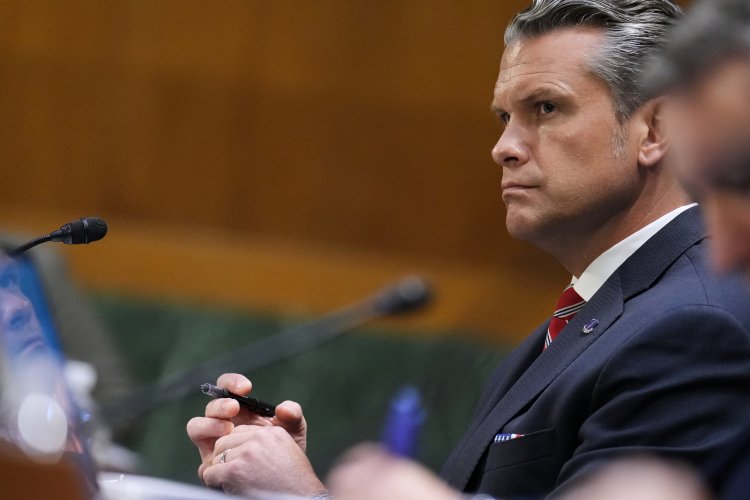
For the last 20 years, the adjective most often associated with masculinity is “toxic,” implying that men who act like men are dangerous – even deadly.
Then along comes Pete Hegseth suggesting that maybe that’s a good thing – at least when it comes to the military.
Earlier this month, Secretary of War Hegseth announced that the U.S. military will begin annual testing of the testosterone levels of service members starting at age 30. If the tests reveal low levels, it would be up to the individual whether to receive testosterone replacement therapy.
Of course, the first effect of Hegseth’s order is that it will greatly increase the opportunity for “Saturday Night Live” to lampoon “he-man Hegseth” as a Neanderthal nincompoop who never got the memo about kinder, gentler manhood.
But despite the potential for giggles, low testosterone is nothing to laugh about. Studies have revealed a “steady decrease” in testosterone levels among young U.S. men in the last quarter century. Research presented this year by Professor Hagai Levine of the Hebrew University-Hadassah Braun School of Public Health found that men’s average testosterone levels declined by 54% between 1972 and 2019, leading to a male fertility crisis. If accurate, that’s one of the most significant public-health trends Americans have never heard about.
Hegseth isn’t worried about fertility, of course, but it’s all related, and the attention Hegseth’s order brings to the question of male hormonal health is crucial. Testosterone is involved in muscle strength, bone density, recovery, red blood cell production, energy, mood, libido, and physical performance.
“This initiative – it’s not about artificial enhancement,” Hegseth said. “It’s about restoring and optimizing your natural capabilities, protecting your longevity, and ensuring you have the biological foundation required to sustain the fight.”
Interestingly, Hegseth’s order applies to women in the military as well as men. That presumably was an attempt to ward off lawsuits alleging sex discrimination, but if so it was probably in vain.
A federal judge has already questioned whether it’s fair to offer testosterone replacement to soldiers while excluding transgender hormone therapy for soldiers transitioning from one gender to another. That pretty much sums up the culture war that provides the political context for Hegseth’s order, and suggests the possibility that it may be too late for masculinity to be rescued from the chopping block.
But before we get distracted by the political and legal ramifications of the news, we should first focus on what it means within the military itself. Because the real question is why America’s military suddenly thinks it should be testing thousands of men for low testosterone in the first place.
The answer may surprise you. It’s really business as usual. The military has always monitored things like cardiovascular fitness, body fat, vision, hearing, and endurance because they affect combat readiness. Hegseth is implicitly saying hormonal health belongs in that same category, and he’s right.
The military isn’t in the business of making social statements. Its purpose is to win wars. If declining testosterone reduces strength, endurance, recovery, or resilience, then it is every bit as relevant to combat readiness as it is poor eyesight or high blood pressure. The Pentagon would be negligent if it ignored the problem simply because discussing male hormones has become politically awkward.
That may be the most important lesson from Hegseth’s directive. For years we’ve treated testosterone primarily as a cultural symbol – something associated with aggressive behavior, locker-room bravado, or the aforementioned “toxic masculinity.” In reality, testosterone is a hormone with profound medical consequences. Men with clinically low testosterone are more likely to experience fatigue, loss of muscle mass, reduced bone density, and diminished physical performance. Those aren’t character flaws. They’re health issues.
Perhaps the military is leading the country toward a conversation we’ve been reluctant to have. If testosterone levels really are declining across generations, that’s not merely a military problem. It’s a public-health problem. Before we argue about whether restoring healthy hormone levels is politically correct, we should first ask whether it’s wise to ignore a biological trend that could affect millions of American men.
The Trump administration is taking the lead on this issue, and not just in the Department of War. The Food and Drug Administration last year removed warnings about possible heart risks with testosterone supplements, based on studies that showed no increase in those problems. And recently the agency proposed allowing use of the hormone for age-related symptoms, such as low libido and erectile dysfunction.
Perhaps restoring healthy testosterone levels won’t solve every problem facing American men. But pretending the problem doesn’t exist certainly won’t solve any of them.
