
[ad_1]
While Washington sets the priorities and commands decision-making, Australian operational staff at the base are outnumbered by Australian “guards and gardeners,” writes .

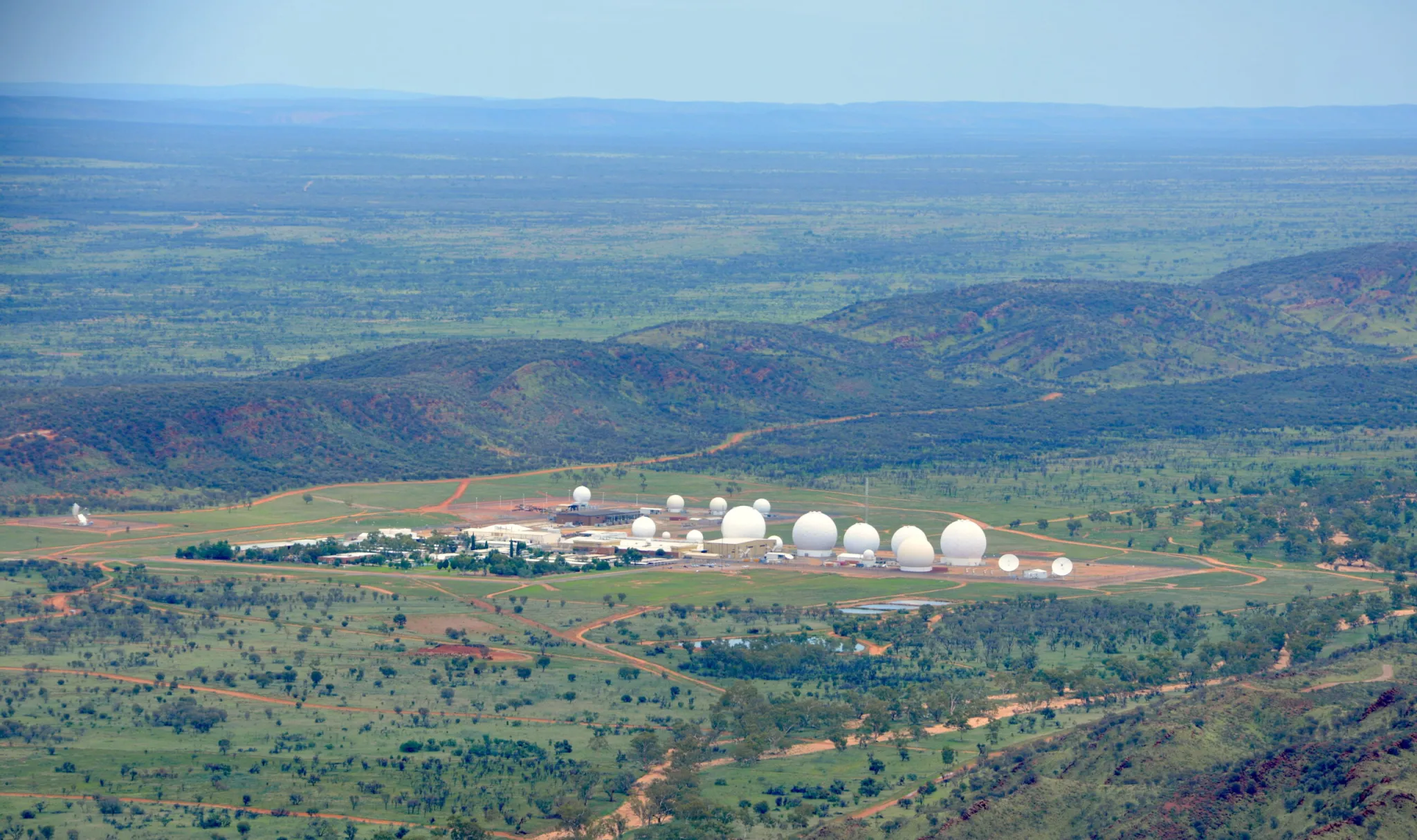
Looking south-west over the U.S. satellite surveillance base at Pine Gap in Central Australia, some 21 of the base’s then 35 radomes and dishes can be made out, in this remarkable 2016 photograph. Since then another 10 radomes and dishes have been built at the sprawling base, bringing the total to 45. (Photo: Felicity Ruby, Declassified Australia)
By Peter Cronau
Declassified Australia
 In the fast-moving first moments of the U.S. conflict with China, Australia won’t have time to consider whether to become involved.
The Australian locations that have been made into forward warfighting military bases against China, like Darwin, Fremantle and Tindal, operate as arms and legs of the U.S. military machinery. And if they are the ‘arms and legs,’ then the radomes and dishes of the Pine Gap intelligence and surveillance base are the ‘eyes and ears.’
Pine Gap is already an active war-fighter base, a key part of the United States global system of intelligence and military capability. The satellites of Pine Gap have been helping the U.S. – in places like Gaza, Ukraine and Afghanistan – fight its wars for years, collecting intelligence, identifying targets, monitoring movements, helping to direct the drones and missiles and bombers.
In the first moments of a serious U.S. conflict against China, the Prime Minister of Australia will call an emergency meeting of the National Security Committee (NSC) to approve Australian involvement.
By then though – as we saw with Iran’s defensive strikes after the February attack by the United States – missiles defending China from apparent American attack will already be on their way and close to impact on the U.S. bases on Australia soil.
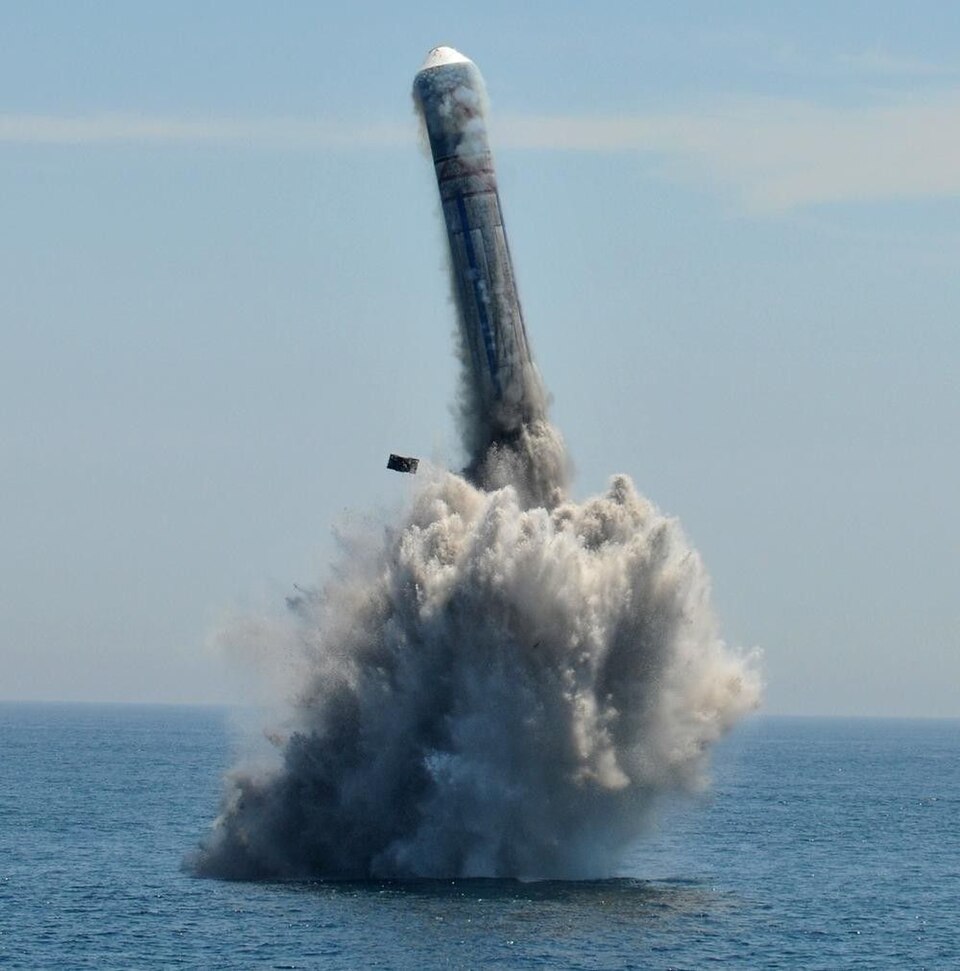
A Julang-2 (JL-2) submarine-launched ballistic missile of the People’s Liberation Army Navy breaks above the water during a test, date unknown. (U.S. DoD, war.gov, 2017, Wikimedia Commons)
The first target for destruction, the most important – with its ability to give the U.S. instant real-time warning of missile launch locations, numbers, trajectory, and the targets of Chinese missiles – will be the U.S. base of Pine Gap.
How do we know? A former Deputy Commander of the base and a highly respected Australian defence and intelligence analyst, Paul Dibb, has conceded the point:
“The joint U.S.–Australia intelligence facility at Pine Gap near Alice Springs will be by far China’s most important and time-urgent nuclear target.”
It will be too late to listen to China’s warning to Australia this month that war is not just a theoretical risk. Following a series of earlier U.S. test firings, on July 6 a Chinese Jin-class submarine test-fired a nuclear-capable hypersonic JL-3 Submarine-Launched Ballistic Missile. This unstoppable ballistic missile with its re-entry speed of 24,500 kilometres/hour could reach Pine Gap in about five minutes after sub-sea launch.
It will be too late for the people in Alice Springs, 20 kilometres north of Pine Gap. As Kieran Finnane reported in Declassified Australia, the first they would know would be the rumble and flash of the impacts and the rising mushroom cloud and a poisonous wind. No emergency sirens would rent the air, nor evacuation orders be broadcast, as none exist.
In Canberra, the meeting of the National Security Committee will be quickly cut short after word of the first impact is received, and the participants hurriedly ushered to a secure ‘situation room’ in the half-built bunker under Parliament House.
There they will have little time to consider the costs of their ‘full knowledge and concurrence’ embrace with the United States. They’ll most likely give the nod to orders for some Australian military responses, and then sit wide-eyed and stupefied at what they knowingly let happen, as U.S. bases along with unlucky nearby towns around Australia are turned to dust.
Few Details & Little Control
The responsible Australia government ministers have long insisted they have “full knowledge and concurrence” of the actions happening at the base the end of Hatt Road, 26 driving kilometres south of Alice Springs.
Sitting on Indigenous land and sovereign Australian territory, the “Joint Space Research Facility” at Pine Gap was virtually handed over in December 1966 by the Liberal government of Harold Holt to a far-away nation ostensibly to conduct “space research,” which in reality was for illegal spying and carrying out catastrophic war.
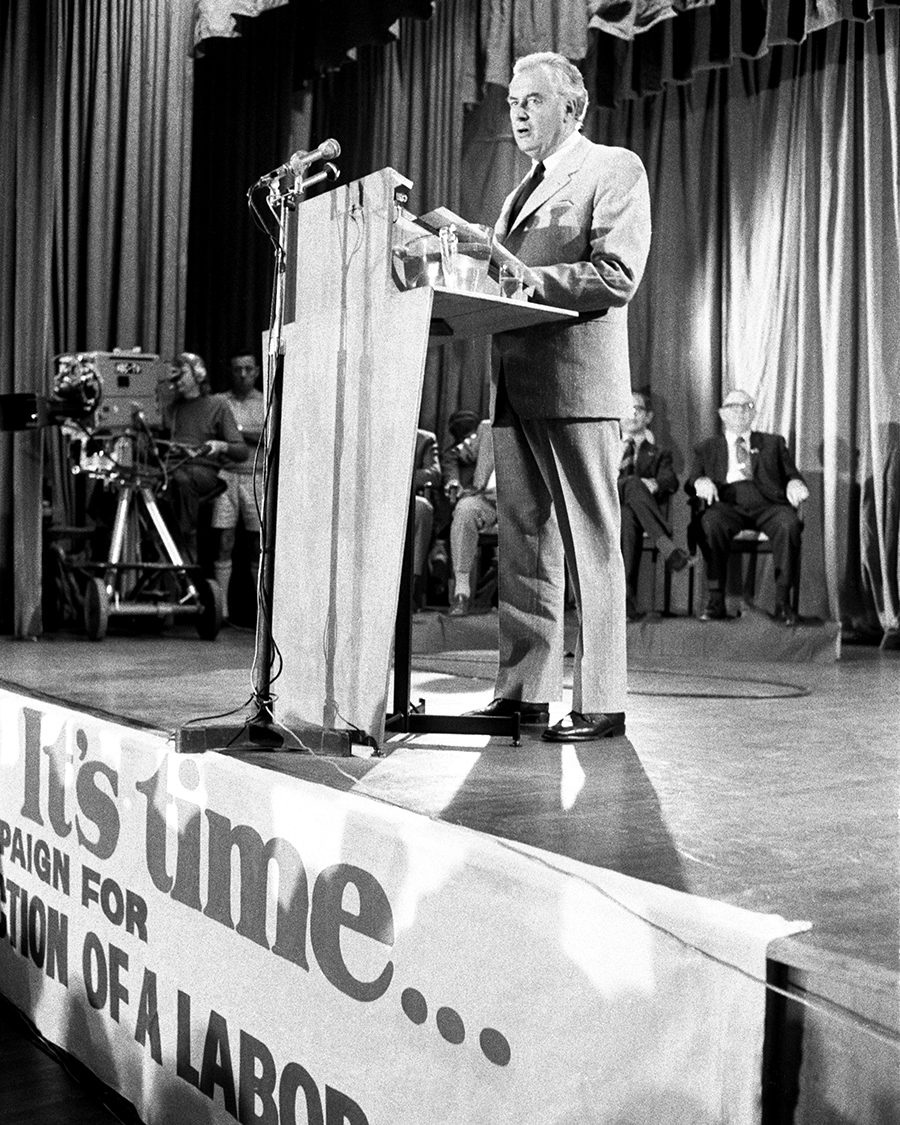
Gough Whitlam giving a speech during the 1972 election campaign. (National Archives of Australia, CC BY 4.0, Wikimedia Commons)
The Whitlam government famously opposed the presence of U.S. bases on Australian soil. In a parliamentary debate in May 1963 on control of America’s new Naval Communications Station at North-West Cape in Western Australia, Gough Whitlam as deputy leader of the Labor opposition stated that any foreign base in Australia would be targeted in a time of war. He memorably put his position:
“There should be no annihilation without representation.”
Whitlam later found out when he was Prime Minister, that the situation was far worse than just Australia’s voice not being heard. He discovered that Pine Gap was put on nuclear alert without him being told.
It was during the 1973 Arab-Israeli war in which the U.S. feared Russia may come in on the side opposing Israel. The perceived risk of Russia using nuclear weapons was so great that all major U.S. bases were placed on nuclear alert.
Australia was involved in a possible nuclear war, with U.S. bases here likely to be involved – and no one in Washington had thought to tell the Prime Minister.
Australia’s current ministerial framing emphasizes that the joint facility at Pine Gap contributes to intelligence cooperation, arms-control compliance monitoring, and ballistic missile early warning, and that this supports the effectiveness of the U.S.’s extended deterrence commitments.
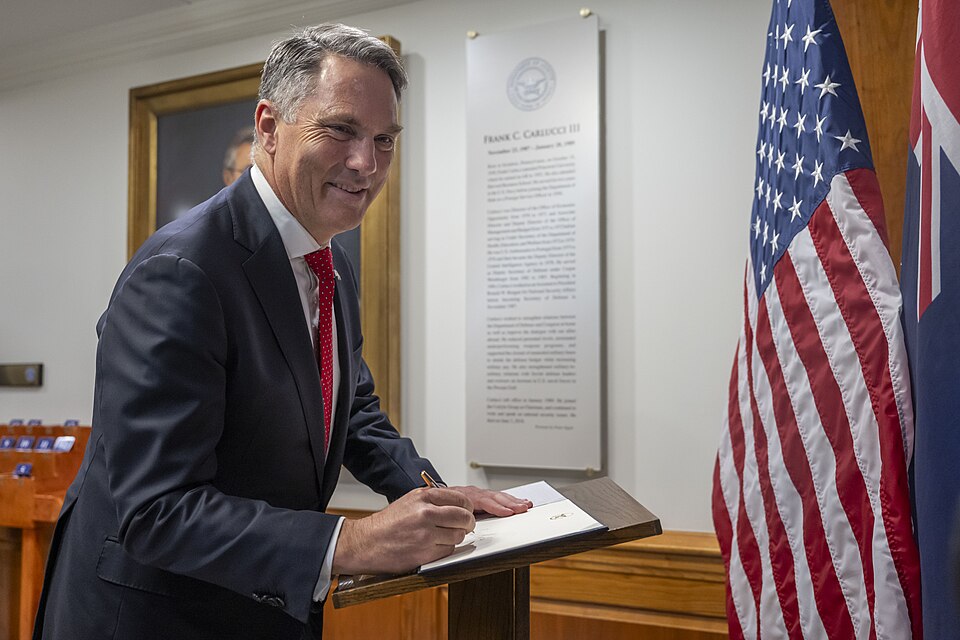
Australian Deputy Prime Minister and Defence Minister Richard Marles at the Pentagon, Washington, D.C., for a bilateral exchange hosted by Secretary of Defense Pete Hegseth. Feb. 7, 2025. (DoD photo by U.S. Air Force Senior Airman Madelyn Keech)
The same ministers refer to the bipartisan “full knowledge and concurrence” framework to reassure the public that they are in some kind of control of the activities at the base, but of course this is a fudge. Australia’s present Defence Minister, Richard Marles, is the latest to repeat this tired axiom:
“A fundamental element of our cooperation with the United States at these joint and collaborative facilities is our long-standing and bipartisan policy of ‘full knowledge and concurrence.’”
He concedes that “knowledge” doesn’t mean of every precise detail, and that “concurrence” does not necessarily mean approval of each specific tasking or action. He states too that it is “long-standing practice” that operational details cannot be publicly revealed.
A secret document leaked to this writer by the National Security Agency (NSA) whistleblower Edward Snowden, and first published by the ABC’s Background Briefing program, gives us a new insight into the Australian government wording:
“RAINFALL [Pine Gap] will not be operated for any purpose without the Full Knowledge and Compliance (FK&C) of the Government of Australia.”
There is a telling difference between these two statements. “Compliance” has a very different meaning than the word “Concurrence,” as the Cambridge Dictionary shows:
Concurrence: a situation in which people agree or have the same opinion.
Compliance: the act of obeying a law or rule.
The U.S. considers it is Australia “obeying” the authority of the United States in supporting Pine Gap. This is very different from what’s presented to the public of Australia that we are voluntarily “agreeing” to supporting the base. So was it an order or was it a mutual opinion? A curious difference.
In providing the real estate for the base, in agreeing to all its operations, in providing a benign cover story, Australia, and its responsible ministers, are likely fully culpable for the crimes committed through the base. In providing personnel to assist in the functioning of the base, Australia is exposing them to credible accusations of involvement in war crimes.
The Australian government cannot walk away from the fact that “full knowledge and concurrence” really means “full culpability.”
Who Is Really in Control?
The Joint Defence Facility Pine Gap is formally described as a jointly operated Australian–United States intelligence facility. Australian ministers emphasise that Australians occupy senior positions, and that half its personnel are Australian.
Richard Marles, Australia’s present Defence Minister, is the latest to again make this hollow claim:
“These facilities are truly joint in nature, integrating both Australian and U.S. operations under shared command and control by Australian and U.S. personnel – which I have had the opportunity to see firsthand… Half of the personnel at Pine Gap are Australian.”
Yet the documented organisational structure points to a more much unequal reality: Australia helps manage and operate Pine Gap, but the United States controls the satellites, intelligence systems and global military architecture that give the facility its purpose.
The senior officer at Pine Gap is the Chief of Facility, a position always held by an American. A Deputy Chief of Facility position was created for an Australian in 1988 to assuage public concerns over the American control of the base.
Its occupant is normally a senior Australian defence or intelligence official commonly from the Australian Signals Directorate. The titles reveal the institutional hierarchy: the American is the chief; the Australian is the deputy, though not a deputy who decides tasking or targeting.
Australian officials have strived to describe the chief and deputy as sharing responsibility. A former Australian deputy, Cameron Ashe, states he was jointly responsible with the U.S. chief for all aspects of facility operations and for ensuring Australian “full knowledge and concurrence.” Nevertheless, the architecture is not symmetrical.
“Australians participate throughout most operational areas, hold senior deputy positions, submit collection requirements and receive intelligence of great value to Australian governments,” according to a comprehensive report prepared by Desmond Ball, Bill Robinson and Richard Tanter for the Nautilus Institute.
Below the more senior positions, multinational teams operate the facility continuously, with Australians involved as mission directors and team leaders managing collection and analysis shifts. Most of those staff are American personnel.
Australian personnel can submit intelligence requirements, take part in collection planning, and obtain access to extensive intelligence output. They are embedded throughout most parts of the facility and are not simply observers. But most global collection requirements originate in Washington and from U.S. military commands, reflecting America’s worldwide military commitments.
Australia has substantial access and operational participation, but it does not possess independent control of the satellite constellations, collection software, communications networks, or ultimate American intelligence-distribution systems.
Accordingly, the most accurate description is that the base is partly jointly-operated, but American-controlled.
How the Numbers Stack Up
Exact contemporary staffing figures remain secret. In June 2015, the Defence Department stated the full staff at the base at 800, but have released no further figures.
The most detailed public estimates of Pine Gap’s workforce place it at around 400 U.S. personnel and around 400 Australians, as recorded in a 2016 Nautilus report by Des Ball, Bill Robinson and Richard Tanter.
The estimated breakdown of the employees was: 20 percent U.S. government; 30 percent U.S. companies; 10 percent Australian government; 40 percent Australian companies. Those estimations, together with other information gathered, mean there are around 160 U.S. government employees, 100 Australian government employees, 220 U.S. private contractors, and 320 Australians employed on contract.
In interviews and in his book, Inside Pine Gap, David Rosenberg, a former N.S.A. electronic-intelligence specialist who worked at the base for 18 years, describes Australian and American personnel working closely together in integrated teams.
His account supports the view that Australians do possess meaningful access and operational responsibilities.
He also confirms, however, that the facility’s priorities were heavily shaped by American agencies and U.S. military requirements.
While Australians are now completely enmeshed into the management structure at the station, with the positions of Deputy Chief of Facility as well as the roles of Deputy Chief of Operations, and Chief of Intelligence Operations, as we have seen, the staffing levels that matter are far from equal.
‘Guards & Gardeners’
Most media reports happily regurgitate the Australian government’s official line, “Half of the personnel are Australian,” as Richard Marles stated in 2023. Accordingly it might be thought to be a neat 50:50 Australian and U.S. staff of the 800 or so employed at the base.
But the comparison is flawed. As we have seen it misses the actual roles the Australians undertake at the base, which are far from equivalent. It is an obvious distraction.
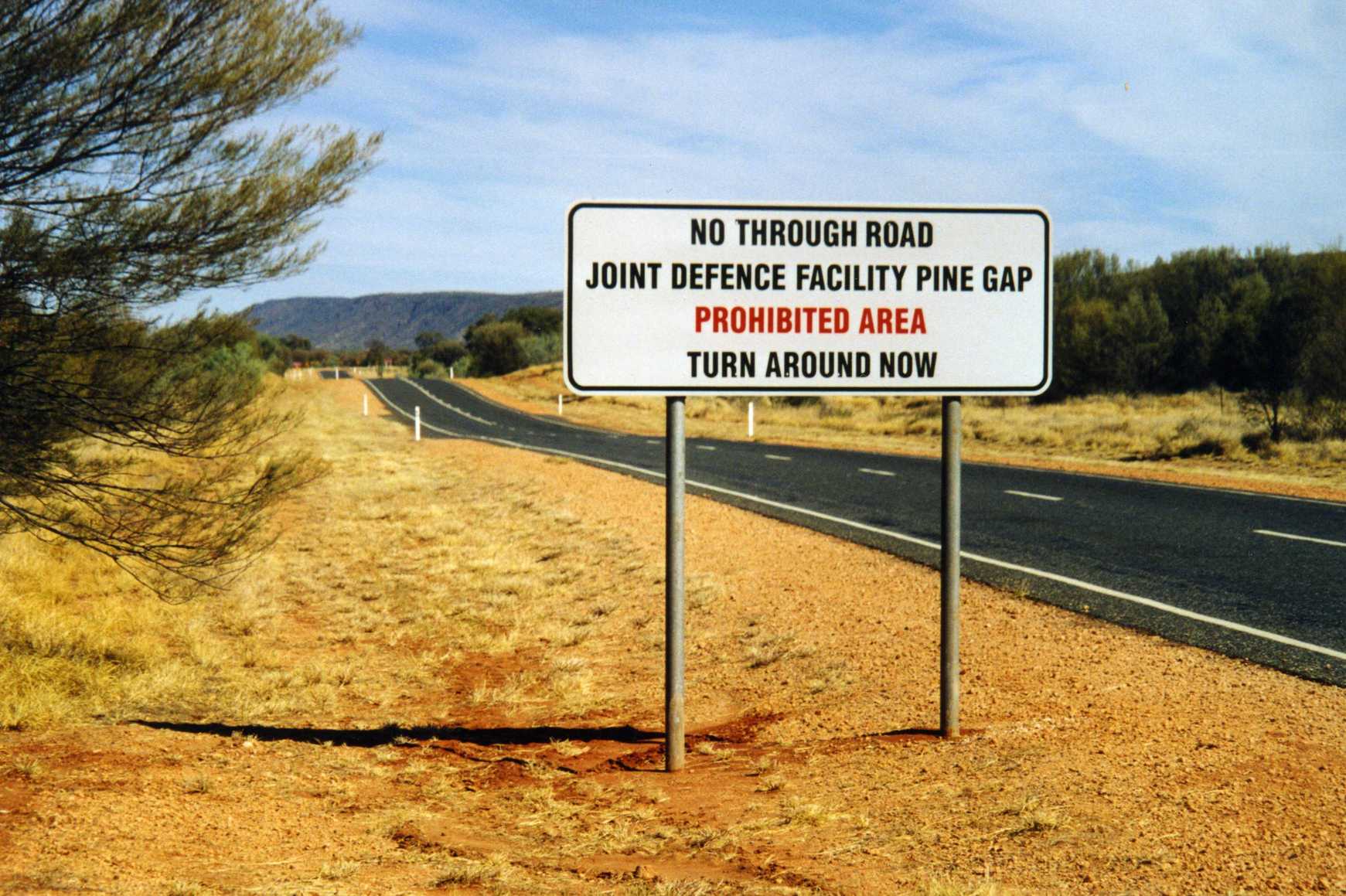
Warning sign on the road to the Joint Defence Facility Pine Gap, the U.S.-Australian military surveillance base near Alice Springs, in the center of Australia. (Schutz, CC BY-SA 3.0, Wikimedia Commons)
According to the best available evidence taken from a 2015 Nautilus report by Desmond Ball, Bill Robinson and Richard Tanter, there are 100 Australian government personnel employed at the base.
However just 50, of that total of 100 Australian government personnel, are actually employed in operations or as analysts – that’s 12.5 percent of the total 400 Australian staff of the base, or 6.25 percent of the full base staff – somewhat fewer than ‘half.’
These 50 Australian analysts and operations staff are drawn from the Australian Signals Directorate (A.S.D.), the Australian Geospatial-Intelligence Organisation (A.G.O.), Defence Intelligence Organisation (D.I.O.), and other units of Australia’s defence and intelligence organisations.
The other 50 Australian government employees are working as A.F.P. Protective Services officers, providing security to the American base.
With a total of 180 personnel of both nationalities understood to be engaged in the base’s intelligence collection, analysis, mission management and related operational functions, it is clear the Americans greatly outnumber Australians on the Operations floor.
That leaves 300 Australian contractors employed by private companies, but it should not be imagined that all those companies are aerospace and defence industry outfits. Most of the Australians are indeed employed by U.S. companies, and one major U.S. company employs the largest share of the contractors.
A Declassified Australia report by Jorgen Doyle in May 2025 found that many of the Australians counted in the 800 full staff figure are involved in catering, cleaning or routine maintenance.
“An Amentum speaker [from the U.S. military contractor] stated that the company is contracted directly by the U.S. government, and ‘employs roughly 400 people’ providing services to the Pine Gap base.”
The base services attributed to Amentum in the Declassified Australia article, include facility operations and maintenance, utilities management, renovations, security, environmental health and safety, plumbing and repairs, medical services, catering, housing, and gardening and pool cleaning. The same Amentum employee stated that as many as approximately 200 Amentum contractors might be working at the facility itself on some days.
Defence Minister Richard Marles makes a big claim when he states:
“A fundamental principle underpinning these activities is the longstanding bipartisan policy of having no foreign bases on Australian sovereign territory.”
Marles relies on saying that American personnel work here “on a rotational basis, within Australian facilities or as a part of jointly operated facilities.”
But when U.S. personnel are spending years deployed in Australia, when the facility was conceived, paid for and built by the U.S., when it employs mostly American analysts and operations staff, and exists for integration into the U.S.’s global warfighting machine, it should be more accurately considered as ‘a U.S. base shared with Australian personnel.’
When Australian employees amongst the staff at Pine Gap base tell inquisitive neighbours in Alice Springs what work they do at the base, they are often heard to say they are ‘gardeners.’
It seems that on many occasions they just might be telling the truth.
Peter Cronau is an award-winning investigative journalist, writer, and film-maker. His documentaries have appeared on ABC TV’s Four Corners and Radio National’s Background Briefing. He is an editor and cofounder of DECLASSIFIED AUSTRALIA. He is co-editor of the recent book A Secret Australia – Revealed by the WikiLeaks Exposés.
This article is from Declassified Australia.
The views expressed are solely those of the author and may or may not reflect those of Consortium News.
Please Donate to
CN’s Summer
Fund Drive!


[ad_2]
Source link
