
[ad_1]
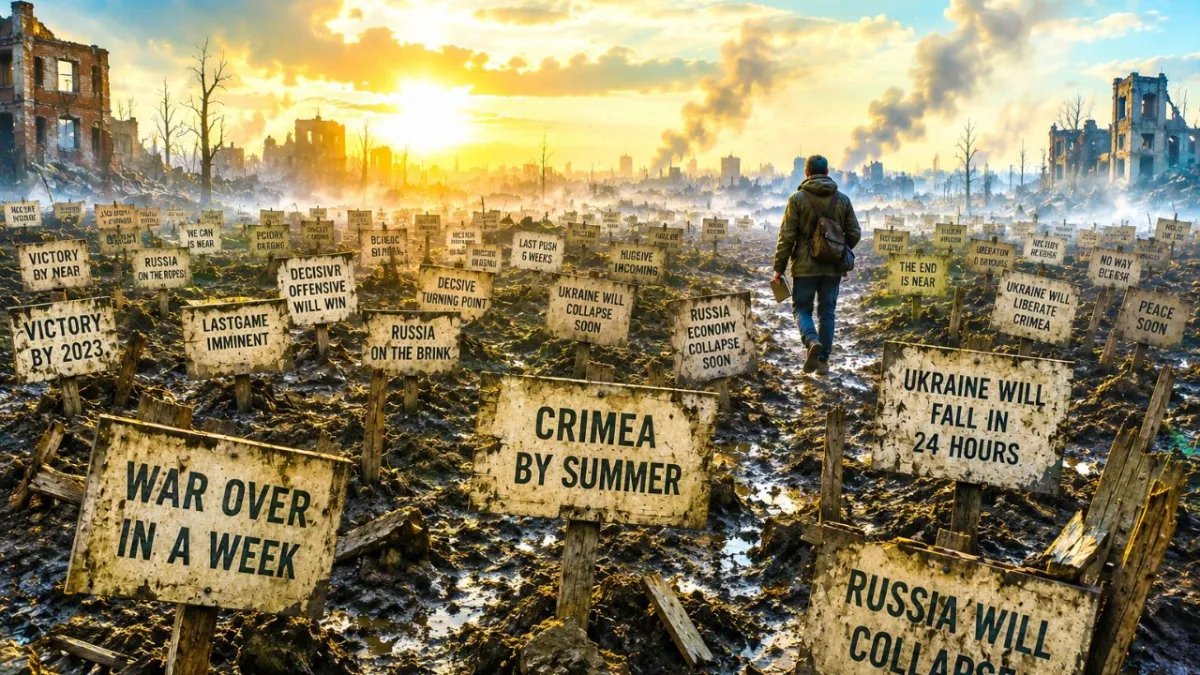
War has always drawn in confident prophets. But if you wanted to design the worst possible system for discussing war, you would build one that rewards confidence over caution and attention over accuracy. In many respects, this is today’s media.
Carl von Clausewitz observed:
“War is the realm of uncertainty; three quarters of the factors on which action is based are wrapped in a fog of greater or lesser uncertainty.”
Yet for more than four years, many of the biggest names commenting on the Russia–Ukraine war have offered one confident forecast after another. And no one seems to remember

[Above] Carl von Clausewitz (1780–1831): war, he argued, is “the realm of uncertainty.”
NATO Senior Mentor for Logistics Ben Hodges, a constant presence across major British outlets, predicted that Russia would be pushed back to its pre-invasion lines by the end of 2022. He later predicted the war would end with Ukrainian victory by summer 2023, including the liberation of Crimea. None of those forecasts came to pass. Even now, Hodges argues that Russia is “in trouble”, that momentum has shifted decisively towards Ukraine, and that sustained pressure will make Crimea untenable.
Another of the UK’s most ubiquitous commentators, Hamish de Bretton-Gordon argued in September 2023 that Ukraine had “a maximum of twelve months, probably less, to vanquish Russia.”
Twelve months came and went.
By September 2025 he was instead arguing that Putin’s remaining strategy was simply to “hang on.” This week, he says that Putin is “barely hanging on”. The rhetoric has changed from imminent Ukrainian victory to imminent Russian exhaustion. The deadlines, however, continue to recede.
But this is not simply a story about rabid war hawks.
Last year, Professor Scott Lucas – whose interviews on The Times podcast attract audiences in the tens of thousands every show – suggested Russia’s economy might have only six to twelve months before economic pressure fundamentally constrained the Kremlin’s ability to continue the war. Scott was an important mentor to me, and one of the best-informed and respected analysts on a range of conflicts. But his year-long deadline, too, is up in August and he is already warning we must prepare for the war to continue “into next winter”.
And nor is this simply an issue just for those sympathetic to Kyiv. On 27 February 2022 the senior Pentagon adviser Colonel Douglas Macgregor suggested Ukraine would surrender within twenty-four hours. The following day he predicted the war would probably be over within another ten days. Weeks later he declared, “The war is really over for the Ukrainians.” Four years later, it continues.
Scott Ritter, former Marine intelligence officer and UN weapons inspector whose interviews have reached enormous alternative-media audiences, was equally sure. Shortly before Russia’s invasion, he predicted that the Ukrainian military would be “annihilated in short order”. When the invasion began, he declared: “This will be over in a week.”
He then kept resetting the deadline. In an October 2022 podcast, he said:
“This isn’t going to take another year-and-a-half. This is going to take at most several months.”
This is not merely my impression. A couple of years ago a major CSIS report by Eliot Cohen and Phillips O’Brien even described the conflict as “A Study in Analytic Failure,” arguing that the problem was not merely that experts were wrong, but that they expressed their judgments with remarkable certainty.
The pattern continues. Just today, the BBC led with an interview with the chief executive of BAE Systems, Charles Woodburn, warning that Britain has been “too complacent” about the threat of war and arguing for higher defence spending. The report is illustrated with stylised fighter jets sweeping across the Westminster skyline, as though Britain itself were already under aerial threat. It is striking that the BBC can consider the head of Europe’s largest arms manufacturer, a company whose commercial interests plainly stand to benefit from that assessment, to be a legitimate assessor of risk.
Of course, the greatest burden of getting it right should fall on those advocating escalation rather than negotiation. When commentators dismiss the risk of their actions provoking nuclear war, they should take ownership of it. And are they really so sure? In March, Polymarket put the chances of a nuclear detonation by the end of 2026 at 24%.
There is nothing wrong with making informed guesses about the future. The problem arises when forecasts presented with great confidence repeatedly fail, yet continue to supply the rationale for policies whose consequences are measured in millions of lives.
Every serious military historian knows that major wars generate surprise, friction, and unintended consequences. As we speak, look at how unstable Kyiv’s attempts are to forcibly recruit new conscripts off the streets – the Ukrainian army could collapse. Yet modern media compounds the already very human need to find optimism in the crystal ball.
The deadlines drift by.
The bodies pile up.
To be clear, I do think there was a case for helping Ukraine resist Russia’s invasion during those desperate opening weeks. Though, whether the conflict could have been avoided beforehand, including through simple diplomacy around NATO enlargement, remains a legitimate subject of debate.
But there is a profound difference between supporting defensive resistance and perpetually forecasting imminent victory.
Foreign policy should not be treated like football punditry – but it is. When influential analysts repeatedly assure the public that victory is just around the corner, they shape expectations, influence governments and narrow the political space for compromise.
Ukraine may conceivably achieve something recognisable as victory – totally dependent on Western weapons and technology. Perhaps Russia can be knocked back and, for some reason, not resort to bigger and bigger weapons or a widening of the war. Who knows, perhaps it is possible simply to keep hitting a bear until it becomes compliant. Even in that case, our victory would be built on more than a million casualties, several hundred thousand deaths, devastated cities, millions displaced and a permanently divided Europe. Ukraine will inherit a legacy of ashes; Russia will never forgive its former partners. Even an unlikely victory would only place us on the first rung of a rotted ladder.
That is precisely why confident prophets should have been in shortest supply.
If you value independent analysis of propaganda and media that isn’t driven by advertisers or institutions, becoming a paid subscriber helps me spend more time researching and publishing work like this. Independent analysis also survives because readers recommend it to one another, so if you found this article useful, please consider sharing it with friends. If you’d prefer to make a one-off contribution, you can also support my work via Paypal. I don’t use social meda – what I write and record is here or on YouTube.
Please share this story and help us grow our network!
[ad_2]
Source link
