
[ad_1]
Nora Barrows-Friedman The Electronic Intifada
The following is from the news roundup during the 23 July livestream. Watch the entire episode here.
Israel has carried out massacres on multiple families this week in Gaza, killing Palestinian children, men and women, as the army encroaches on more land and squeezes Palestinians into smaller and smaller areas.
On Wednesday, an Israeli drone strike on a tent sheltering displaced people killed a Palestinian and injured several others west of the Nuseirat refugee camp in central Gaza, according to medical sources.
Thirteen Palestinians were killed in a series of Israeli attacks on Tuesday, including a strike on a home in the pre-dawn hours that killed six members of a family in Gaza City.
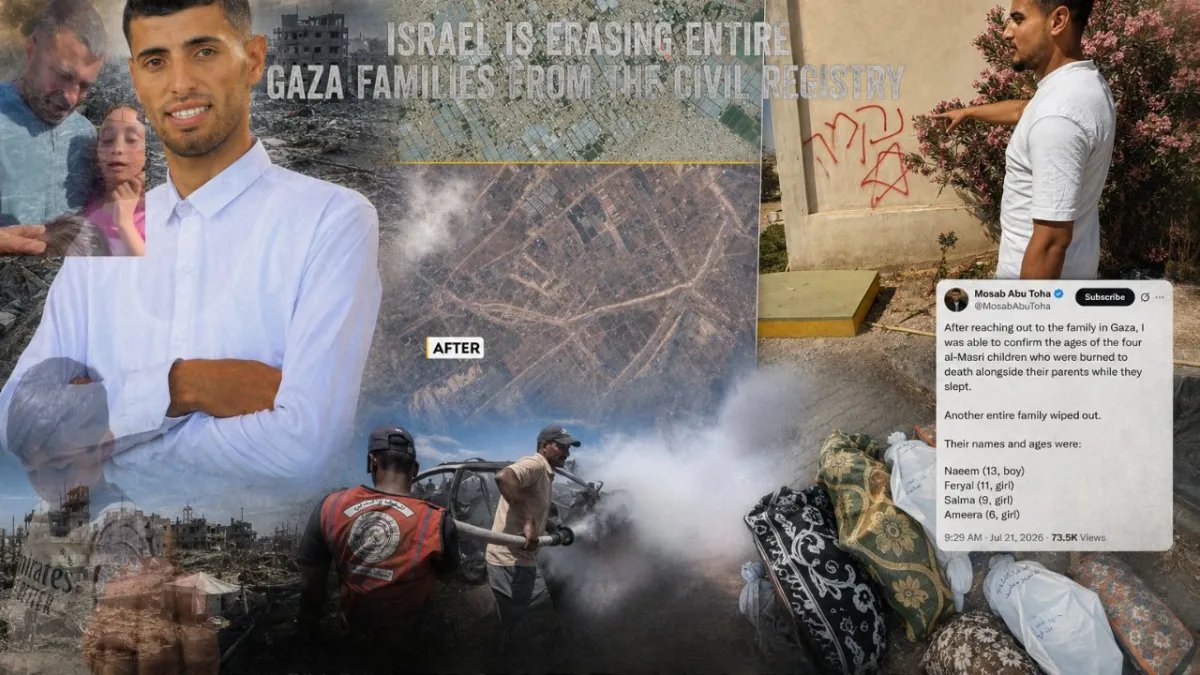
The Cradle reports that Feras al-Masri, his wife Salsabil, and their four children – Naim, 13 years old, Feryal, 11, Salma, 9, and Amira, 6 – were killed while they were sleeping. The Israeli drone strike engulfed the entire home in flames, and rescue crews say they found the bodies so completely burned that identification efforts were extremely difficult.
The explosion also forced residents in surrounding areas to flee in search of safety, while shrapnel reportedly reached nearby displacement camps, piercing tents housing displaced Palestinians, The Cradle added.
Palestinian Civil Defense spokesperson Mahmoud Basal reported from the wreckage of the home, holding a piece of the loitering munition, a so-called “suicide drone,” that hit the building.
He said the residents were burned alive, and added that rescuers could hear them screaming and begging to be pulled out, but all attempts had failed.
The Civil Defense has warned repeatedly that Israel’s deliberate targeting of its vehicles and equipment, along with the scarce amount of fuel and lack of spare parts to repair damaged or worn-out vehicles has made rescue efforts like these nearly impossible.
Videos circulated on social media show Civil Defense crews pulling the charred remains of bodies, some of them small, out of the building in the aftermath of the strike.
Four Palestinians were killed in a separate strike on Tuesday, also in Gaza City, when an Israeli missile targeted the entrance to the Muslim Young Women’s Association building.
They were identified as Muhammad al-Hawwari, 46, Jehad Azzam, 37, Subhi Saqallah, 34, and Abdullah Joha.
The Israeli army targeted a car in the central Gaza Strip, killing two Palestinians, identified as Raed al-Amassi and Nabhan al-Amassi. Video footage shows passersby and rescue workers pulling the blackened remains of two bodies from the smoldering vehicle.
And Aya Ubaid, whose husband Muhammad was killed in an Israeli attack days before in Gaza City, died of wounds she sustained in that strike.
On Monday, 20 June, Israel targeted the Al-Yemen Al-Saeed Hospital, which has been turned into a displacement shelter in the Jabaliya refugee camp, in northern Gaza. The strike killed two and injured at least 16 others, mostly children, in a so-called double tap strike.
The Wafa news agency reported that Israeli warplanes fired two missiles at the first floor of the building. A woman’s body was torn apart in the attack.
A boy who was injured in the attack says, “I can’t even speak due to everything we saw. I lost my cousin, I was injured and he was martyred, not from the first strike, but the second one. They bombed a car, I pulled myself away and kept walking, I hadn’t even gotten there when the street was bombed again.”
On Monday evening, the local Wafa news agency reported that one person was killed in an Israeli drone strike targeting an electric bicycle in the central Gaza Strip.
Israeli artillery shelling on tents for forcibly displaced Palestinians in al-Mawasi Khan Younis killed one man, Osama Abu Tayyem, on 19 July. Ten others were wounded, according to local reports.
Drop Site news reported that a woman was killed and her daughter and several others were wounded in an Israeli artillery attack in the al-Zaytoun neighborhood of Gaza City, and the bodies of two more Palestinians were brought to Al-Shifa Hospital after Israeli attacks the previous night.
Also on 19 July, Aisha Mahmoud al-Arja, a 6-year-old girl, was shot by Israeli soldiers in al-Mawasi Khan Younis. Witnesses said Israeli army vehicles had opened fire toward tents sheltering displaced people.
Five members of the Nesman family were killed in an Israeli airstrike in Gaza City on Saturday, 18 July. Adham, 42, his wife Marwa, 40, and three of their children – 8-year-old Arwa, 16-year-old Ibrahim and 18-year-old Yahya – were killed, leaving their 13-year-old son Ayham the sole survivor because he had been at a nearby market.
Reporter Nahed Hajjaj filmed Ayham in shock and grief, standing over the bodies of his parents and three siblings later in the day on Saturday.
Local reporters filmed the body of his 8-year-old sister Arwa being carried by rescuers to a nearby hospital, her limbs torn and hanging in shreds.
A 16-year-old boy was shot and killed by Israeli soldiers in Gaza City also on 18 July. Reporter Saleh Joudah filmed the child’s father grieving over his body, on the floor in a hospital.
On Friday, 17 July, Israeli forces carried out a massacre on a funeral procession in the Nuseirat refugee camp in central Gaza, killing at least seven Palestinians and wounding more than 20, according to local reports.
Medhat Saleh, who was wounded in Friday’s Israeli strike on the funeral procession, told Drop Site news’ Abdel Qader Sabah that he was heading to a relative’s wedding when he passed the funeral for a man who was killed in an Israeli airstrike on the camp earlier in the day, when the attack happened.
Saleh said, “We couldn’t have imagined they would bomb a funeral of this size. Many children, women and men. People have become afraid to walk in the street.”
And a 49-year-old mother, Amani Abu Jazar, was shot and killed by Israeli soldiers in southern Gaza on Friday, leaving behind her daughter who was waiting to receive treatment outside Gaza.
Gaza’s stolen landscape
In addition to the massacres, airstrikes and sniper attacks on people across Gaza this week, the Israeli army continues to carry out heavy demolitions of entire neighborhoods on the eastern side of the so-called yellow line.
The United Nations high commissioner for human rights’ office said this week that more than nine months after the announcement of a so-called ceasefire, “still, nowhere is safe for Palestinians in Gaza.”
The office’s spokesperson Thameen Al-Kheetan added that the line is constantly being moved, “presenting a continuous threat to life as the Israeli military appears to routinely fire on Palestinians for mere presence in the vicinity of that line, in violation of international human rights law and international humanitarian law.”
Furthermore, Israel has been quickly constructing earthen berm and trench systems hundreds of meters beyond the yellow line, steadily increasing its seizure of Gaza’s land to more than 60 percent.
Satellite images published this week also show the establishment of at least three new military bases.
The Gaza Government Media Office stated this week that “it has become clear that the Israeli occupation is using the ‘yellow line’ as a cover for a creeping policy aimed at isolating and destroying vast areas of the Strip. The latest field data indicate that the restricted areas have expanded to consume about 65 percent of the total area of the Gaza Strip, after it was estimated at 53 percent.”
Over the past few days, the media office added, “we have observed a dangerous advance of military vehicles and yellow concrete cubes in several axes. In the Central Governorate, the yellow line was moved to a distance ranging between 300 to 350 meters to the west, which led to the confiscation and bulldozing of agricultural lands and residential homes belonging to Palestinian families, and placing other homes a few meters away from the occupation’s [army] barracks.”
The Government Media Office remarked, “The expansion of the occupation is not limited to the theft of land, but is accompanied by direct, bloody terrorism. Approaching this line has turned into a death sentence, as field and international reports documented the [killing of] 23 martyrs in just one week, between 13 and 20 July, near this line.”
As of 23 July, the Palestinian health ministry in Gaza says that since the so-called ceasefire in October 2025 was declared, at least 1,185 Palestinians have been killed.
Israeli army, settlers kill Palestinians in West Bank
Turning to the occupied West Bank, Israeli soldiers and settlers shot and killed two Palestinians during a raid on the village of Deir Jarir near Ramallah on the night of 19 July.
The Palestinian health ministry said that Awda Farakhna, 53, and Ahmed Abdul Abu Mukh, 26, were killed and several others were injured in the attack.
Local sources told the Wafa news agency that Israeli occupation forces also opened fire at an ambulance transporting one of the injured Palestinians to the hospital.
The Guardian newspaper reports that Israeli settlers from a nearby colony outpost arrived after 9 pm, “claiming that they were searching for stolen livestock. Israeli soldiers and police soon joined them, protecting them as they sought to take several villagers’ sheep by force.”
But when people in the village “raised the alarm and a crowd gathered, soldiers shot two men, beginning a night of three successive raids by settlers from nearby outposts and Israeli soldiers that lasted until after 2 am, according to Palestinian residents of Deir Jarir.”
In interviews with The Guardian, as they buried their relatives, “family and friends of the dead Palestinian men described several attacks each month in which they said settlers, backed by Israeli forces, arrived in houses on the outskirts of the village and then stole livestock.”
“It’s a partnership between the army and the settlers,” Adel Rashid, the father of the younger victim, Ahmed Abu Mukh, told the newspaper.
“Rashid said local settlers on Sunday had stolen 21 of his sheep, while 50 more had been taken from another member of the village. Video of Sunday’s incident showed a settler protected by four Israeli soldiers in green camouflage leading a sheep out of a local house,” The Guardian reported.
A 17-year-old child, Fadi Hamdallah al-Nassan, who was shot by Israeli settlers attacking his village of al-Mughayyir, near Ramallah on 11 July, died of his wounds a week later, on Saturday, 18 July.
Fadi was a member of the Palestinian national youth football team, and played for the local club. Al Jazeera reports that dozens of mourners carried his body from the Palestine Medical Complex in Ramallah to al-Mughayyir for burial.
The Palestine Football Association said that Israeli forces shot Fadi in the thigh while settlers were attacking the village. His leg was later amputated, and he died from the injuries.
he association said in a statement on social media that with Fadi’s killing, 1,103 Palestinian athletes have been killed by Israel since 7 October 2023. In total, 568 of those athletes – more than half – were football players.
His father, Hamdallah al-Nassan, told Al Jazeera that his son had run towards the scene after hearing women and girls screaming during the settlers’ pogrom, and was shot.
Fadi’s mother, Hanan, said, “He was a good student, good in sports, and loved playing football. Everyone loved him.”
On Saturday night and into the early hours of Sunday, 19 July, dozens of masked Israeli settlers attacked the village of al-Tuwani.
The Israeli lynch mob set fire to the mosque, two houses, a dairy factory run by women, and a vehicle, and smashed windows and sprayed graffiti on the walls of the mosque with the Jewish star of David and the word “revenge,” according to reports.
A local Palestinian activist told reporters that the attack unfolded “in full view of the Israeli army,” with a military watchtower located next to the mosque and soldiers providing protection for the settlers.
The United Nations Office for the Coordination of Humanitarian Affairs says that since the beginning of the year – and as of last week – it has documented more than 1,260 incidents across 250 Palestinian communities involving Israeli settlers that resulted in casualties, property damage or both, averaging about six attacks per day.
This week, a teenager from Jenin died of gunshot wounds he sustained from Israeli forces more than three years ago, in March 2023.
The Wafa news agency reported that Ashraf Mahmoud Najib Farahati, 19, was shot in the head and had been receiving prolonged medical treatment in hospitals in both Palestine and Jordan ever since.
His family told Wafa that Fadi died in Jordan, but they would bury him in a cemetery in Jenin once his body was returned to Palestine.
Four Palestinians were killed and 23 were injured during that attack by the Israeli army’s special forces unit on 16 March 2023, which took place inside a shopping area in Jenin. The Palestinian Center for Human Rights described the massacre at the time as a criminal gang-style extrajudicial assassination campaign targeting Palestinian resistance fighters.
Israeli attacks continue in south Lebanon
In Lebanon, our contributor Roqayah Chamseddine reports that Israeli attacks have continued across the south.
She filed this report for The Electronic Intifada on Wednesday evening:
Highlighting reclamation
And now, as we always do, we wanted to highlight people expressing joy, determination and reclamation across Palestine and around the world.
Hamada Shoo’s videos of preparing delicious food at community kitchens in Gaza always go viral, for good reason.
This past week, he created videos of himself making barbecued seafood with fish and shrimp that he and his team caught in the sea, as well as crispy fried chicken, all for the community in Gaza’s displacement camps.
He also made an enormous fruit salad, what he calls “the ultimate fruit pool party,” served it with ice cream, blueberry sauce and pistachios, and distributed the sweet treats to the kids in the camp. The kids remark how delicious and refreshing it was.
Editor’s Note: At a moment when the once vaunted model of responsible journalism is overwhelmingly the play thing of self-serving billionaires and their corporate scribes, alternatives of integrity are desperately needed, and ScheerPost is one of them. Please support our independent journalism by contributing to our online donation platform, Network for Good, or send a check to our new PO Box. We can’t thank you enough, and promise to keep bringing you this kind of vital news.
You can also make a donation to our PayPal or subscribe to our Patreon.
Please share this story and help us grow our network!
[ad_2]
Source link
