
[ad_1]

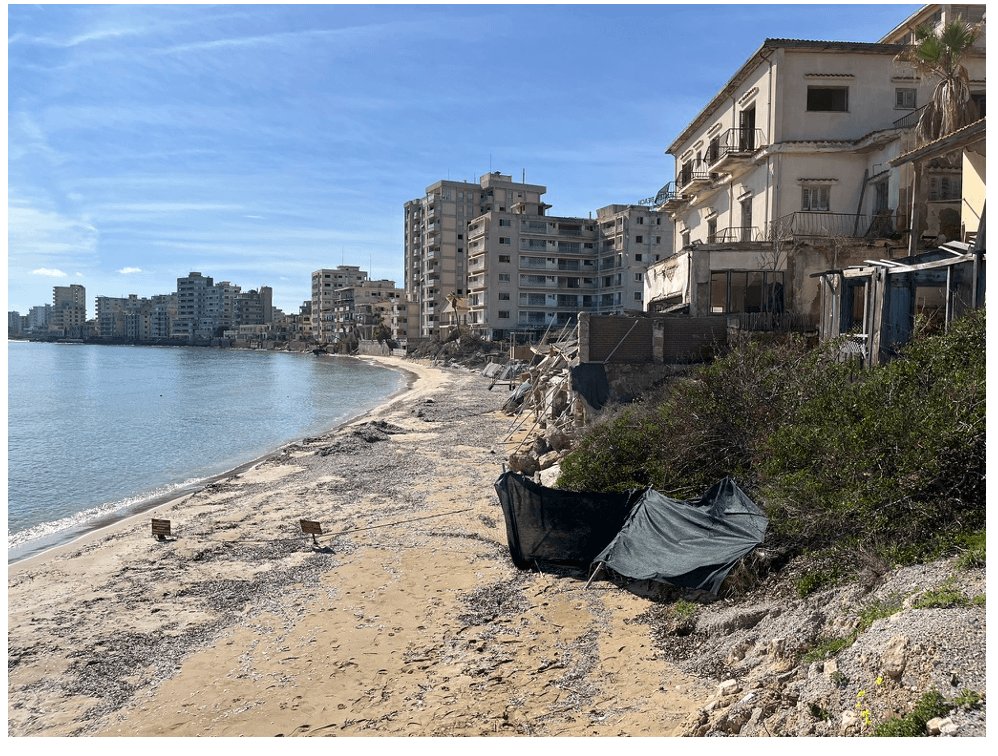
The uninhabited “lost” city of Varosha, a district of Famagusta, along the Green Line in Cyprus. Photo by Matthew Stevenson.
Armed with a paper map of Cyprus that showed principal roads and the dividing Green Line (between Cyprus and the Turkish Republic of Northern Cyprus), plus GPS on my phone and an off-line cycling map of the island, I set off after lunch in the direction of Famagusta, northeast of Larnaca.
I figured it to be about thirty miles or a four-hour ride (with stops for water and pictures), and my only hope was not to be pedaling in darkness, although I did have a set of lights in my saddle bags.
For a while I rode on a segregated bicycle path. Much of it was constructed with cheap red bricks, many of which were loose or covered with beach sand, and there was little unity to the path’s direction, so often, when I came to a stoplight or roundabout, the cycle lane vanished or mysteriously led me into the Larnaca suburbs (rows of drab modern townhouses).
About five miles into the ride, following signs for Famagusta, I cut inland, which took me up a long hill and through a corner of a British military base. I knew that I was in what is formally known as a Sovereign Base Area when I rode past a golf course.
Just before the town of Achna, I made my first contact with the Green Line—barbed wire in a distant field. As I got closer to Achna, I could see that it was a ghost town—a long line of empty concrete block houses stretching between the no-man’s land.
When Turkish forces landed in Cyprus in summer 1974, their goal was to seize the northern port of Kyrenia and a corridor into the capital, Nicosia. But after breaking through the mountains behind Kyrenia, the Turks were unopposed until they bogged down in heavy fighting around Achna—through which the ceasefire and Green Line were drawn in August 1974.
In recent years, however, the Green Line has become more relaxed, and while I saw numerous observation posts along the divide, rarely were there UN peacekeeping troops on guard duty (a few did pass me in jeeps).
Nor was the barbed wire in Berlin Wall mint condition. Instead, it was a haphazard barrier, and when I resumed my ride past Achna, I could see local farmers who seemed to be working both sides of the dividing line.
Some of the best biking of the day came between Achna and the border of Northern Cyprus. I was on a plateau with wind at my back, and seemingly for the first time in months I had winter sun and warm air on my face.
Just before crossing the Green Line, I came upon the British listening post and military base at Ayios Nikolaos, marked by looming radar towers on a hillside. My road cut casually right through the base.
It was to keep bases such as this one from falling into the hands of alleged Greek communists and irredentists that in 1974 President Richard Nixon and his Secretary of State Henry Kissinger encouraged both the Turkish invasion and the partition of the island. (In the midst of the crisis on Cyprus, Nixon resigned from the presidency.)
In their excellent history The Cyprus Conspiracy, Brendan O’Malley and Ian Craig write:
Thus…during the Cyprus crisis, publicly Kissinger called for stability in NATO’s south-eastern front, but privately the United States tacitly encouraged the Greeks to lead a coup on the island and gave an implicit green light to the ensuing Turkish invasion.
In 1974, Kissinger thought he will playing 3-D Cold War chess by dividing Cyprus to secure permanent access to the British/NATO bases on the island, but, in reality, all he was doing was adding Cyprus to the list of countries (Cambodia and Vietnam are also on that list) that were sacrificed to satisfy the geopolitics of his massive ego.
I did not know what to expect when I crossed the Green Line into the Turkish subdivision, but the frontier post at which I stopped my bicycle was a sleepy affair.
I handed my passport to the Turkish officer on duty. He glanced at it (maybe he scanned it; I could not tell), and handed it back to me. No one looked in my bags. Then he nodded down the main road when I asked directions into Famagusta. The crossing took less than a minute.
I spent that night at the Mystery Garden Guest House, where the only staff on duty was a tabby cat who greeted me at the front door (I got my key from a lockbox) and followed me into my quirky room off the garden courtyard full of cactus, to take up residence on my bed and rummage around my snack bag.
The historic town of Famagusta is a great Mediterranean outpost, with Greek, Byzantine, Venetian, and Genovese ruins spliced among the bars, restaurants, and gift shops that line many of the streets. Although it is a port, the old town is slightly removed from the waterfront, and I ate overlooking one of the town squares.
Much to the anger and regret of Greek Cypriots, the Turkish army captured Famagusta in August 1974, cutting off Greek access to the old town, the port, and the nearby seaside resort of Varosha (the Turks call it Maraş).
Much Greek anger at Turkey focuses on the loss of Famagusta—in many ways the Jerusalem of Cyprus.
Other than where the Green Line snakes its way through the divided capital of Nicosia, the most dramatic image of divided Cyprus is the ghost town of Varosha, which is unchanged from summer 1974, when the invading Turkish army evicted the Greek and European tourists and switched off the city’s lights.
I had seen pictures of the time-warped resort (just south of Famagusta’s port) and read that it was possible to tour through the ruins, although when I rolled up to the main gate the next morning, the guard on duty informed me that I would have to lock up my bike and rent another bicycle to tour through the ruins.
I must have rolled my eyes at this strange request, and I said to the guard: “Does this really make any sense?” Then as I was struggling to connect my bike lock and frame to a nearby chainlink fence, the guard said to me: “Okay, go ahead. I will give you thirty minutes inside the city.” (You might think it was radioactive, like Chernobyl.) Off I went on my own bike—not on a rusty Varosha rental.
The street pavement in Varosha is fine for bike riding and motorized scooters, but the rest of the city is crumbling, untouched from when Turkish armor blasted its way into the Greek seaside resort.
Varosha is an open time capsule—lined with small drug stores, newsstands, little resort hotels, and travel agencies on the streets leading to the forlorn beach, not unlike the “Place of the Gods,” post-apocalyptic New York City in Stephen Vincent Benét’s 1937 short story “By the Waters of Babylon.”
Biking around Varosha for my allotted thirty minutes in purgatory, I thought a lot about Turkey’s symbolic use of ghost towns in its foreign policy.
A few years ago on my way to the republics of Georgia and Armenia in the Caucasuses, I took the train to Kars in eastern Turkey and drove in a taxi to another lost city, Ani, once the capital of medieval Armenia.
The ruins of Ani (dozens of dilapidated churches, but still the spiritual heart of Armenia) are on the border between Turkey and Armenia, but in 1921, in the Treaty of Kars, Ani was awarded to the new Turkish state (not Soviet Armenia), and it has remained Turkish ever since.
It would not take much for Turkey to redraw its border with the Republic of Armenia and give Armenians access to their medieval capital, but Turkey refuses to budge—angry over the use of the term “genocide” in reference to the mass killings of Armenians in 1915 and after.
As a result, Ani is another symbolic ghost town, with few visitors (mostly foreigners who find themselves in Kars). Varosha in Famagusta is a similar lost city, detached from its historical moorings—a hostage to Ottoman fortunes and the duplicity of Henry Kissinger.
This is the sixth in an occasional series about travels through the Balkans to and from the Green Line in Cyprus.
[ad_2]
Source link
