
[ad_1]
Hamideh Khaleghi Mohammadi, University of Sydney and Ali Abbasi, University of Sydney The Conversation
Coverage of the conflict between Iran, Israel and the United States has largely focused on battlefield developments, political statements and international diplomacy.
However, another story has been unfolding on the streets of Iran.
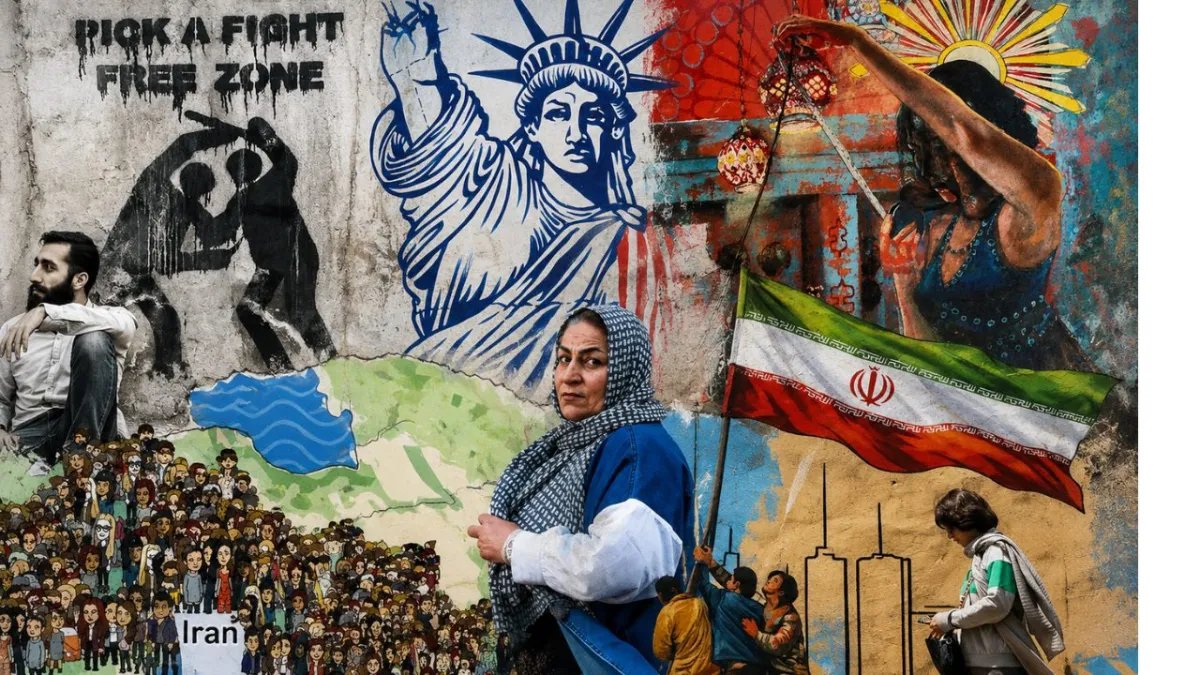
Despite fears of further military escalation dominating daily life, residents continue take up space, both in person and online. Night after night, they gather in public spaces, posting the evidence on social media.
In this process, many have turned to culture and the arts to show solidarity, and to encourage coming together during this uncertain time.
Battling crisis through community
It’s common for civilians living through conflict to seek community.
Ukrainian protesters met in public spaces following Russia’s 2014 invasion. New Yorkers assembled after September 11. And in the second world war, masses of Londoners gathered underground during the Blitz bombing campaign by Nazi Germany.
In moments of crisis, public visibility becomes a way to reclaim agency when all else feels precarious. In Iran, this response is taking shape across three interconnected layers: physical presence, cultural presence and digital presence.
Physical presence
The Iranian public has maintained a noticeable presence in streets, parks and public squares. What began as gatherings shaped by shock, mourning and uncertainty gradually evolved into a kind of ritual.
The significance of these gatherings goes beyond displays of courage. During wartime conflicts, empty streets can become symbols of fear, instability and social disruption.
Public presence, by contrast, communicates continuity. By remaining visible, citizens symbolically assert they have not completely surrendered to the logic of war.
For many, this isn’t necessarily about supporting a certain political system or leader. It’s about protecting the places, communities and relationships that define their lives.
Years of work, family histories and collective memory are threatened by this conflict. Remaining present is a way to defend these attachments.
In April, after US President Donald Trump threatened Iran’s critical infrastructure, musician Ali Ghamsari protested by travelling to the Damavand power plant and playing his music in front of the facility. Ghamsari’s image quickly became part of a broader conversation around civic responsibility.
We also saw the strength of mass physical presence demonstrated earlier in July, during the funeral ceremonies for Iran’s Supreme Leader Ayatollah Ali Khamenei. Tens of thousands of mourners gathered in Tehran in a major public display of collective mourning.
Cultural and artistic presence
Artists, musicians and cultural figures have played a key role in Iran’s collective response to the war.
Their participation helps instil a sense of belonging, while encouraging people to remain engaged with public life.
In this sense, art and culture function not only as entertainment, but as a form of social infrastructure connecting individuals with communities.
Music, poetry, religious chanting and visual art have all become ways to collectively process fear, grief and uncertainty – and explore broader questions of resilience and identity.
One example is the song Hasbi Allah by Iranian singer-songwriter Mohsen Chavoshi, with lyrics by Mehdi Abbasi.
This song draws on a long tradition of Iranian poetry, music and spirituality. It reflects on the human cost of war, mourning those who have suffered, while expressing attachment to the homeland.
Similarly, religious chants (maddahi) have become an important part of wartime gatherings.
Traditionally associated with mourning and collective remembrance in Shia Islam, these chants in a conflict context often combine religious symbolism with expressions of love for one’s country, and a willingness to sacrifice for it.
Some chants also draw on Iran’s broader cultural and historical imagination. Another video, for example, references figures such as Arash the Archer, or Arash-e Kamangir. This hero from Persian mythology is said to have sacrificed his life by shooting an arrow that defined the borders of Iran.
These performances create a bridge between religious devotion, historical memory, and national identity.
Digital presence
One of the most distinctive features of this conflict has been the emergence of AI-generated videos, memes and parody as vehicles for wartime storytelling.

Photo by rezasaad رضاصاد on Unsplash
Unlike the highly ideological, martyrdom-centred narratives in earlier eras of Iranian propaganda, much of this content adopts the language of contemporary internet culture.
One example is a series of AI-generated Lego animations that have gone viral, with some accumulating hundreds of millions of views. These videos recreate military events, while incorporating references to Iranian history and mythology and humour – often parodying Donald Trump and Israeli Prime Minister Benjamin Netanyahu.
Many are overlaid with English music and lyrics, which suggests they were designed to travel beyond Iranian audiences. Yet the creators behind them are largely anonymous.
We’ve also seen younger residents use irony, memes and pop culture references to communicate their feelings about the war.
For instance, the video below combines patriotic themes with playful visuals and self-aware humour. The rap repeats the line, “from us remain spirits that live on because they love the homeland”.
These examples reveal a significant shift in the language of wartime communication. Iranian citizens are no longer just audiences receiving official messaging. They are active participants in building narratives about the war.
Some of the most compelling stories of the conflict have emerged not from the battlefield, but from the people who refuse to watch along helplessly.
Hamideh Khaleghi Mohammadi, Lecturer in Media and Communications, University of Sydney and Ali Abbasi, Sessional Academic and Researcher in Media and Communications, University of Sydney
This article is republished from The Conversation under a Creative Commons license. Read the original article.
Editor’s Note: At a moment when the once vaunted model of responsible journalism is overwhelmingly the play thing of self-serving billionaires and their corporate scribes, alternatives of integrity are desperately needed, and ScheerPost is one of them. Please support our independent journalism by contributing to our online donation platform, Network for Good, or send a check to our new PO Box. We can’t thank you enough, and promise to keep bringing you this kind of vital news.
You can also make a donation to our PayPal or subscribe to our Patreon.
Please share this story and help us grow our network!
[ad_2]
Source link
