
[ad_1]

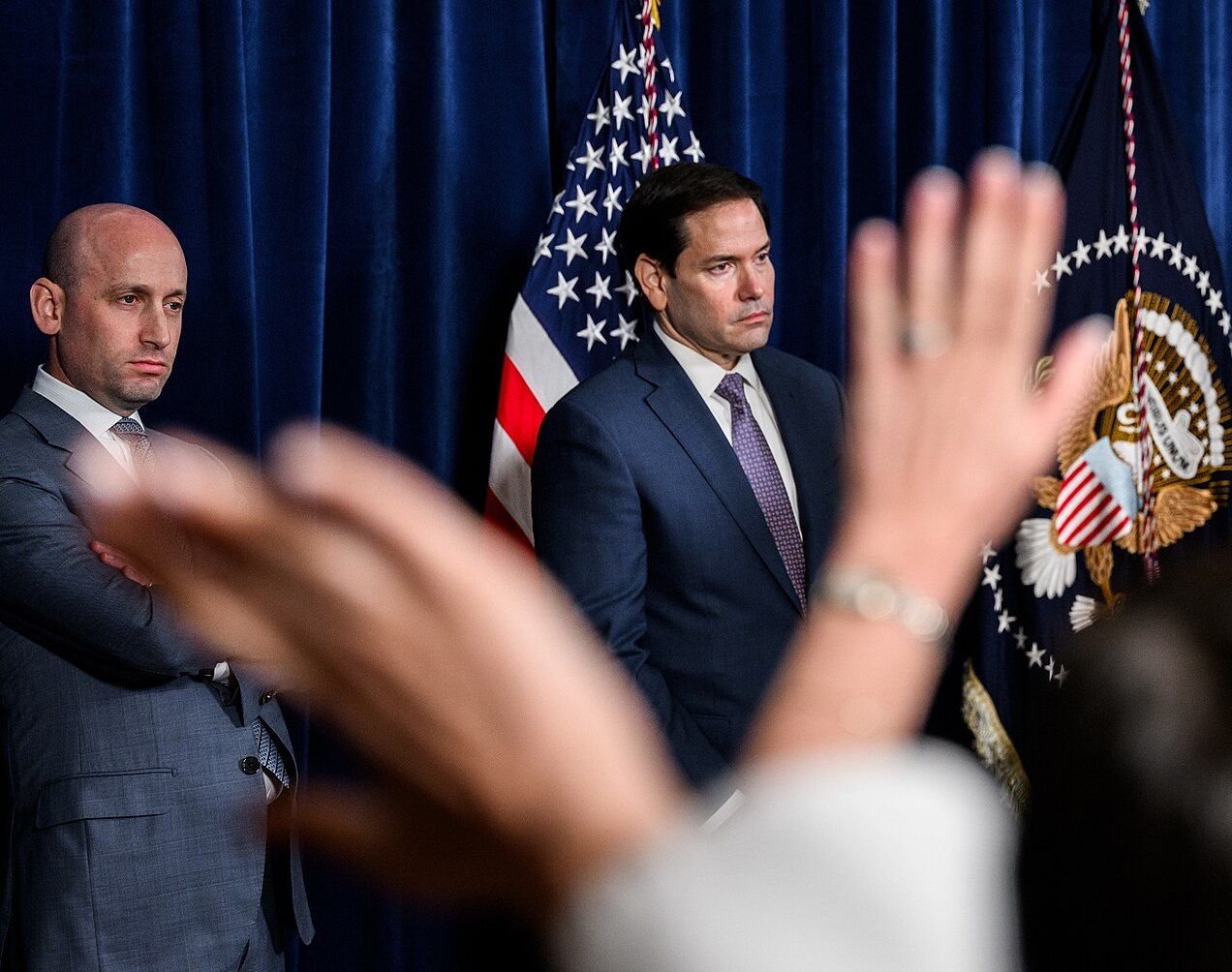
Photograph Source: The White House – Public Domain
On July 16, inside the Loy Henderson Conference Room at the U.S. State Department, Secretary of State Marco Rubio and White House Deputy Chief of Staff Stephen Miller stood before representatives of more than 60 countries and declared open season on the global left. Billed as a ministerial on the “resurgence of political terrorism,” the gathering was in reality the launch of a coordinated international campaign to criminalize dissent against U.S. imperial power and its most conspicuous contemporary project: the ongoing destruction of Gaza.
Israeli Foreign Minister Gideon Sa’ar was not merely present—he took the floor. Speaking directly to the assembled governments, Sa’ar declared that “terror groups have an operational alliance today with radical leftist elements in Western democracies, in Europe, in Latin America, in Africa, and beyond.” He accused activist networks of advancing the agendas of Hamas and Hezbollah under humanitarian and political cover, singled out the Global Sumud Flotilla as a supposed front operation, displayed photographs linking pro-Palestinian activists to Hamas and Hezbollah figures, and called on governments to dismantle organizations that provide “civilian cover” for terrorist objectives. “Israel is on the front line of this fight,” he concluded. “But this fight belongs to all democracies.”
Sa’ar’s intervention made the underlying logic of the summit unmistakable. The United States was internationalizing the repression of those who oppose the arming, funding, and diplomatic protection of Israel’s campaign in Gaza—and Israel’s own foreign minister was there to help write the script.
Rubio and Miller did not obscure their purpose. Rubio described leftists as driven by “poisonous resentment,” an “encroaching darkness,” and “enemies of civilization” who “despise the West because the West is great.” He vowed to “dismantle these networks brick by brick” and declared it “time to crush this evil forever.” Miller matched the rhetoric, portraying “the leftist” as motivated by “envy, by hatred, by jealousy”—a “cancer” that must be rooted out. Civil liberties concerns, he instructed the assembled governments, “must fall on deaf ears.”
This is not the language of sober counterterrorism. It is the language of an imperial order that can no longer tolerate the exposure of its own violence. American exceptionalism has always required the conversion of resistance into existential threat. What is new is the explicit internationalization of that conversion under the banner of “far-left terrorism,” with Palestinian solidarity placed at the center of the net—and with Israel’s foreign minister actively promoting the “operational alliance” thesis that equates solidarity with terrorism.
Targeting Palestinian Solidarity as Imperial Enforcement
Administration materials and related designations have repeatedly highlighted supposed “convergences” between far-left networks and “pro-Iranian and antisemitic” elements. Sa’ar’s speech simply made the equation official. The language is deliberately elastic. It is designed to sweep in activists opposing U.S.-backed operations in Gaza, those organizing against arms shipments, those participating in boycott campaigns, and those who simply name the systematic destruction of Palestinian life for what it is. Economic sabotage, protest, and speech critical of Israel or of U.S. complicity are being reframed as potential support for designated terrorist networks.
This is the classic imperial move: the power that arms, funds, and diplomatically shields the destruction of a people then criminalizes those who document and resist that destruction. The administration has already designated European Antifa groups, including Germany’s Antifa Ost, as Foreign Terrorist Organizations. It has rolled out new visa restrictions targeting “Far-Left Terrorist and other aligned groups.” National Security Presidential Memorandum 7 supplies the domestic blueprint for disruption, defunding, and prosecution. The July 16 summit internationalizes the machinery — with Sa’ar’s presence and remarks confirming that the special relationship is not a passive beneficiary but an active partner in the project.
European Partners and the Limits of the Coalition
Italy sent Parliamentary Undersecretary for the Interior Nicola Molteni. The decision was a political compromise pushed by Meloni herself despite internal reluctance at the Foreign Ministry and recent public tensions with Trump—including the G7 photo spat in which Trump claimed Meloni had “begged” him for a picture, disputes over the use of Italian military bases, and a series of personal barbs that strained their once-close relationship. Sending a mid-level political representative allowed Meloni to keep a seat at the table while managing domestic and diplomatic fallout.
Germany is treated by the Trump administration as a key partner. Rubio specifically highlighted rising far-left violence in Germany (citing a more than 40 percent increase) and announced that the next U.S. counter-terrorism workshop would be co-organized with Germany. Antifa Ost, one of the groups previously designated, is German-based. Berlin’s security establishment is being courted as a central European pillar of the initiative.
The United Kingdom was invited, but public reporting has not clearly identified a high-level delegate. At the time of the July 16 summit the UK was in the final days of a leadership transition: Keir Starmer was still formally in office, and Andy Burnham would not take over as Prime Minister until July 20. The relative absence of a prominent British presence is therefore best understood as a product of that domestic political interregnum rather than a settled policy stance.
These European connections reveal both the ambition and the fragility of the project. Some invited nations recoiled at the heavy-handed focus. European diplomats expressed confusion about the threat inflation. The architecture is being built nonetheless—now with the explicit participation and rhetorical leadership of the Israeli foreign minister.
Historical Precedents: The Red Scare as Imperial Technique
What we are witnessing is not new. It follows a well-worn American pattern.
The First Red Scare (1917–1920) erupted after the Bolshevik Revolution and a wave of anarchist bombings. Attorney General A. Mitchell Palmer launched mass raids that swept up thousands of immigrants, socialists, and labor organizers—far beyond those involved in actual violence. The Espionage and Sedition Acts criminalized dissent. Deportations and warrantless arrests became routine. The scare collapsed under the weight of its own excesses, but not before establishing the template: convert specific threats into an existential ideological menace, then expand state power accordingly.
The Second Red Scare / McCarthyism (late 1940s–mid-1950s) refined the model. Real Soviet espionage existed, yet it was inflated into a sweeping purge. Loyalty oaths, blacklists, HUAC hearings, and guilt by association destroyed careers across government, universities, Hollywood, and the labor movement. “Fellow traveler” became a weapon. Internationalist causes and left-wing associations were treated as evidence of disloyalty. The machinery only receded after McCarthy’s overreach discredited the project—but the institutional scars remained.
Common patterns are unmistakable and highly relevant today:
• Amplification of limited threats into civilizational ones
• Broadening of targets from violent actors to entire political traditions and their “aligned” supporters
• Dehumanizing language that pathologizes the left
• Internationalization of the threat (Bolshevism then; “transnational far-left terrorism” and alleged foreign convergences now)
• Use of administrative and legal tools to bypass normal democratic constraints
Rubio and Miller’s rhetoric—“enemies of civilization,” “cancer,” “poisonous resentment”—fits squarely within this tradition. Sa’ar’s claim of an “operational alliance” between the radical left and terrorist organizations simply updates the “fellow traveler” charge for the Gaza era. The addition of Palestinian solidarity as a core target, now endorsed from the podium by Israel’s foreign minister, mirrors earlier red-scare efforts to criminalize internationalist and anti-imperialist solidarity. The recruitment of foreign governments to share intelligence and enforce designations is the latest evolution of the same playbook, refined for an era in which U.S. power is increasingly naked in its defense of Israeli military dominance.
Exceptionalism as Justification for Impunity
American exceptionalism has always rested on a double claim: that the United States and its allies represent the highest expression of civilization, and that any force which challenges that claim is therefore not political but pathological. Rubio’s assertion that leftists “despise the West because the West is great” is the purest distillation of this logic. It erases the actual historical record — slavery, indigenous genocide, imperial wars, coups, sanctions regimes, and the current arming and diplomatic protection of Israel’s genocidal campaign in Gaza — and replaces it with a moral fairy tale in which resistance itself is the crime.
By recruiting governments into this framework, and by giving Israel’s foreign minister a platform to equate solidarity with terrorism, Rubio and Miller are attempting to build a selective international of the right, a 4th Reich: one that coordinates surveillance, financial warfare, travel bans, and prosecutions across borders to crush movements that name and oppose the imperial order. Palestinian solidarity is not collateral damage. It is a central target, because the Gaza genocide and ethnic cleansing of all of occupied Palestine has become one of the clearest contemporary demonstrations of what U.S. power is willing to underwrite.
History is littered with warnings about where this leads. Once the category of “aligned” threats expands to include solidarity movements, student activists, journalists, and NGOs, the machinery rarely stops at the margins. Some invited nations recoiled. European diplomats expressed confusion about the threat inflation. Yet the project advances, even as cracks show in relationships like the Trump–Meloni feud. This is the early architecture of authoritarian internationalism in the service of empire — extreme-right zealots in Washington partnering with the Israeli state itself to globalize their domestic culture war and the protection of U.S.–Israeli strategic interests.
Rubio, Miller, and Sa’ar have made their intentions unmistakable. They are not defending the West from terrorism. They are leading a campaign to criminalize the global left, from antifascist streets to Palestinian solidarity campaigns, under the banner of civilization itself. They are following a path well-marked by previous red scares and refined for the needs of a declining but still lethal empire.
The left — and all who value genuine democratic freedoms and the elementary right of a people not to be erased — must recognize this for what it is: a dangerous escalation in the ongoing struggle against state repression. The battle lines are drawn. The question is whether this international crusade will be allowed to consolidate unchecked.
[ad_2]
Source link
