
[ad_1]

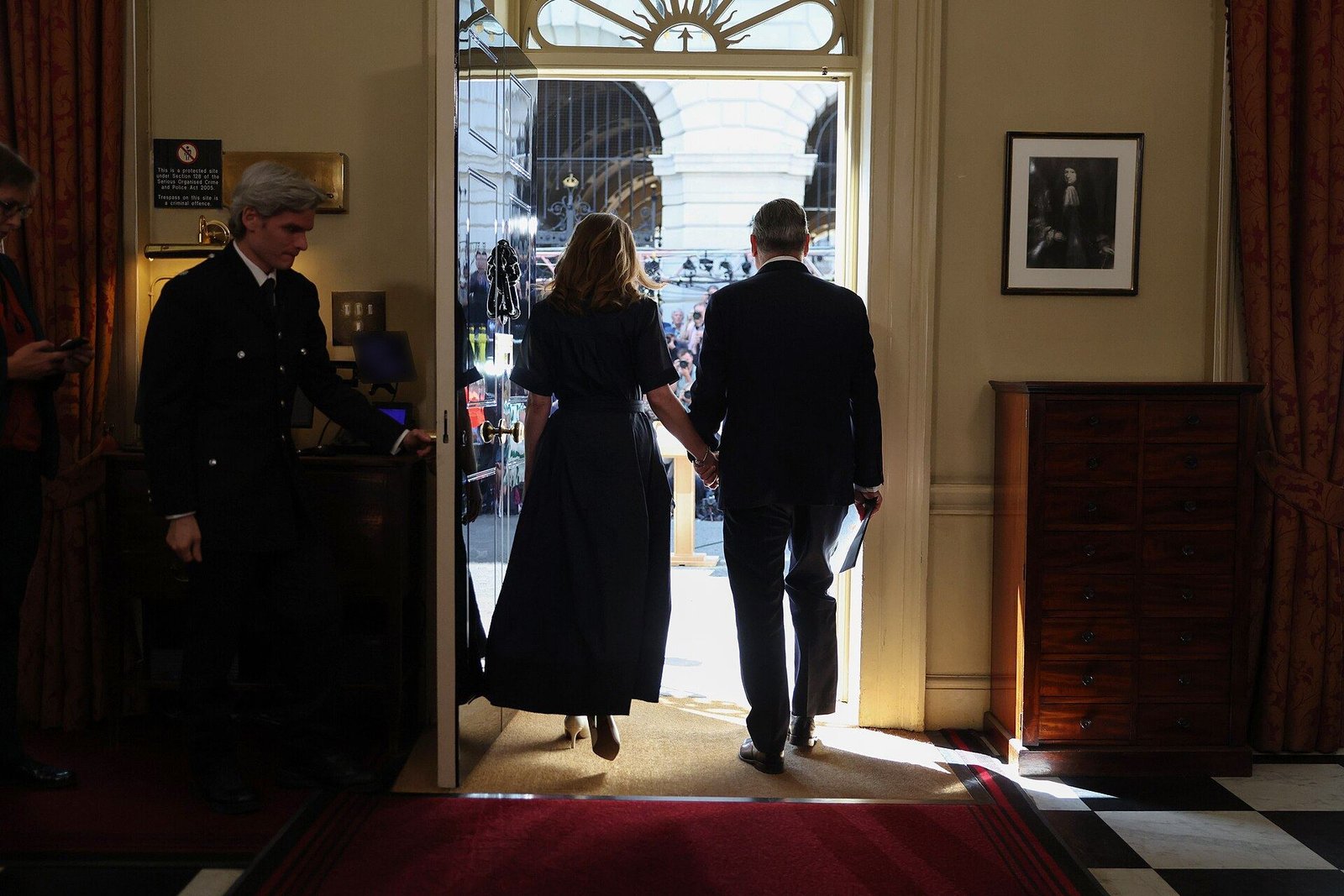
Photograph Source: Simon Dawson / No 10 Downing Street – OGL 3
As Keir Starmer left British politics, with the last of the summer light catching his spectacles, I found myself wondering what comes next. Perhaps a pint of his favoured IPA (India Pale Ale) while reading about his beloved Arsenal in Isaac Khan’s forthcoming “22 Years: The Inside Story of Arsenal’s Title-Winning Season”? Or a secluded family holiday in France where he has already been so feted? Politics teaches us that getting into office is everything. Win Downing Street, occupy the White House, enter the Élysée—and the story is complete. Yet history tells us something else. For a handful of leaders, the significant moment comes after they leave.
Westminster, meanwhile, has already begun speculating about Starmer’s future, with chatter that he could end up at the United Nations, although one trade union figure I spoke to dismissed this with a wave of the hand. Another rumour imagined Starmer returning as Foreign Secretary. Few politicians achieve an impressive second act. Nelson Mandela may be the greatest exception. After serving as South Africa’s president following 27 years in prison, his stature only increased. Freed from the strictures of office, he emerged as the closest thing to universal moral authority, though his pursuit of peace came at the expense of deeper economic justice. He spoke openly about HIV/AIDS when many shied away from the subject. He quietly mediated conflicts across Africa. Through the Nelson Mandela Foundation he built an institution to carry those ideals forward, whatever disagreements remained over how they should be interpreted. Above all, he became the living embodiment of reconciliation and forgiveness—those two golden words that sound almost unfathomable today but which, in Mandela’s latter years, briefly felt like the future.
Jimmy Carter left the White House under a cloud of criticism, his presidency widely regarded as uneven. Jeffrey St. Clair of this parish has repeatedly and successfully returned to the argument that Carter helped lay the groundwork for decades of conflict in Afghanistan. Yet what followed may have become one of the most remarkable political turnarounds in modern history. Through the Carter Center, he devoted decades to election monitoring. The organisation monitored more than a hundred elections across the globe. He championed public health, helping drive Guinea worm disease to the brink of eradication, and continued to throw himself into conflict resolution—while Afghanistan burned—and humanitarian work. The Nobel Peace Prize followed, by then almost a formality. Carter had already redefined what an ex-president could be seen as—less retired politician than global public servant.
Starmer has never shown any of Carter’s missionary appetite, but politics has a habit of surprising us. For a British prime minister, the nearest precedent may be Tony Blair. His post-Downing Street career—largely through the Tony Blair Institute—demonstrates both the possibilities and the pitfalls of life after office. He may somehow have remained influential, but he never escaped the shadow of Iraq, a reminder that reputations made in office place tough limits on what can follow. His institute extended his reach, but not his absolution. Gordon Brown, by contrast, found renewed purpose through global education and development campaigns, showing that influence after office need not depend on returning to frontline politics.
Measured against Mandela and Carter, Starmer is a much more modest figure: diligent and serious, but hardly cut from the same cloth. His recent work in Ukraine could offer us some clues. (“I believe Ukraine will win this war,” he said on his final visit.) A more plausible comparison might be Mary Robinson—though one wonders how Starmer’s deference to Israel over Gaza would have played with her. (“I am sorry for that,” Starmer’s successor, Andy Burnham, has freshly stated about Gaza.) As President of Ireland, Robinson transformed what had often been a largely ceremonial office into something warmer and more outward-looking. Yet it was after leaving Dublin that her influence truly flourished. As United Nations High Commissioner for Human Rights, and later as one of the world’s leading voices on climate justice, she built institutions, convened world leaders, and helped shape international debates in ways that arguably surpassed her achievements as president. Unlike Mandela or Carter, her authority rested less on heroic biography than on the credibility she gathered through decades of work after office—a reminder that a moral compass can be created as well as inherited. If Starmer is to have a second act, it is likely to resemble Robinson’s more than Mandela’s—not heroic, but institutional.
Could Starmer find encouragement in Mikhail Gorbachev? The former Soviet leader’s defining achievements—the reforms of perestroika and glasnost and his role in ending the Cold War—came while still in office. Yet retirement hardly diminished his stomach for public life. Through the Gorbachev Foundation he continued to champion political reform, campaign for nuclear disarmament, and promote environmental causes. Outside Russia, his reputation remained exceptionally high. Inside, it never really recovered because many blamed him for the Soviet Union’s collapse and the economic turmoil that followed. His reputation also showed that a foundation can sustain a leader’s voice, but it cannot rewrite what was achieved in power.
José Mujica of Uruguay offers the most intriguing case. The famously frugal former president, who drove a battered Volkswagen Beetle—perhaps listening to his favourite tango, “Volver” by Carlos Gardel and Alfredo Le Pera—and spoke with disarming honesty about politics and human nature, never sought to build a personal foundation or institute. Instead, after leaving office he became a global public philosopher. He reached far beyond Uruguay, while his austere lifestyle lent rare credibility to arguments about consumption, democracy and happiness. Unlike Carter or Mandela, his influence rested on simple force of character, suggesting that authenticity itself can become a stage.
Of course, history more often supplies the opposite. For every Carter there is a Richard Nixon, whose attempts to rehabilitate himself as a foreign-policy statesman never quite escaped the shadow of Watergate. Boris Yeltsin spent his final years marked by ill health and seclusion, while his legacy became increasingly messed up with economic turmoil and the rise of Vladimir Putin. Others simply fade into irrelevance, discovering that authority can be borrowed from office, but moral stature cannot.
If there is a single benchmark for Starmer, it is probably Carter. Few former leaders have so completely rewritten the verdict on their public lives. Although his presidency was widely regarded as a disappointment, his decades beyond it were not.
Whether Starmer possesses either the appetite or the temperament for such a transformation remains impossible to know. Many would doubt it. “Put it like this,” artist Matthew Radford told me recently, “I wouldn’t want him as my lawyer.” The real test of political greatness may not be how leaders acquire power, but what they do once they no longer need it.
The post Turn and Face the Change appeared first on CounterPunch.org.
[ad_2]
Source link
