
[ad_1]

Factsheet
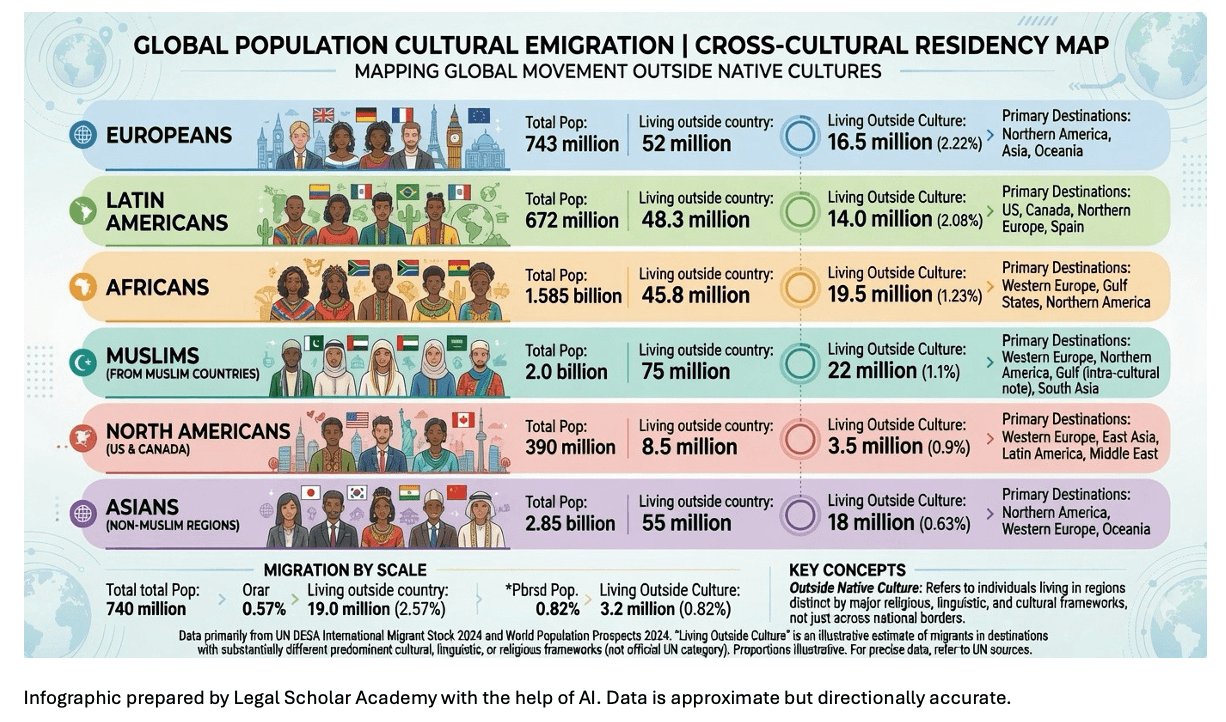
The infographic identifies four broad patterns of global migration, providing a critical factsheet in support of the thesis that migration is a transfer of human capital from one country to another—an asset primed to become scarce and drive the coming global competition among nations.
First, contrary to popular perception, cross-cultural migration is remarkably rare. Although hundreds of millions migrate internationally, the vast majority remain within their own continent or cultural sphere. Only about one percent of humanity lives outside its broader cultural zone. Africa and non-Muslim Asia illustrate this pattern particularly well. Africans, numbering over 1.5 billion, move primarily within Africa, with only 19 million (1.2% of total population) having migrated to non-African countries. Likewise, non-Muslim Asians, with a combined population of 2.85 billion, live mostly in their home countries or move to other Asian countries, with only 18 million (0.63% of total population) residing in non-Asian countries.
Second, Europeans and Latin Americans stand out as the groups with the highest percentages of their populations migrating beyond their home continents. Of Europe’s 743 million people, 52 million live outside their home country, and 16 million live outside Europe, making them the largest group by percentage of the total population (2.22% TP) living outside their continent. Latin Americans, including those from the Caribbean, migrate primarily to other countries on the continent. 14 million (2.08% TP) migrate to North America, Spain, and Northern Europe.
Third, Muslims, with a global population of 2.0 billion, make up the largest number of international migrants in absolute terms, at 75 million. (This substantial outflow may stem in part from conflicts in Palestine, Syria, Lebanon, Iraq, Libya, and Sudan.) However, most Muslim migration occurs to other Muslim countries. Only 22 million (1.1% TP) Muslims migrate to non-Muslim countries, including Western Europe and North America. As a percentage of total population, Muslims migrating to non-Muslim countries (1.1%) represent roughly half the rate of Europeans migrating outside Europe (2.22%).
Fourth, migration is not a phenomenon unique to economically needier regions. Residents of wealthy societies also seek opportunities, lifestyles, and relationships abroad, illustrating that migration is a worldwide human behavior rather than a one-way flow to rich countries. While many migrants aspire to reach North America, the infographic also reveals that North Americans themselves engage in significant outward migration. Like other populations, nearly 1% of North Americans (3.5 million) migrate to other continents, including Western Europe, East Asia, Latin America, and the Middle East.
After accounting for intra- and intercontinental migration, it is noteworthy that more than 96% of the global population remains in the place where they were born and raised. This statistic suggests that people prefer to live with their families in countries where they can practice their religion, follow their culture, speak their language, and be honored and respected. People do wish to travel as tourists, but permanent migration is not their preferred way of life, even if socioeconomic conditions at home are harsh.
Even with high global economic inequality, human migration is far from liquid; it is closely tied to identity, dignity, and belonging. Human societies are built through intergenerational stability; migration remains the exception rather than the rule. The infographic patterns reveal a simple yet profound human reality: people do not disperse randomly across the globe; they move reluctantly and selectively. Yet the movement of people across borders is the movement of capital.
The migration patterns described above point toward a larger economic reality. Every migrant represents not merely the movement of a person across national borders but the transfer of a productive asset. That reality will shape the next great competition among nations: the demand for human capital.
Human Capital
The greatest asset humanity has ever produced is not agriculture, factories, computers, or artificial intelligence, but the human being ─ the creator of crafts, arts, sciences, and technology, and the master producer of secondary assets. The twenty-first century will soon make this truth increasingly difficult to ignore. The human population is peaking, and it is unlikely to rise dramatically beyond 10 billion, if it reaches that mark. The fertility rate in scores of countries, including India and China, which together account for 35% of the world population, is declining. In some developed countries in Europe and elsewhere, fertility has fallen below the replacement rate needed to maintain their existing population size.
Economics has long studied competition for scarce resources. Soon, humans will be the most sought-after asset everywhere, and nations will compete for them, offering more than just residency or work visas. It will be the migrants’ market.
As the value of human capital becomes evident, history will remember the practice of forced deportation, which often separates children from their parents, in the same way it remembers the forced enslavement of people, which tore families apart. In the twenty-first century, for example, the United States, the number one recipient of migrants, is repeating a dark historical pattern: just as its seventeenth-century conduct featured the forced importation of enslaved labor, its present era is marked by the forced deportation of migrants.
History will also remember overloaded migrant boats, overflowing with adult men and women ready to work, drifting near the shores, but there were no takers. Some vessels broke apart, drowning their human capital, like a ship carrying gold sinking. These scenes will be remembered not merely as cruelty but as the story of a time when countries were shortsighted, failing to see the value of human capital, just as they failed to see the value of solar energy, migratory birds, or all the precious species that constitute the planet’s wealth.
These historical dynamics will change as nations recognize the value of the human capital they have developed with limited resources. Rather than continuing to supply talent and raw labor freely to other countries that offer neither gratitude nor fair treatment, these nations will increasingly retain and protect their people, demanding respect for the migrants who contribute substantially to host economies.
Coming Reversal
If a world without sovereign borders is a distant goal, the immediate future points toward a free yet highly contested movement of human capital. However, human capital will no longer be available for free. Migrants will enjoy far greater choices than they do now, making the reversal of current migration patterns increasingly inevitable.
For too long, recipient states have received human capital without any compensation. Sending states will realize that by letting their adults migrate to another country, they are losing their investments. It takes resources to develop a child into an adult, and even more resources to make that adult into a skilled worker, engineer, or physician. The sending state bears all these developmental costs. Transferring this human capital for free to a recipient country is a transactional folly: remittances from these migrants, if any, and even when substantial, rarely offset the development costs, let alone the opportunity cost of retaining skilled workers domestically. This inequity is the great scandal of migration.
Even to secure a better deal for free human capital, recipient states increasingly use immigration filters to select skilled, healthy, and productive migrants. Yet even after admission, many migrants face discrimination and unequal treatment despite contributing substantially to the host economy. This contradiction illustrates the persistent undervaluation of human capital. Recipient states resent illegal immigration primarily because they cannot assess migrants’ potential productivity. Yet everybody who works, regardless of the job, creates wealth, a point I have made in other publications.
As prosperity spreads across nations in Asia, Africa, and Latin America, economies will offer far more incentives than those in the current recipient states. The two largest countries supplying human capital have been India and China, which are rapidly developing and poised to become among the top three economies in the world. Smaller nations, once they begin to develop, as they will, will have fewer residents wishing to migrate to unfamiliar cultures.
The assumption that a sending state simply lacks the capacity to retain workers reflects a paucity of imagination regarding how to productively employ its own people. The challenge is not to facilitate the export of workers but to create opportunities at home. Nations prosper by cultivating entrepreneurship that generates employment rather than relying primarily on a job-seeking culture. Not everyone will become an entrepreneur, but every successful economy encourages entrepreneurship at every scale. In the emerging global economy, attracting and retaining human capital will become central to national strategy.
Retention State
A few centuries earlier, there was a rush for gold; then came the age of the colonies, then the age of oil. The new era will have no choice but to value human capital, for it, too, has become scarce like gold and oil, in fact, much more so. The demand for human capital will give rise to what might be called the retention state, a state that makes a great effort to retain its workers at home, learning from the historical experience that an outright ban on the movement of human capital, tried in the Soviet Union, does not work. Policies to value human capital are likely to be much more sophisticated and humane.
The retention state benefits inherently because, as the infographic demonstrates, most people prefer to live with dignity within their own cultures and families. Migration is rarely their first choice. However, the retention state will have to do much more than merely rely on people’s sentiments to remain where they were born.
Here are a few things the retention state will likely do. First, the retention state rejects the cynical view of its citizens as exportable commodities destined merely to generate foreign remittances that subsidize imported comforts for ruling elites. Second, it will offer solid inducements, such as service-based scholarships, tax incentives, start-up grants, affordable housing, and health care. These measures are additional investments in human capital that strengthen the ties between the state and the people. The paramount concern for the retention state will be how many citizens it can afford to lose.
The retention state will judge its performance not only by its gross domestic product (GDP) but also by its net human capital gain or loss. Its entrepreneurs, scientists, engineers, physicians, and skilled workers will become as valuable as, if not more valuable than, its natural resources. If the retention state fails the population replacement test, its need to attract and retain migrants may become as vital as its need for energy or food security. Likewise, a state that resorts to intense inequality based on race, religion, ethnicity, or national origin will struggle to attract and retain the human capital it needs to prosper. The retention state must therefore pursue a far more demanding course than the conventional recipient state.
Political labels, such as the “heritage people” and “new arrivals” – odious terms popularized by some quarters in the United States to distinguish old European arrivals from recent migrants and their descendants, are incompatible with the spirit of equal citizenship. Such labels can never be the language of a retention state.
As with other things, some states will use unlawful means to acquire human capital, as they do with natural resources. Even the best human projects sometimes fail because predatory states refuse to play by the rules and assert their dominance or pursue acquisitions through force. This inherent flaw among some states poses the greatest threat to the retention of militarily weak states. However, just as a nation protects its waters, skies, and land, it will protect its human capital from unlawful seizure. Ideally, international law should be made more effective at enabling states to retain their human capital without facing or resorting to force or economic sanctions. Just as the national security state protects territory, the retention state protects the nation’s human capital.
Conclusion
The empirical patterns in the infographic are clear: more than 96 percent of humanity still lives in the country of birth, reflecting a profound preference for cultural familiarity, familial bonds, linguistic continuity, and communal dignity. Permanent migration across cultural spheres remains the exception rather than the rule, even amid significant global economic disparities. Yet the movement of even a small fraction of the population constitutes a transfer of human capital, the scarcest and most valuable asset of the twenty-first century.
For decades, a few recipient states in the Gulf, Western Europe, and North America have benefited from free human capital developed at the expense of sending societies, often without adequate recognition or compensation, while subjecting many migrants to discrimination, family separation, and ill-treatment. This inequity cannot endure. As economic development spreads across Asia, Africa, and Latin America, sending nations will increasingly become retention states, investing in domestic opportunities and viewing their people not as export commodities but as sovereign assets deserving stewardship. The competition for human capital will intensify, echoing historical struggles over gold, colonies, and oil, yet with far greater moral and civilizational stakes.
Nations may resort to coercive measures, such as draconian emigration bans or predatory acquisition of human capital, but history warns against such shortsightedness. A more humane and sustainable path is to recognize human capital as a shared global asset. Through principled international frameworks grounded in equity, dignity, and mutual respect, states can transform this emerging competition into cooperative mechanisms that honor individual agency and advance cooperative prosperity. Ultimately, the true measure of a nation’s success will be its ability to cultivate, retain, and engage its greatest resource fairly: its own people and migrants who choose to contribute without coercion.
The nineteenth century fought over territory. The twentieth century fought over oil. The twenty-first century will compete for people. Nations that grasp this transformation early will flourish, whereas those that persist in treating their citizens as expendable exports will gradually impoverish themselves, regardless of the resources beneath their soil.
[ad_2]
Source link
