
[ad_1]

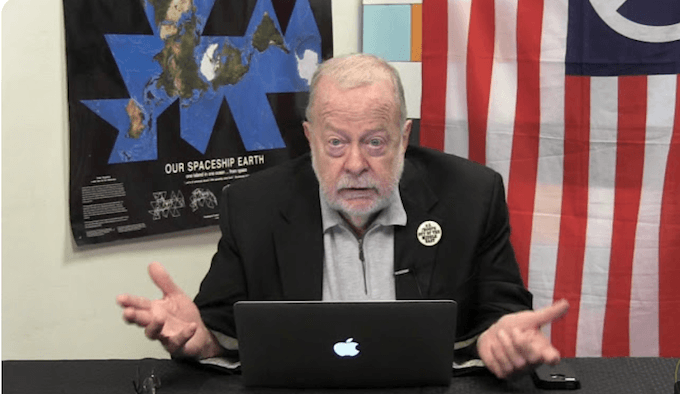
Carl Estabrook delivering the News From Neptune from the studio in Urbana, Illinois.
When I think of my friend Carl Estabrook, as I often have in the weeks since he died, I see someone who was fully engaged with life. Almost every aspect of life mattered to Carl, was worthy of being experienced, observed, analyzed, discussed and debated. He had a roving mind and an unchained spirit. There was nothing dour about him. He was witty and charming and empathetic. He also knew who the enemies of life were, the people and institutions who profited from inflicting pain on others and he didn’t hesitate to call them out. In other words, he had the courage of his conscience. He put what he believed into practice.
Carl spoke his mind. He believed everyone should and defended their right to do so, whatever they said. Speaking his mind often got Carl in trouble, as it tends to do when you speak your mind about the things that really matter in life: politics, art, education, war, capitalism and religion. So his stints at the universities where he taught tended to be fractious and abbreviated: Notre Dame, Brown, Rochester, Stonehill and Illinois. Still, he left his mark at all of them. The best teachers I’ve had challenged both their students and their colleagues and administrators. Carl was one of them. I didn’t take any of his classes, but I learned from his writing, his public speeches, debates, and private chats. He taught me how to see old disputes in new ways. His analysis pierced through the corrupting cant of political speech to the core truths hidden beneath.
Carl saw through both political parties, but he didn’t give up on politics as a means of organizing people to make their lives better. No matter how bleak the circumstances, he didn’t surrender to fatalism. He admired Ralph Nader and Jesse Jackson’s campaigns and saw the value, when many progressives couldn’t, in Ron Paul’s anti-war crusades. In 2004, Carl ran for Congress as a Green and garnered a respectable four percent of the vote. Four years later, having seen Obama up close in Illinois, he didn’t fall for the hope and change rhetoric and he soon became one of the most astute and acerbic critics of Obama’s dismal presidency.
He was a free speech absolutist. He went so far as to defend the Supreme Court’s Citizens United decision on First Amendment grounds. I disagreed with him vehemently, but I knew there was a consistency to Carl’s argument, that it was well-reasoned, logical, even irrefutable within his frame of moral reference. When CounterPunch was caught up in the RussiaGate hysteria for publishing a few pieces by someone under the pen name “Alice Donovan,” Carl’s advice was adamant: “Don’t back down. Don’t apologize. Publish whomever and whatever you want. It’s none of their business.” If I’d taken it, I’d probably saved ourselves a lot of unnecessary trouble and distraction.
Carl was a militant civil libertarian who abhorred bigotry in all of its guises, especially towards outsider sects often despised by liberals. He enjoyed puncturing the hypocrisy of censors and cultural scolds and once defended a polygamist Mormon community against media and legal persecution with such vigor I was tempted to write an amicus brief in their defense.
Three key people shaped Carl’s thinking and he thought deeply about almost everything, including the ups-and-downs of the NFL team in Washington–the Catholic philosopher and theologian Herbert McCabe, Noam Chomsky and his wife of 62 years, Leigh, the former dean of the University of Illinois’ School of Information Sciences. By one of those strange twists of fate that Thomas Pynchon called a Kute Korrespondance, my wife, Kimberly, was one of Leigh’s graduate students, though it took a while for any of us to realize the connection.
Carl took his Catholicism seriously, in the same way the Catholic Workers and Liberation Theologians did. He wanted his church to live up to its ideals. He certainly did. Carl was pro-life, which meant that he was anti-war, against the death penalty and anti-abortion. He ministered to the poor, the hungry and the abandoned. His views on abortion conflicted with mine and alienated some of his political and academic allies. But it was honestly held and consistent with the philosophy by which he lived his life. Carl explained his positions clearly and firmly, which is all you can ask for and more than you usually get.
Carl’s weekly political radio show was called the News from Neptune. The title was a tribute to Chomsky, whose method of political analysis the columnist Jeff Greenfield had once derisively described as coming from “Planet Neptune.” The news may sound like it’s coming from Neptune, but it accurately described the corrupted state of the American Empire in late capitalism. I was happy to publish Carl’s political writings under the same banner on CounterPunch for many years. The analysis was sharp and fresh and to the point. Carl was a contrarian, but not in the performative sense of Christopher Hitchens, which led him to help plot bombing raids in the Bush Executive Office Building. Carl’s contrariness cut through political propaganda to get you closer to the reality of what was really going on. He often got you uncomfortably close, which is what the best political analysis and journalism must do, especially in times of economic privation, forever wars and state terror.
Carl was an actor in a local theater company where he played Prospero in “The Tempest,” a play written by Edward de Vere, the Earl of Oxford, or so he argued with vigor and good humor. I’m a Marlowe man, myself and we had fun debating the relative merits of both as the real author of the plays attributed to the Bard of Stratford, neither of us giving an inch of ground. He deeply admired the writing of Samuel Beckett, especially Beckett’s plays, and I consulted him on my parody of Endgame, which serves as the concluding chapter of my book on Bernie Sanders.
He read widely and voraciously: history, philosophy, theology, psychology, drama, poetry, novels. There was rarely a book I’d read that Carl hadn’t. I tried to take him by surprise, but rarely succeeded. More often he was introducing me to books and writers I hadn’t read. His belief in the power and potency of poems and poets was such that he co-hosted a weekly poetry radio show, which he lured me into appearing on a couple of times. I remember reciting and mangling the meter of Keats’s magnificent poem “To Autumn,” followed by a lively discussion about its radical subtext as a critique of the anti-gleaning laws enacted by the landed British gentry. I quickly found he knew more about those grim episodes of English history than I did. So I sat back, listened and learned.
In our last email conversation, a few weeks before he died, Carl asked what I’d been reading for fun and I told him I’d spent the last four months reading Proust’s In Search of Lost Time, if not for fun, then out of obligation, since Proust had spent the time to write. Carl replied: “As I lack your industry, I will probably leave Proust forever unread: but you’re an encouragement to do otherwise… I will at least get back to reading all the manifestations of CounterPunch.” That’s a friend, a friend I’ll deeply miss.
Now, a couple of weeks after his passing, I come back to the fearless engagement Carl had with life: embracing its preciousness, defending its vitality among the weak, the infirm, the marginalized and dispossessed among us. Seeing each life as inviolate as any other was the essence of Carl’s life work. It’s the way he lived. The way he treated and cared for his family, his friends, his colleagues, his neighbors and fellow parishioners. When I think of Carl today, I’m reminded of a poem by DH Lawrence called “We Are the Transmitters,” where Lawrence writes: “And if, as we work, we can transmit life into our work, life, still more life, rushes into us to compensate, to be ready and we ripple with life through the days.” The ripples of Carl Estabrook’s life don’t stop with him; they carry on, they continue to transmit…
[ad_2]
Source link
