
Shortly after the Trump administration announced massive new tariffs on some Canadian imports on Monday, the White House’s official X account made a telling statement about the policy.
“Canada imposed an unfair tariff scheme on American cars,” the post explained, before claiming that the tariffs had caused fewer cars to be imported into Canada and had been costly for American automakers.
“President Trump won’t put up with Canada’s trade schemes,” it concluded.
Yes, if there is one thing Donald Trump simply cannot stand, it is arbitrary, costly, protectionist trade policies.
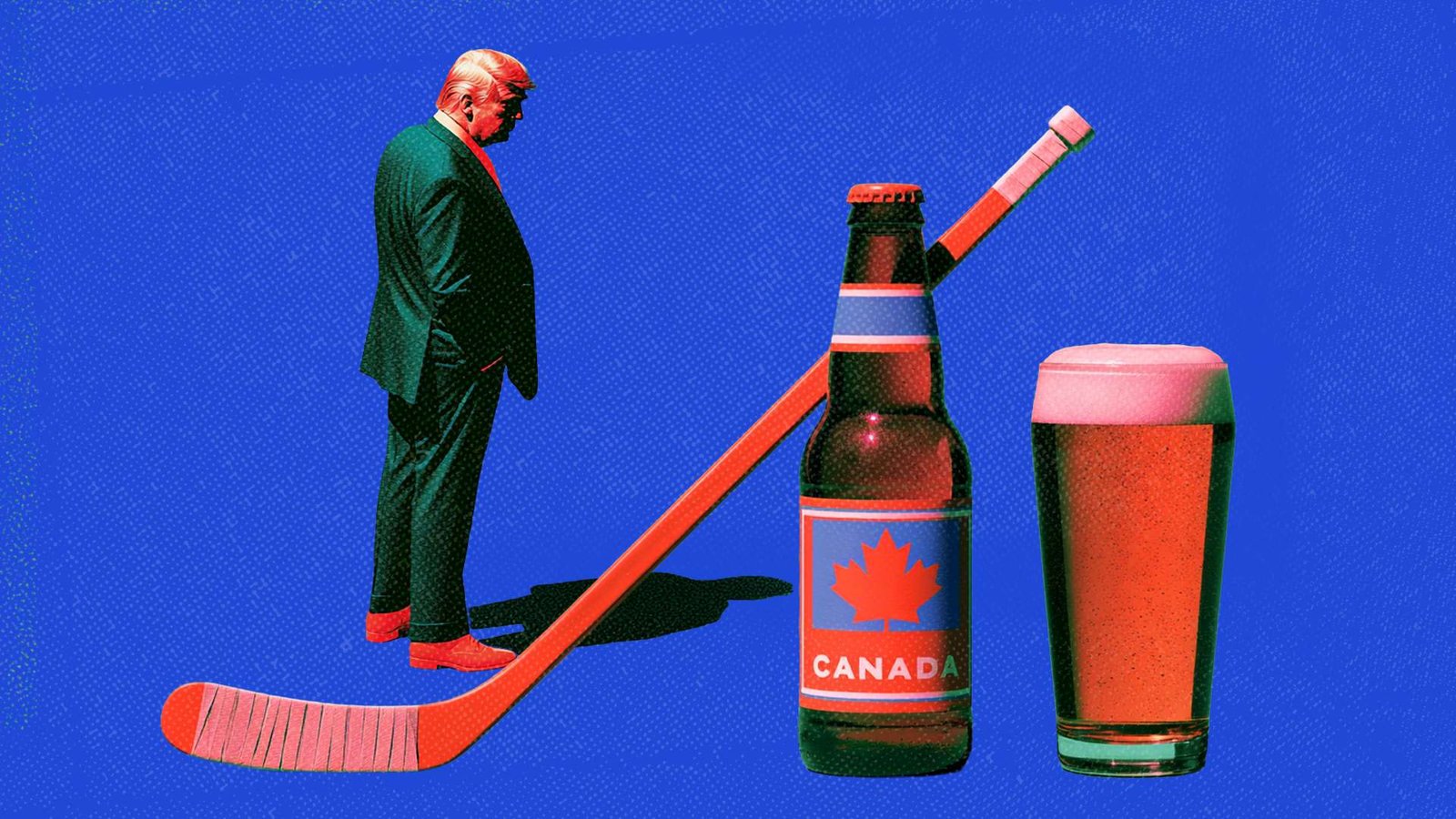
In response, Trump imposed some arbitrary, costly, and protectionist measures. The new 50 percent tariffs will target a mishmash of Canadian cultural goods like beer, whisky, and hockey sticks (yes, really). The tariffs will cover over $20 billion worth of annual imports, about 2 percent of all U.S.-Canada trade last year, according to The New York Times. They will apply to many items that are supposed to be covered by the United States-Mexico-Canada Agreement (USMCA), which Trump negotiated during his first term but has recently tried to tear up.
Even by the standards of Trump’s second term—which once included the attempt to place tariffs on an island inhabited only by penguins—this latest move against Canada seems economically illiterate and legally dubious. Like with all his tariffs, it will primarily be Americans who pay the cost.
As for the legal side of things, Trump has dusted off Section 338 of the Tariff Act of 1930, which is more commonly known as the “Smoot-Hawley” tariff law and generally regarded as the law that turned the Great Depression from “pretty bad” into “The Great Depression.” Technically, the law allows the president to impose tariffs of up to 50 percent on countries that are somehow discriminating against American commerce. It’s an extremely broad tariff power, but one that has never actually been used to impose tariffs before—and one that Congress should have repealed long ago, as American Enterprise Institute Senior Fellow Stan Veuger has argued.
Even without Congress taking action, however, there are big questions about whether Section 338 can be used like this. Ilya Somin argues that the provision was “long-ago superseded by new legislation enacted in 1962 and 1974, and is therefore defunct.”
Courts will probably have the final say on that. In the meantime, the way the White House is talking about the latest set of tariffs is also quite telling. Indeed, the new Canada tariffs seemingly prove that, no, trade wars aren’t “good and easy to win” after all.
Take, for example, how the U.S. Trade Representative (USTR) Jamieson Greer’s office tried to justify the new tariffs. In a series of posts on Monday, the USTR highlighted how Canada has purchased less alcohol and fewer cars from the U.S. in recent years. This is taken to be evidence of “discrimination” against American commerce, thus triggering the tariffs.
But, really, isn’t this just evidence that Trump’s trade policies have failed?
The Trump administration promised that its more bellicose approach to trade would pay dividends for American businesses, but now it is pointing to declining overseas sales as justification for an even more bellicose approach to trade. It turns out that pissing off the people who live in a neighboring country—a country that’s full of customers for American businesses—is a shortsighted strategy for economic growth. Who could have guessed? But no matter what happens, the White House’s answer is always the same: more tariffs. This is no way to run an economy or engage in international relations.
“While trade concerns and bilateral irritants should be addressed, tariffs are not a substitute for constructive engagement,” said the Canadian American Business Council in response to Monday’s tariff announcement. “Lasting solutions require dialogue, regulatory cooperation, and a commitment to resolving outstanding issues in a way that strengthens our shared economic prosperity.”
That’s a very diplomatic way of putting it. Trump’s latest tariffs are utterly nonsensical—and that’s before you get to the key question: How will taxing Americans who buy Canadian beer and hockey equipment punish Canada, exactly?
This is why trade wars are bad news. Tariffs beget more tariffs, and retaliation invites further retaliation. Already, groups like the Canadian Labour Congress, the largest labor union in the country, are calling for “counter-tariffs” and export taxes on goods sent to the United States. The chain of escalation is real, even if it is also, often, quite absurd. Like in real war, the victims are most likely to be ordinary people rather than foreign governments.
With his newest tariffs on Canadian imports, Trump is simply proving once again that his trade war is a failure. The time to stop fighting is now.
