
[ad_1]

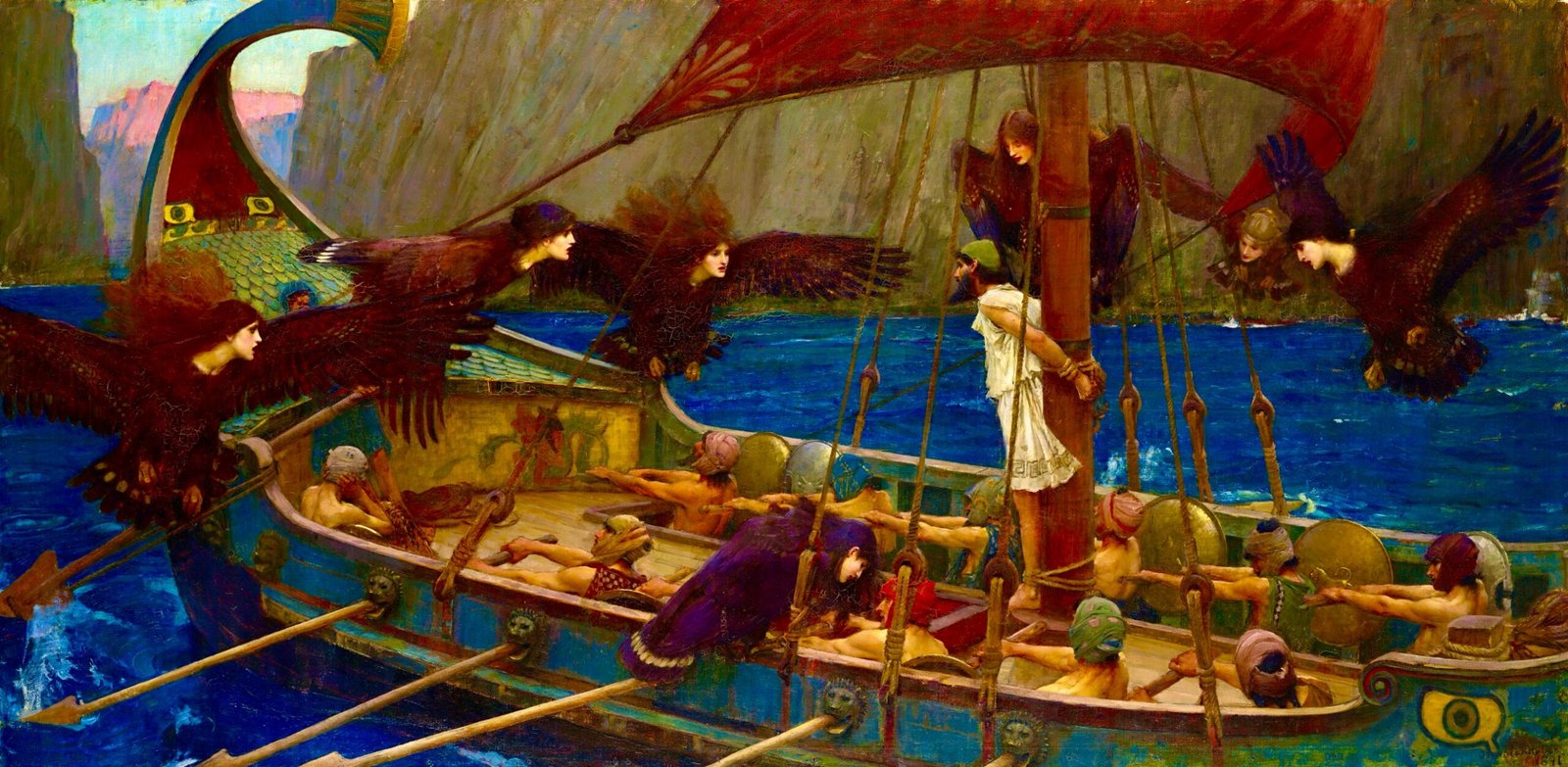
Odysseus and the Sirens by John William Waterhouse, 1891. National Gallery of Victoria, Melbourne, Australia. Wikipedia, Public Domain.
Prologue
Christopher Nolan, producer of “The Odyssey” movie, admitted he was enchanted from childhood by Homer’s Odyssey. He produced a 250-million dollars film that rewrites both Homer’s Odyssey and Greek history. His Odyssey movie separates the Greeks from their gods. However, Greeks and their gods were inseparable.
The Greeks and their gods
“Told in this way, with divine intervention at a minimum,” says Richard Brady of the New Yorker, “the story remains an exciting adventure filled with passion, terror, tenderness, and wonder, but it lacks the particular thrill that comes with reading Homer, a sense of the gulf that separates modern minds from Bronze Age ones…. By suppressing this continuity between the natural and the supernatural realms, Nolan omits much of what makes the Homeric age so different, including the ambience of the divine and the distinctive moral realm that goes with it…. rather than trying to take the audience inside the ancient Greek mind-set, Nolan chooses a slimmed-down, almost naturalistic approach, tamed and tempered…. Psychologizing Odysseus… lends “The Odyssey” a readily digestible modernity—ancient Greeks, they’re just like us!—but does so at the expense of the richness of detail and the societal complexity that makes reading Homer such a vital and immediate experience.”
Beautifully said. I fully agree with Brady.
Nolan feels uncomfortable with the Greek gods. His reading of Homer has the monotheistic fear of the gods being so close to the Greeks, thus missing the subtlety and beauty of the Homeric poetry and story of the enormous energy, passion and struggle of Odysseus to return home to Ithaca.
Homer starts the Odyssey with an assembly of the gods to decide the return of Odysseus to Ithaca. Both Zeus and his daughter Athena like Odysseus and agree they should restrain Poseidon from killing him because Odysseus blinded Cyclops Polyphemos, son of Poseidon. Athena is close to Odysseus. Without her insights and advice, there would have not been an Odyssey. None of these connections are obvious in Nolan’s Odyssey.
Nostos, day of return
Nolan misses completely the real purpose of the Odyssey, that is, the dramatic effort of Odysseus to return home to his wife Penelope and son Telemachos. The exciting and passionate day of return, the Homeric νόστιμον ήμαρ, is absent from “The Odyssey” movie of Nolan.
History of Homer and the Trojan War

Astronomical phenomena during the Trojan War. Homer describes a solar eclipse in the Odyssey 20.356-357. On the left, we see the killing of Patroklos by Hektor, and on the right, the killing of Hektor by Achilles as well as the killing of the suitors by Odysseus. Painting by Evi Sarantea.
The other problematic aspect of Nolan’s film is that Nolan, like most modern students of Homer, assumes wrongly that the Trojan War was made up, that it was not a historical event.
Homer existed (Anthologia Palatina 14.102) and the Trojan War happened in late 13th or early 12th century BCE. Two teams of astronomers confirmed the eclipses of the Sun that Homer described in his Odyssey (20.356-357). Just as fundamental in establishing the historical origins of the Odyssey, is the evidence from Aristotle. He was the greatest philosopher of all time. He was the inventor of zoology and meteorology in the 4th century BCE. Aristotle loved Homer and repeatedly cited him in his philosophical, scientific and political works. Aristotle trusted Homer, the teacher of the Greeks for centuries. His epics were Greek language, myth, history, astronomy, cosmology, science and technology, geography, traditions, piety for the gods and pride for Greek civilization. Greeks read, sang, copied and gained inspiration from Homer. Aristotle edited Homer’s Iliad and Odyssey for his pupil, Alexander the Great. He would not have tolerated falsehoods and fiction from anyone, much less Homer.
In modern times, and especially in 21st century America, not merely Homer but all Greeks cause anxiety to theologians, scholars and theater and movie producers. Daniel Mendelsohn, who translated the Odyssey, liked the Nolan film of the Odyssey. He says that “Helen of Troy is starting wars again. But this time the legendarily beautiful, semi-divine queen of myth, whose adulterous elopement with the Trojan prince Paris brought on the 10-year-long Trojan War, has launched a thousand tweets.”
All this may be partly true about beautiful Helen, but she was not fictional. She was the daughter of Zeus and the queen of Sparta that eloped with Paris or Paris abducted her. And, yes, she caused wars then and slight controversy now.
Mendelsohn explains that Helen was “a skilled orator and the object of skillful oratory.” True. Helen in Nolan’s account is neither beautiful nor eloquent. She is insignificant. But the timeliness of Nolan’s film was not accidental. American politics, Trump in the White House, the war Trump and Netanyahu of Israel have been fighting against ancient Persia / Iran at a time when the US is a badly divided society and in dramatic decline might have something to do with Nolan’s choices. Still, Nolan’s Odyssey is not completely divorced from Homer.
Is Nolan asking us to dream bigger?
A reviewer, in fact, raises Nolan to heavens. “Nolan’s love of movies and commitment to them — to what they can do, what they can be, what they should be –” says Manohla Dargis, chief film critic of the New York Times, “runs like an electric current through his filmography, lighting it, and oftentimes you, up. That passion is in every frame of his monumental adaptation of “The Odyssey,” one of the most Nolan of Nolan spectacles in its thematic concerns, formal playfulness, kinetic thrills and unabashed showmanship…. he always aims to please…. Nolan turns a mythological tale into cinematic realism with creaking wood and straining rope, the grunts and cries of men. He brings characters who can seem exotically distant nearer to us, humanizing people, including those Odysseus will soon help slaughter…. Nolan asks us to dream bigger. His “Odyssey” is a classic in every sense, a transporting affirmation of the art and a work of pure cinema.”
This extraordinary praise is mostly fiction. Dargis is under the delusion she is reviewing a story of myth, in which case exaggeration causes little harm. But as I have already explained, the Odyssey is a real icon of the struggle to return home of a very intelligent, god-like Odysseus. Goddess Athena loved him. Nolan is in no position to “humanize” the Greeks. On the contrary, “The Odyssey” humanizes us. And Nolan is not asking us to dream bigger. In fact, the thunderous noise and ear-piercing sounds, lightnings, and violence crushes our dreams. We are tempted to think we see a new super big science fiction story.
The Odyssey movie
I went and saw “The Odyssey” movie. Nolan excels in depicting warfare, fear, terror and danger. For example, he captures the terror of the crossing of the strait of Messina between Sicily and Calabria in southern Italy by Odysseus and his crew. We could see the wind-powered Bronze Age ships of Odysseus headed straight for the dangerous giant round blue whirlwind waters of Charybdis. And those who survived Charybdis were attacked by the six-headed monsters of black Skylla, female dogs. Those monsters grabbed some of the crew of Odysseus for eating them.
Nolan did what he pleased with the text and stories of the Homeric Odyssey. In each episode he brought to life, he added or subtracted characters or details of what Homer described. He ignored Aiolos, god of the winds, who had put all the winds in a leather bag, while he allowed only a Western wind that would take Odysseus’ ships to Ithaca. Aiolos, however, warned Odysseus not to open the wind bag. And Homer says that Aiolos’ wind drove the ships very close to Ithaca. But despite Odysseus’ warnings to the sailors not to touch the wind bag, while asleep, the crew opened the bag thinking Odysseus was hiding gold in the bag. Once the winds were outside the bag, they forced the ships to return to the Aiolos island. The heartbroken Odysseus spoke to Aiolos, but the wind god was angry and ordered Odysseus off his island. Nothing from this exciting episode appears in Nolan’s Odyssey.
The other distressing change Nolan did was to alter events. Once Odysseus and his crew landed accidentally to the land of the Laestrygonians, Nolan added more terror by converting the giant cannibals to giant mechanical robots that killed most the followers of Odysseus. Only the ship of Odysseus and its crew escaped the slaughter.
In the case of the Cyclops, only terror and screams and frightened sheep running withing the semi dark large cave dominated the confrontation of the monster one-eyed son of Poseidon eating a few of the crew of Odysseus. Homer, however, allowed Odysseus to talk to the Cyclops and get him drunk, which gave the trapped Greeks an opportunity to blind Polyphemos and escape his deadly grip by tying themselves under the belly of large sheep. None of these interactions appeared in Nolan’s film.
Nolan also modified the Homeric story of Odysseus meeting Circe, daughter of the Sun god Helios. Nolan shows Circe as an elderly woman who metamorphosed a number of Odysseus crew into pigs. He avoided reporting that the messenger of the gods, god Hermes, interrupted Odysseus on his way to confront Circe. Hermes gave Odysseus Μῶλυ, a plant / drug that cancelled the magic power of Circe. With that divine advice and strength, Odysseus forced Circe to undo her evil work. Nolan deleted this important affair between Hermes and Odysseus and then Odysseus and Circe.
Nolan also bypassed the very important “visit” of Odysseus to the dream-like island of Phaiakia / Kerkyra. The stormy sea threw the almost drowned and naked Odysseus in a beach of Phaiakia, very close to a small number of women washing clothes. Princess Nausicaa, daughter of King Alkinous and Queen Arete, and her servants discovered the suffering Odysseus buried in olive tree leaves very close to the waters of a river emptying in the Ionian sea. Odysseus explained to Nausikaa, as well as he could, his dangerous travels. Nausikaa assured him all was well; she found clothes for him and guided Odysseus to her father.
King Alkinous was pleased to meet Odysseus. He feasted him in his palace. During the festivities, Demodokos, a local bard (αοιδός) sang from the poetry of Homer the exploits of Odysseus (Odyssey 8.46). At that moment, Odysseus broke down. He covered his head with his cloak and started crying. Alkinous noticed the drama and urged Odysseus and his guests to go outside for athletic competition. Odysseus displayed his athletic Prowers. Then Alkinous asked him to speak about himself, revealing his name and identity. Odysseus said: “I am Odysseus, son of Laertes. I am known all over the world for my cunning. My fame even reached the heavens. I come from the island of Ithaca.” (Odyssey 9.21-24). Odysseus then pleaded with Alkinous to help him to return home to Ithaca. Alkinoos did. He offered a ship to carry him to Ithaca. The ship was pilotless. It had advanced technology that read the thoughts of the passengers. It took the sleeping Odysseus to Ithaca. When Odysseus woke up in Ithaca, he was lost. He did not recognize Ithaca after 20 years of absence. Goddess Athena was waiting for Odysseus in Ithaca. She told Odysseus he was at home. She informed him of the crisis at his home with Penelope being courted by several powerful men, proposing marriage to her. Penelope was torn between her love for Odysseus and the marriage proposals of handsome and powerful men. She was convinced Odysseus was dead.
While Nolan ignored this important experience of Odysseus in Phaiakia, he highlighted the violent effort of the suitors to capture the kingdom of Ithaca by deception and teasing of Penelope. We see Odysseus entering the fray dressed like a beggar. Athena had also made him look like a very old man. Odysseus enters the palace and begs for food among the suitors enjoying themselves. They ate meat and bread and drank wine. They sat on comfortable chairs around large wooden tables in the main hall of the palace.
The beggar Odysseus had been recognized by his faithful dog Argos and his old nurse Eurykleia. The dog moved slowly his tail and died. Eurykleia was washing his legs when she noticed a wound he had suffered from hunting a wild boar when he was a teenager. Odysseus prevented her from expressing her joy.
Nolan’s movie resurrects the strategic patience of the warrior Odysseus, his tenacity, courage and power and knowledge of the use of his old weapons, the wooden bow and bronze-tipped arrows. We barely see details but hear the screams and blows of men fighting to death. Odysseus kills most of the suitors. His son Telemachos and his old shepherd Eumaios are his sole co-warriors. At the end of the palace battle, we see the victorious Odysseus with two arrows on his back. Nolan ends the movie with dead Odysseus, which contradicts Homer. Odysseus lived a happy life with Penelope and Telemachos. But with several flashbacks of Odysseus we witness extraordinary events, including the building of the Wooden Horse and the horrific burning of Troy.
Epilogue
Homer was the son of Telemachos, who was the son of Odysseus and Penelope. Homer’s mother was Polykaste, daughter of Nestor, King of Pylos who fought in the Trojan War (Anthologia Palatina 14.102). This explains the richness of events and details of the epic poems, Iliad and Odyssey. The Iliad tells the story of the historical Trojan War and the Odyssey the passionate struggle of Odysseus to return home to Ithaca.
The Trojans were Greeks, who had left mainland Greece for Ionia or Asia Minor. Odysseus was the greatest of all heroes who fought in the Trojan War. His Wooden Horse deception destroyed Troy and started his desperate journey to find his way back to Ithaca.
Homer’s epics have been the foundation stones of Hellenic and Western literature and civilization. They have no precedent, though they influenced literature to our own time. Yet Westerners have always had great difficulties to translate those epics into readable and accurate prose or stage them as worthwhile theater plays or movies.
The latest effort by Christopher Nolan of Hollywood to make “The Odyssey” movie reflects the perennial problem of helping the Western viewer feel comfortable in reading and understanding the Greek mind. Yes, to some degree, we are all Greeks.
Nolan took the Odyssey of Homer and made a Hollywood adventure full of excitement, violence, thunderous sounds, terror and warfare. These exaggerations do reflect events in the Odyssey, but they are removed from their Greek context of ceaseless communication and relationships between Greeks and their gods. The gods, Greeks thought, could disguise themselves as the strangers one meets (Homer, “The Odyssey” 17.524-529). The second failure of Nolan’s praiseworthy effort was the metaphysical and political assumptions that Homer’s poems were imaginary. That is, neither the Iliad nor the Odyssey represent historical events. Of course, these assumptions are wrong. Homer existed and wrote for the most part about historical events. Finally, the third failure of Nolan was to film this Homeric movie in the Morocco-occupied land of Western Sahara. Why did he not produce the movie in Greece? His decision to do the work in Western Sahara has given rise to protests against the movie. The people of Western Sahara rightly resent Western companies like Universal Pictures doing business with Morocco, which for 50 years is occupying their country.
I hope Nolan would abandon Morocco’s Western Sahara. He ought to recreate his Odyssey movie in Greece. In that process, the best guide is Homer. Let the gods have their say. That way, he and the new movie will have the opportunity to read the Greek mind and educate Americans and Western people of the beauties and wisdom of Greek culture.
[ad_2]
Source link
