
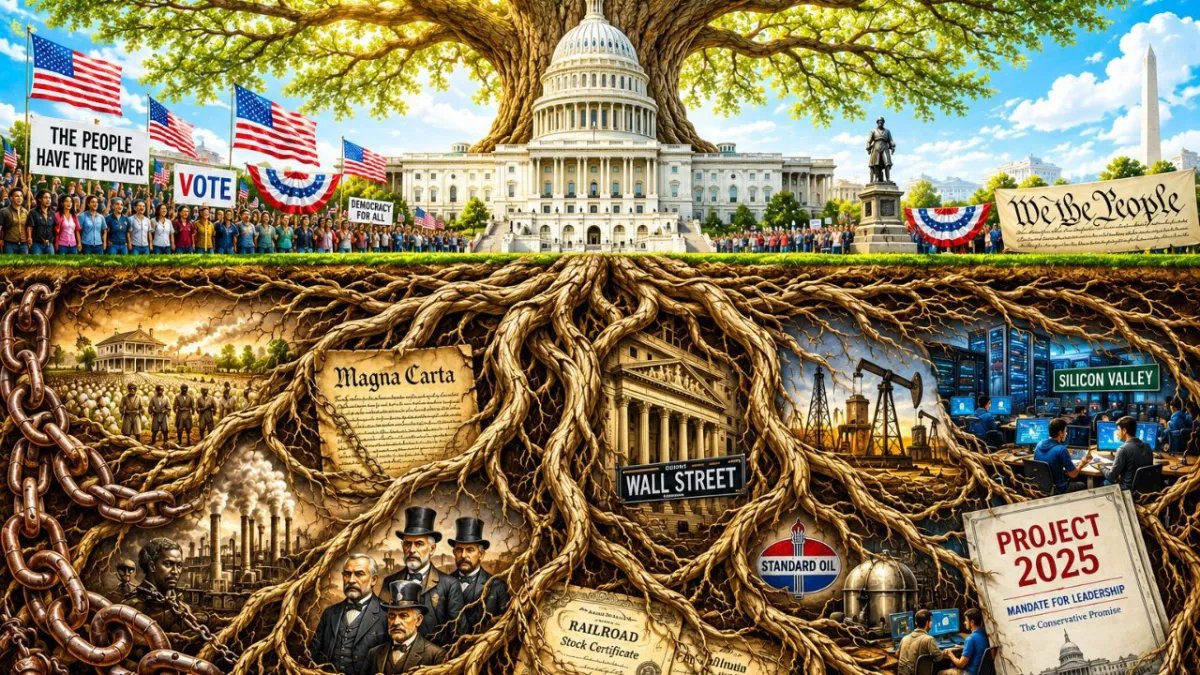
Are Americans Wired for Authoritarianism? Charles Derber argues the nation’s democratic ideals have long masked an entrenched system of elite rule.
As Donald Trump openly defies constitutional norms and concentrates power in the White House, many Americans see him as a dangerous break from the nation’s democratic traditions. Sociologist Charles Derber argues the opposite. In this wide-ranging conversation with Robert Scheer, the Boston College professor contends that authoritarianism has been embedded in the American political system since its founding. In his new book, Wired for Authoritarianism: American Oligarchy and How to Revive America for the People. Derber draws on the history of the Constitution, the Magna Carta, corporate power, and popular resistance, Derber argues that Trump did not invent oligarchy—he simply stripped away the illusion that the United States was ever governed primarily by the people. The discussion explores the country’s long struggle between concentrated wealth and democratic movements, asking whether today’s crisis marks the collapse of an old political order—or the beginning of a genuine fight to build one that serves ordinary Americans.
Has Donald Trump fundamentally transformed American democracy—or merely exposed what has always existed beneath its surface?
That is the provocative question at the center of a new Scheer Intelligence conversation between journalist Robert Scheer and Boston College sociologist Charles Derber, author of Wired for Authoritarianism: American Oligarchy and How to Revive America for the People. Derber argues that while Trump’s second presidency represents an alarming escalation of authoritarian politics, it did not create the conditions that made such a presidency possible. Instead, Trump has stripped away the democratic veneer from a political system that has long concentrated power in the hands of economic elites.
“The founding document, the Constitution, is not a democratic document,” Derber argues. “It was fundamentally an authoritarian document.”
Rather than viewing the Constitution as the birth of popular rule, Derber contends it was designed by wealthy landowners and merchants seeking to divide political power among themselves while limiting the influence of ordinary citizens.
“Trump didn’t invent American authoritarianism,” Derber says. “He came to power precisely because there already existed a deep structure of authoritarian rule.”
For much of American history, he argues, this system operated through what he calls “covert authoritarianism”—a political order that maintained the appearance of democracy through elections and constitutional ideals while allowing economic elites to dominate public life from behind the scenes.
Trump’s contribution, Derber says, has been to make that hidden structure visible.
“He turned what I call covert authoritarianism into a much more visible… nakedly authoritarian kind of system.”
The Magna Carta and America’s Founding
One of Derber’s most striking arguments traces the origins of the Constitution to the Magna Carta.
Contrary to the popular understanding of the Magna Carta as a democratic milestone, Derber argues it was fundamentally an agreement among elites to redistribute power within the ruling class—not to empower ordinary people.
“They were going to curb the power of the king—not to ordinary Americans—but to people like themselves.”
According to Derber, the framers embraced this same philosophy when drafting the Constitution.
“The founders were looking at the medieval document of the Magna Carta… They wanted to spread power—not to ordinary Americans—but to people like themselves.”
Even after constitutional amendments expanded voting rights following the Civil War and women’s suffrage, Derber argues the nation’s underlying power structure remained largely unchanged.
“It never fundamentally changed the essential character of that document… which was to lock in a kind of oligarchy.”
America’s Democratic Myth
Throughout the conversation, Scheer acknowledges that he, like many Americans, grew up embracing what Derber calls the nation’s founding myth—that the United States had created history’s greatest democratic experiment.
Derber describes Americans as having “drunk the Kool-Aid of democratic constitutionalism.”
Yet Scheer argues the country’s history cannot be reduced simply to elite domination.
“There was always resistance,” Scheer insists.
He points to abolitionists, labor organizers, suffragists, civil rights activists, and countless grassroots movements that continually forced American institutions toward greater democracy.
Invoking Leonard Cohen’s famous lyric, Scheer reminds viewers:
“There’s a crack in everything—that’s how the light gets in.”
For Scheer, the country’s democratic achievements came not because power voluntarily yielded authority, but because ordinary people repeatedly forced change from below.
Corporate Power Behind the Curtain
Despite emphasizing resistance, Scheer agrees with Derber that concentrated corporate power has steadily overwhelmed democratic institutions.
Derber argues that today’s billionaires differ less in substance than in visibility.
“The billionaires… have always run the country… they’re now directly in the White House.”
Trump’s administration, he argues, merely formalized relationships that had existed for decades.
As evidence, Derber points to Project 2025, arguing that conservative think tanks and corporate interests had already prepared a detailed governing blueprint long before Trump’s return to office.
“Trump didn’t have to figure out what to do,” Derber says. “It was all written up in the thousand pages of Project 2025.”
Understanding Trump’s Appeal
Rather than dismissing Trump voters as irrational, Derber argues many were responding to genuine economic frustration.
“People voted for Trump because they said, ‘This economy sucks. I’m doing terribly.’”
He argues many Americans correctly recognized that corporations exercise enormous influence over government, even if Trump’s policies ultimately strengthened that very system.
Scheer agrees.
“Trump was successful because he knew the thing was not working.”
The danger, both men argue, lies in confusing Trump’s diagnosis with his prescription.
Beyond Trump
Scheer directs some of his sharpest criticism not at Trump but at earlier Democratic administrations.
He argues that Bill Clinton’s embrace of deregulation, free-market globalization, and financial liberalization accelerated the concentration of corporate power.
“Bill Clinton… took us away from that New Deal tradition.”
From financial deregulation to telecommunications policy, Scheer contends neoliberal reforms laid much of the groundwork for today’s oligarchic political economy.
In that sense, Trump inherited—and intensified—a system already dominated by corporate interests.
Why Simply Defeating Trump Isn’t Enough
Derber argues that restoring pre-Trump politics would fail to address the deeper crisis.
“To overthrow Trump and go back to where we were was a recipe for getting another Trump.”
Instead, he believes both political parties—and particularly Democrats—must confront the structural inequalities that produced widespread public dissatisfaction.
He points to figures like Senators Chris Murphy and Chris Van Hollen as evidence that some Democratic leaders are beginning to acknowledge these deeper economic failures.
Rebuilding Class Politics
Throughout the interview, both Scheer and Derber repeatedly return to class politics.
Derber notes that Americans increasingly distrust concentrated corporate power.
“About 75%… think that large corporations are messing up their lives.”
Scheer argues that younger generations are increasingly questioning capitalism itself while demanding stronger labor organizations and greater democratic participation in the economy.
“People want collective power,” Scheer says. “They want their share.”
AI and the Next Political Crisis
Looking ahead, both men warn that artificial intelligence could deepen already staggering inequalities.
Scheer asks the question he believes society has yet to answer:
“Where do we all come in?”
As AI threatens both blue-collar and professional employment, Derber says he is already writing another book examining the political consequences of this technological transformation.
A Reason for Hope
Despite offering a sobering diagnosis of American history, Derber concludes on an optimistic note.
He says recent protests against ICE raids, immigrant detention centers, and authoritarian policies reveal what he calls “a level of radical empathy.”
“What we’re seeing on the streets today is the beginning of a movement.”
Rather than becoming more isolated, he believes many Americans are rediscovering solidarity across traditional political divisions.
“You can’t get change individually,” Derber says. “You need to bring people together.”
Scheer agrees that this tradition of organized resistance remains America’s greatest democratic inheritance.
“The power of your book is to show that, by design, the system was rigged,” Scheer tells Derber.
But Scheer also insists history is never predetermined. From abolition to organized labor, from the civil rights movement to today’s protests, democratic advances have come through collective struggle—not elite benevolence.
Their conversation ultimately suggests that confronting Trump’s presidency requires more than defeating one political leader. It requires confronting the deeper structures of concentrated wealth and power that, Derber argues, have shaped American politics since the nation’s founding—and deciding whether democracy can finally become more than an aspiration.
Editor’s Note: At a moment when the once vaunted model of responsible journalism is overwhelmingly the play thing of self-serving billionaires and their corporate scribes, alternatives of integrity are desperately needed, and ScheerPost is one of them. Please support our independent journalism by contributing to our online donation platform, Network for Good, or send a check to our new PO Box. We can’t thank you enough, and promise to keep bringing you this kind of vital news.
You can also make a donation to our PayPal or subscribe to our Patreon.
Please share this story and help us grow our network!
