
Marah Abdel Jaber Prism
A seasoned humanitarian aid worker directing distributions to Gaza since the start of Israel’s genocide in October 2023 went on their first mission to the Strip last winter. During the two-week mission, they conducted a ground assessment: testing the efficacy of aid, recording field interviews with residents, and surveying the functionality of local hospitals. They have requested anonymity in order to share what they learned publicly, and minimize the risk of retaliation from Israeli officials.
In a Q&A with Prism in February, they reflected on the direct role of global humanitarian aid organizations in escalating the dehumanization of Palestinians under Israel’s genocide, the lack of a true ceasefire, and the world’s abandonment of Palestinians.
This interview has been edited for clarity and brevity.
Marah Abdel Jaber: What were the conditions of Gaza upon your arrival?
Humanitarian Aid Worker: When entering, we crossed through the Karem Abu Salem border and drove straight across the militarized yellow zone through Rafah. If I didn’t know any better, I wouldn’t think that it was an actual city before. It’s almost entirely flattened, and most of it has been bulldozed. As we made our way up towards Khan Younis, we saw some demolished buildings and rubble. You would never think that there were people living there before. It was obvious that the Israeli forces were bulldozing away evidence of war crimes, the genocide, and the dead. That was all I could think about while driving through it.
Abdel Jaber: What was a typical day in the field for you?
HAW: My role required visiting different programs that [a medical NGO] was running and giving feedback. I also looked into some of their pilot programs or their areas of interest for launching new programs. I visited a lot of different clinics, hospitals, a school, and even an orphanage. I spoke with different parts of the population dealing with orphaned or unaccompanied separated children, the elderly, amputees, or those receiving therapy. I had quite a diverse exposure to the issues that the population is facing there, in addition to the aid situation and the distribution.
Abdel Jaber: What was most striking about the reality on the ground?
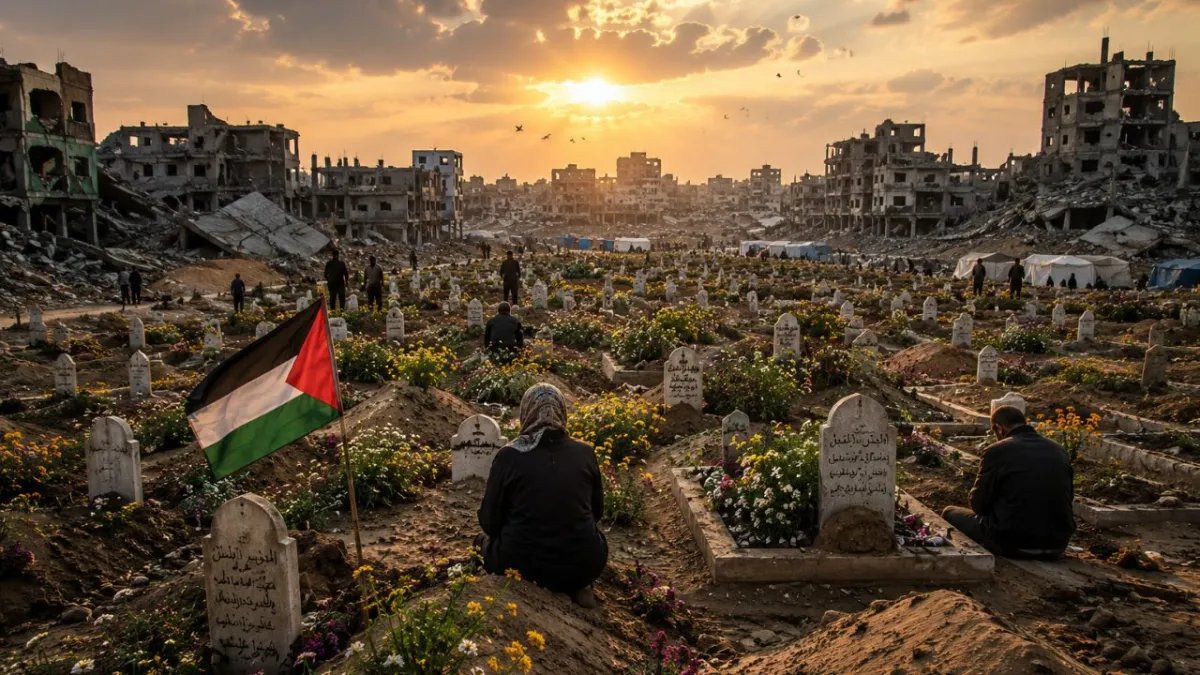
HAW: The living conditions are horrendous. Many people don’t know about the reality on the ground because mainstream media is pushing the narrative of a ceasefire to distract from the next phase of the colonial project: to build on top of a cemetery. Gaza is essentially one giant graveyard. Airstrikes are happening in the dozens, day and night; the Israeli military ships would still shoot out from the sea; and fighter jets and drones were everywhere. Oftentimes people would tell me that I should have visited Gaza before the genocide, because it was heaven. It would stop me. I couldn’t bear the thought of that. It was still occupation, injustice, and apartheid, but they would say it was better than now. They want the Palestinian people to choose which level of oppression they have. You can have minimal or maximum oppression, because you will never have absolute freedom. These are your options. Genocide, or apartheid and occupation.
People would tell me I should have visited Gaza before the genocide, because it was heaven. … I couldn’t bear the thought of that. It was still occupation, injustice, and apartheid, but they would say it was better than now.
Abdel Jaber: How would you qualify the ceasefire in Gaza during your mission?
HAW: There was nothing that would indicate an actual ceasefire. People outside of Gaza view this as a successful ceasefire for two reasons. First, the idea that aid is flowing in daily. It is, but it is still incredibly minimal while being distributed inefficiently and ineffectively. Israeli forces are also allowing in consumer goods. This signals that residents can now purchase goods, but the vast majority in Gaza have been without work for two and a half years. And a lot of people lost their money in the banks because the [Israeli Occupation Forces (IOF)] destroyed them, so they could no longer access the systems.
The secondary narrative being pushed is that, before the ceasefire, we would hear of hundreds upon hundreds of Palestinians being killed every day. Now you don’t hear as much of that. People assume that there isn’t any more killing, when really dozens will get killed in a day. That’s not a ceasefire.
Abdel Jaber: What was the status of the Gaza Humanitarian Foundation (GHF) aid distribution during your mission?
HAW: GHF closed officially before I got there. But what most people are unaware of is that they actually resumed their contracts and operations. GHF didn’t fully close in October; they just shut down operations at the pre-existing sites. They opened at least a dozen new sites in other areas across Gaza. I spoke to Palestinians who went to GHF aid distribution sites, and met a couple of young men who had become amputees. One of them was in a camp in the Deir al-Balah area when he went to get aid. He was sniped in the leg, and he had to have his leg amputated below the knee. I noticed that [Israeli soldiers] primarily targeted legs. I met an older woman who was also shot in the leg, but, luckily, she didn’t lose it. There was a pattern. I met a family in Gaza City whose 23-year-old cousin was sniped and killed at GHF. It was his first time going to get aid, and he was killed. Palestinians in Gaza were aware that the GHF sites were deathtraps. From the beginning, no one thought that they existed to do good. All the people that I spoke to recognized immediately that the setup was intentional. It was dangerous, but, as they told me, what options did they have?

Abdel Jaber: What did you gather from those conversations about GHF?
HAW: Everything that we’re seeing in this genocide in Gaza, everything that the Israeli forces have implemented, is intentional. It is by design. There is nothing coincidental about it. The intentional deprivation and inhumane conditions are meant to squeeze every ounce of hope out of Palestinians in Gaza. They signaled to people that if they want to stay in Gaza, they would have to get their aid in this way. The killing was intentional to serve as a warning for everyone else watching that they either starve or die trying to access essential aid. They don’t want them to have options. At first, it seemed like the only option was to leave. Now it looks like what is being done with this Board of Peace, and building this Riviera on a graveyard, is to use Palestinians as cheap labor.
Abdel Jaber: Is there any specific testimony that stuck with you?
HAW: Several. You know, there’s been a lot of debate in the humanitarian field about how using the words “resilient” or “resiliency” can do more harm than good. I had a conversation with a young man in his 20s in Deir al-Balah, and I was explaining this dilemma, telling him that everyone regards the Palestinians as resilient and courageous. He told me, “We are the sacrificial lambs of the world.” I’ll never forget that.
We have elevated Palestinians to this superhuman status to minimize the reality of their suffering. Nothing that has happened to the Palestinians in the past two years, even since 1948, is natural or unavoidable. Every single thing has been manmade. Any group of people would be resilient if they were trying to defend their lives. In elevating them to superhuman status, we’ve inadvertently taken away their humanity. We use this framing to avoid affecting any material change for the people of Gaza. What are we actually doing for them?
Abdel Jaber: What did you witness while visiting hospitals throughout the Strip?
HAW: There was one story of a patient that really struck me. I knew an [ear, nose, and throat doctor] working at Nasser Hospital while I was visiting. He told me that there was an airstrike inside the green zone, and a family was sleeping in the area where they hit. A little boy around 10 years old was brought into the hospital with damage to his neck. Thankfully, they were able to successfully do a surgery. When he woke up, he had a [tracheostomy] tube in his throat. He couldn’t speak, but he was mouthing to the hospital staff asking about his parents. The nurse had to tell him that his parents were killed in the airstrike, and the staff watched as this little boy started to hysterically scream and cry without releasing any sound because of his trach tube. I could tell the doctor was traumatized by the boys’ reaction from his haunted narration of the story. He said the image will forever be engraved in his mind. Luckily, he had other surviving family who were able to visit and care for him. So many children in Gaza have this experience and will have to carry this loss for the rest of their lives.
Abdel Jaber: How do you assess the efficacy and long-term impacts of the current aid situation in Gaza?
HAW: Before I went in, we knew that the aid was insufficient and being distributed inefficiently. And it’s not just because Israel bans types of aid, but it also limits how many trucks enter. Pre-genocide, Gaza was receiving about 500 aid trucks daily. So now, some aid agencies will say 700 to 800 are needed. I would say closer to 900 to 1,000 trucks are needed. I’m sure you’ve seen the videos inside showing a big surge of people holding up their ID cards with hands stretched out at aid distribution sites. Seeing it in person was jarring—seeing those lines, hearing people shoot guns in the air to control the crowd, being worried about the children getting stomped on. I’ve sent in aid trucks, but I’ve never actually been inside where the distributions are.
What I saw was complete and utter laziness by a lot of these aid organizations. They are supporting the intentional drive of desperation that we’re pushing Palestinians in Gaza to.
Abdel Jaber: What was your major takeaway from witnessing this scene firsthand?
HAW: I realized that the aid agencies are a big part of the problem. They are contributing to the dehumanization of Palestinians. Israel wants the Palestinians to act like animals. There is no designated strategy for distribution, unless it’s very small and controlled. But I’m speaking generally about the larger distribution sites. It’s chaos. You will never convince me that aid organizations are unable to have more control over how things are distributed, even with all the disorder surrounding them. That is literally their job: to distribute aid safely, effectively, and efficiently. What I saw was complete and utter laziness by a lot of these aid organizations. They are supporting the intentional drive of desperation that we’re pushing Palestinians in Gaza to. Aid agencies not only have to do better; they can do better.
Abdel Jaber: Can you speak more to the deliberate dehumanization of Palestinians in Gaza?
HAW: Someone asked me the other day, if Israel is hellbent on getting rid of the Palestinian population, why not just drop a bomb and get it over with? Why are they torturing them? Everyone knows the IOF is killing them. Why not just do it? Well, first of all, that would make the genocide too obvious. But what a lot of people miss, and we really have to stress this as often as we can, is that genocide, ethnic cleansing, apartheid, occupation, injustice—and everything all within that realm—is not only physical, it’s psychological. The psychological aspect is crucial. You can control a population through psychological torture. It explains why, even before the genocide, Israel denied the entry of chocolates, wedding gowns, construction paper, and other menial things into Gaza. Cutting off food and medication, not allowing a catheter to come in for a dialysis patient, banning menstrual pads, and more—they want to remind you at every opportunity that they are in control of everything. There is a psychological toll that has detrimental, long-term impacts. The trauma, the lack of education, the epigenetic changes that are going to happen over the years, birth defects, and mental health will take forever to deal with. They want to ensure every aspect of Palestinian society, physical and psychological, has been damaged.

Abdel Jaber: What is the demand for people outside of Gaza, not just humanitarian organizations?
HAW: When I was in Gaza, people repeatedly told me that no one outside cares about them, and they’ve stopped paying attention. Others would ask me, “Why isn’t the world helping us? Why aren’t they doing anything?” They’re right. We’ve completely abandoned the people of Gaza. Years from now, we will be absolutely ashamed of ourselves. Future generations will look at us and ask, “How did they just sit by and watch this happen?” People in the U.S. ask me how they can convince others to care for Gaza. You shouldn’t have to convince anyone of anything. I don’t care if they don’t call it genocide. However you want to define it, however you want to label it is irrelevant. What are the facts? Hundreds of thousands of Palestinians in Gaza have been killed. Food, water, and medication have been deprived. No one can say they didn’t know the severe reality on the ground in Gaza.
Abdel Jaber: Is there anything I didn’t ask that you would like to share?
HAW: I want to highlight the exit security, because it’s actually stricter than when we entered. That’s primarily because they don’t want anyone to take anything that could be used as sampling, especially soil or water. If you have nothing to hide, if you’re not using toxins or banned chemicals, then you wouldn’t be this paranoid. We need to be critical and question what they’re trying to hide. Most people going out want sand from the Gaza beach to remember the city. On the way out, they have full-body scanners and an X-ray machine, but entering is similar to a typical airport security system in the U.S. You’re not allowed to take anything that has Palestinian symbols, like a map. They don’t want you to take any good memories with you or feel connected to the people of Gaza in any way. The psychological part is not just for the Palestinian people. They’ll allow some medical specialists to enter Gaza, but ban their equipment to force them into practicing “MacGyver” medicine. It’s inhumane and unjust. Consider it. Why allow in the specialist, but refuse their equipment, the medications, or even a catheter? Gaza is the guinea pig of the world. Palestinians are fully aware that they are being tested on by Israel for many things, not just military weapons, security, or surveillance. It’s also how to effectively pursue collective punishment, how to displace people, how to weaponize food and medical aid, and more. Gaza is literally ground zero.
Editorial Team:
Tina Vasquez, Lead Editor
Lara Witt, Top Editor
Rashmee Kumar, Copy Editor
Marah Abdel Jaber is a Palestinian writer, researcher, and creative. She was the team lead on Palestine Square’s “Firsthand Accounts from U.S. Medical Missions in Gaza” series, collecting testimonies from a variety of physicians who have conducted missions in Gaza since the start of the genocide. She has continued these Q&As at Prism. Her scholarship focuses on constructions of the Palestinian nation, fragmented identities, environmental development, creative movements, and imagined space. She previously taught at the Newberry Library. Marah holds an M.A. in Middle Eastern Studies from the University of Chicago and a B.A. in Political Science from the University of Texas at El Paso.
Editor’s Note: At a moment when the once vaunted model of responsible journalism is overwhelmingly the play thing of self-serving billionaires and their corporate scribes, alternatives of integrity are desperately needed, and ScheerPost is one of them. Please support our independent journalism by contributing to our online donation platform, Network for Good, or send a check to our new PO Box. We can’t thank you enough, and promise to keep bringing you this kind of vital news.
You can also make a donation to our PayPal or subscribe to our Patreon.
Please share this story and help us grow our network!
