
[ad_1]
News Desk, The Cradle.
Following strike on desalination plant.
Iran responded to overnight US strikes on civilian infrastructure by striking targets in Jordan, Bahrain, and Kuwait as part of Operation Nasr 2.
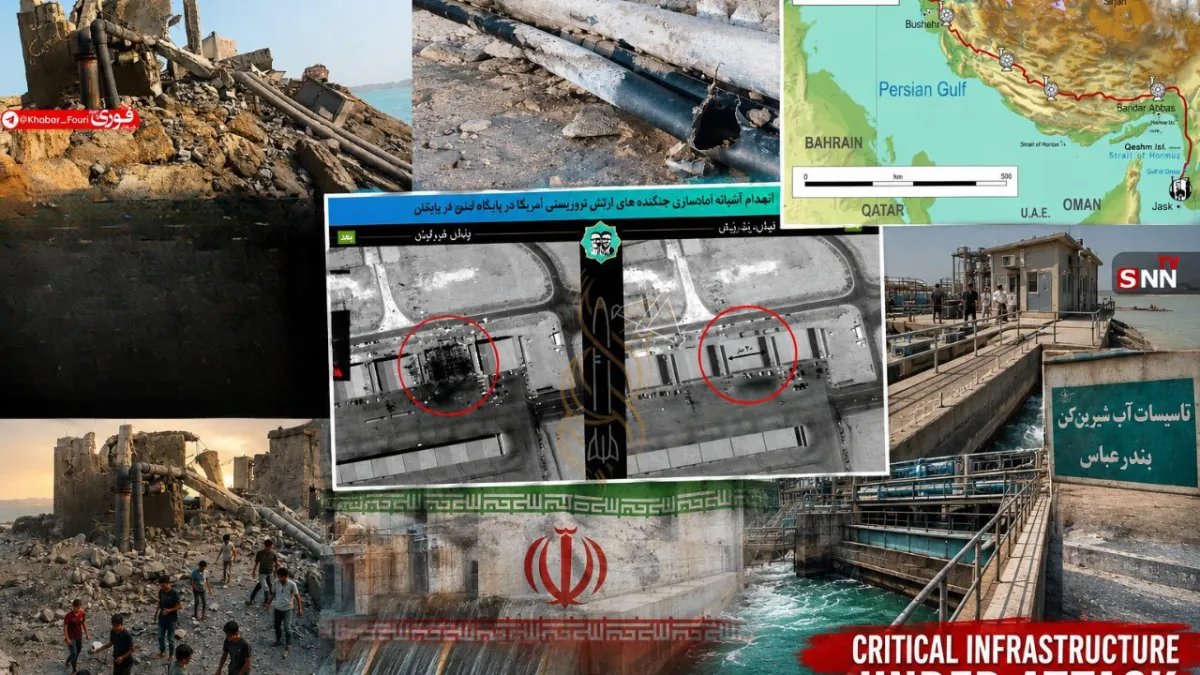
Around 10,000 people in Iran’s Hormozgan province are without drinking water following US strikes on a desalination plant in the coastal village of Bunji, Tasnim News Agency reported on 18 July.
The CEO of the Hormozgan Water and Wastewater Company stated that the attack “completely disrupted the supply of drinking water to 20 villages with a population of about 10,000 people.”
“These villages are facing a water shortage crisis,” the official added.
The desalination plant was one of multiple targets struck by the US military starting on Friday night, the seventh straight night of airstrikes on Iran since US President Donald Trump declared an end to the Islamabad Memorandum of Understanding (MoU).
US Central Command (CENTCOM) announced its forces “hit surveillance sites, military logistics infrastructure, underground weapons storage, and maritime capabilities.”
US strikes also knocked out 100 telecommunications masts, disrupting landline, mobile and internet services in northern Hormozgan province.
Photos circulated online showing multiple bridges destroyed by US warplanes in Hormozgan, which borders the Strait of Hormuz.
Local authorities said seven people were killed in US attacks across the province.
Since 27 June, US attacks have killed at least 50 people and injured 500, Iranian Health Ministry Spokesperson Hossein Kermanpour announced on Saturday.
“The fatalities include five women and two children under the age of 18, while there are 32 women and 18 minors among the injured,” he added.
Iran responded to the US escalation by striking strategic targets in Jordan, Kuwait, and Bahrain early Saturday as part of the 20th wave of Operation Nasr 2.
Iran’s Islamic Revolutionary Guard Corps (IRGC) announced that its Aerospace Force carried out a missile and drone attack on the US military base in Azraq, Jordan.
The IRGC said the operation targeted fighter jet shelters and a large runway at the base, destroying at least two US fighter jets and three other US aircraft
“Your religious and humanitarian duty is to eliminate them by any means and cleanse the sacred land of Jordan of the killers of oppressed Muslims,” the IRGC statement urged.
Jordan’s military said it intercepted 10 Iranian missiles fired into its airspace overnight and that no damage resulted.
On Friday, CBS News reported that several US service members were injured during Iranian attacks on two Jordanian bases over the past week.
Tasnim reported further that IRGC naval forces launched drone and missile strikes successfully targeting a US fleet fuel support pier at Al-Ahmadi port in Kuwait, as well as a US signals and communications center in the country.
In Bahrain, Iran struck the Sheik Isa Air Base and destroyed a US intelligence data center, known as Batelco, Tasnim added.
Kuwait’s Ministry of Electricity and Water said on Saturday that Iran struck an electricity and water distillation plant, which led to a fire erupting in one of the plant’s components.
Iranian missiles also targeted an oil facility in Kuwait, causing significant damage and some injuries, according to Kuwait’s state news agency.
Tehran confirmed the suspension of the Memorandum of Understanding (MoU) with Washington in response to violations by the US.
“We have suspended our commitments under the Islamabad Memorandum of Understanding. The US has violated and suspended all of its commitments,” Deputy Foreign Minister Kazem Gharibabadi declared on Saturday.
“We have also suspended our commitments, are not currently implementing them, and are focused on defending the country.”
Iran’s strikes on US sites in Jordan result in ‘dozens of casualties, destroyed helicopters’
Iran struck Washington’s forces in Jordan four times within five days, US media revealed, as Tehran retaliated to new US strikes.
US troops in Jordan were directly struck by Iran’s retaliatory operations four times in a period of five days – resulting in destroyed equipment and dozens of casualties, including two dead US soldiers and one declared “missing” a few days ago, the New York Times confirmed late on 19 July.
Iran’s responses have continued since then, as the NYT report coincided with US attacks on the Islamic Republic.
“The Iranian attack that killed two US soldiers and left one service member missing on Friday was the fourth in five days on US forces in Jordan. Taken together, the attacks have wounded dozens of US service members and damaged a number of helicopters,” officials told the outlet.
According to the report, Jordan’s strategic importance increased significantly after Washington reportedly shifted troops and assets from Bahrain, Qatar, and the UAE to Jordan and Israel, considering them relatively safer locations in the lead-up to the war.
The pace of the Iranian responses and the heavy losses they inflicted are a “sign” to Washington that the Islamic Republic “not only still has ample missile stocks but [has] also become more adept” at evading Washington’s air defenses, the officials added.
According to the report, the first strike hit King Faisal Air Base’s accommodation facility, injuring five US soldiers who were stationed there.
The second Iranian attack struck another US base located in east Jordan, damaging a “significant number” of Blackhawk helicopters.
Iranian statements from that week, detailing the operations, said the attacks targeted fuel facilities and aircraft shelters.
The Pentagon has not revealed details but confirmed that two US soldiers were killed and others transported to hospitals in Jordan.
Iran’s responses continue, with reports of explosions and air defense activity in Bahrain on Sunday. Manama claimed it intercepted several Iranian projectiles.
Additionally, Tehran downed three US MQ-9 drones over Iranian territory on Sunday.
The Islamic Revolutionary Guard Corps (IRGC) also said that four vessels coordinating with the US were prevented from transiting Hormuz earlier on 19 July after turning off navigation systems, ignoring IRGC naval warnings, and attempting to exit the strait along an “unsafe route.”
Two of the vessels were involved in an “incident” that forced them to halt in their place, while the other two backtracked, the IRGC said.
The IRGC added that Hormuz was under Iranian control and that “not a single drop of oil,” gas, or fertilizer will pass without Tehran’s authorization.
The statement comes after Iran’s army announced a series of overnight strikes on US assets in the Gulf.
According to statements by the Iranian army, Tehran’s forces launched successive drone attacks against US military facilities in Kuwait overnight and into the early hours of Sunday.
It said it targeted a US ammunition depot at Camp Buehring as well as Patriot and air defense radar systems at Ali al-Salem Air Base.
The army added that it resumed drone strikes at dawn targeting both US facilities for a second time. Reports on Sunday said powerful explosions rocked Kuwait, and that Ali al-Salem base was directly hit in an Iranian strike.
This was a retaliation for the latest round of US strikes on Iran overnight. The US attacked Sirik, Hajiabad, Qeshm Island, and the vicinity of Shadegan.
Editor’s Note: At a moment when the once vaunted model of responsible journalism is overwhelmingly the play thing of self-serving billionaires and their corporate scribes, alternatives of integrity are desperately needed, and ScheerPost is one of them. Please support our independent journalism by contributing to our online donation platform, Network for Good, or send a check to our new PO Box. We can’t thank you enough, and promise to keep bringing you this kind of vital news.
You can also make a donation to our PayPal or subscribe to our Patreon.
Please share this story and help us grow our network!
[ad_2]
Source link
