
[ad_1]
For two and a half decades, Christopher Nolan has been Hollywood’s great liberal humanist, a defender of the secular, human ideal, and a mournful viewer of man’s tragic nature—and society’s. His Batman trilogy began with his hero defeating the threat of martial authoritarianism, moved on to a story about the destruction wrought by nihilistic chaos-mongers, and closed with a warning about the appeal of strongman populism. His Interstellar warned of decline through stagnation, as humanity forgot how to be bold in progress. His Tenet and Oppenheimer foretold man’s capacity for self-annihilation. We’ve been living in Nolan’s world.
His latest, an adaptation of Homer’s The Odyssey, takes us even deeper into that world, via an ancient epic poem. Those familiar with the Greek epic will recognize much of what’s on screen, and Nolan has done justice, at least visually, to many of its most iconic moments, from the whirlpool to the encounter with the cyclops to the Trojan horse attack that left the story’s hero stranded and separated for years before his return home.
But this adaptation is pure Nolan, not only in its glorious analog revanchism, but in its time-looping structure, its psychological fascinations, and its ultimate view of what holds civilization together: Like his Batman films, Nolan’s The Odyssey is a story about the restoration of the liberal order, or what passed for it in ancient times, by way of the sacrifices of a hero. It’s the story of a broken civilization and how to get it back.
That story begins with a warrior—a man with a duty to his people—who is also just a man with a wife and a child. Odysseus left home to fight a war against the Trojans, but has been gone for years. Back home in Ithaca, his court has been overrun with greedy, sniveling suitors who live off his wealth while scheming to replace him in the bedroom and on the throne. He has a wife, Penelope, and a son, Telemachus, who are growing desperate as the suitors take advantage of them. But they cannot evict the societal malfeasants who have encumbered their household for fear of violating a societal ideal—Zeus’ law, which is not a formal law so much as a shared expectation that one give food and shelter to strangers, since even a beggar might be a god in disguise.
In Ithaca, then, Nolan once again gives us a dilapidated society, rotted from within by weak and selfish men who decided to take advantage of an informal social bargain—the duty to provide aid to strangers. The liberal bargain, such as it is in Ithaca, is coming undone.
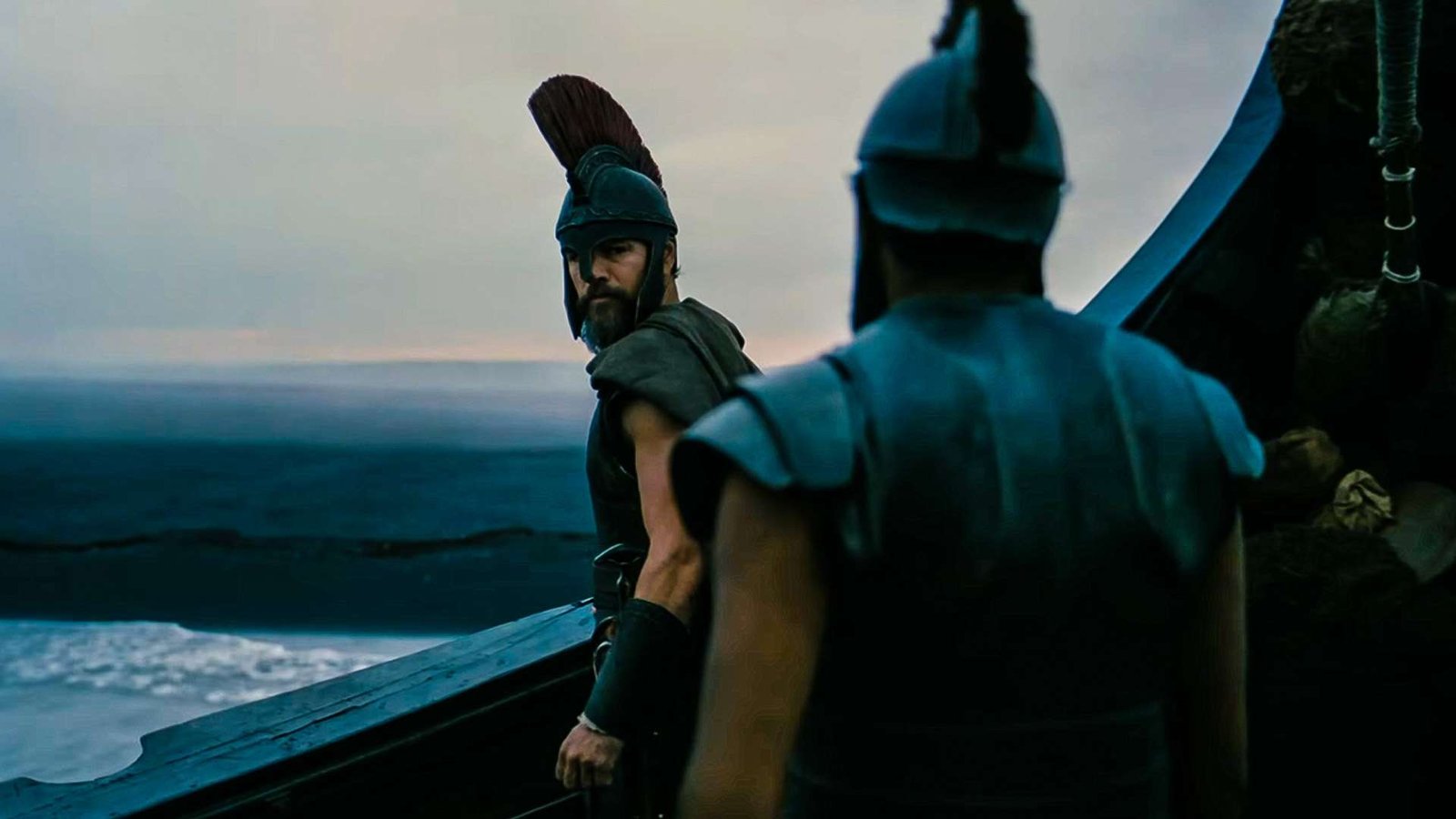
Telemachus decides to take action, traveling afar to seek news of his father. But it’s Odysseus’ own journey home that makes up the story’s spine. Odysseus and his men sail the ancient coast, encounter monsters, witches, and even gods of a sort.
On a pure filmmaking level, these episodic adventures are some of the most gripping stuff I’ve seen on screen in a long time; the encounter with the cyclops, a one-eyed giant who eats men like crunchy snacks, is particularly awe-inspiring. Nolan famously dislikes computer-generated effects, and is said to have built a 60-foot puppet to play the monster, which was transported to a real-world Mediterranean cave. (Imagine trying to explain having that in your luggage.)
Nolan isn’t as interested in dialogue; he prefers expository aphorisms, often muddled and buried in the sound mix, to natural conversation. Those who love Homer’s poem primarily for its specific language may find themselves disappointed. But Nolan is a filmmaker, not a poet, and his language is epic images. There simply aren’t many filmmakers who would attempt this sort of globe-spanning, analog production, and there are even fewer who could pull it off with such élan. At every stage of the movie, it helps that Nolan is so ambitious, so virtuosic, so technically capable.
But Nolan has more on his mind than analog wows. As Odysseus returns home in the film’s final hour, the director’s grand themes and thematic hobbyhorses assert themselves: Nolan’s adaptation emphasizes that it’s not just the suitors who have broken the liberal bargain, but Odysseus himself, through his celebrated trickery and violence. Odysseus is known throughout the land because of the songs sung about him, but those legends are just the stories told after the fact to justify horrors that fractured the social compact.
Thus Odysseus returns home a man wracked by guilt and trauma, living in his memories, with a burning need to set things right for himself, his family, and his country. And while he has been warned and tricked and occasionally even guided by the gods, he finds—as Nolan’s protagonists often do—that they are cold and distant. The responsibility to fix what is broken is his, not fate’s. Man is alone in an uncaring universe, but he can also be the master of his own fate. This is Nolan’s worldview, his Odyssey, as much as it is Homer’s. And the shattered liberal order it describes is one that feels just as relevant today.
[ad_2]
Source link
