
[ad_1]
Ellen Brown
Discussions of artificial intelligence typically begin with the question, What happens when the machines take our jobs? For thousands of years, work has been the means by which we fed our families, earned our place in society, and gave structure to our lives. We have come to equate paid employment with identity.
That presumption may soon be obsolete.
When Elon Musk proposed replacing Universal Basic Income with what he calls a Universal High Income—a level of income sufficient for everyone to live comfortably while intelligent machines produce much of the goods and services society requires—critics warned that people would become lazy. They would stop pursuing college degrees, stop starting businesses, stop inventing, stop contributing. Without jobs, it was argued, life itself would lose meaning and purpose.
Interestingly, humanity’s oldest written history begins with the premise that the purpose of humans is to work. The earliest known writing was impressed into clay tablets in ancient Sumer more than five thousand years ago. The Sumerian Atrahasis tablets tell of sky-deities called Annunaki, cast in modern “ancient architect” scenarios as extraterrestrial engineers. The heavy labor required to maintain life on earth was delegated to junior gods called Igigi, who finally grew weary of the arduous work, laid down their tools and rebelled.
The remedy was to create a new being to carry their burden. This was done by genetic manipulation to upgrade the highest life form found here, creating the human species. Whether we read that as history, allegory, or mythology, its underlying message is that humanity was conceived as a labor force – and human civilization begins with a control system to manage the laborers.
The first writing was not poetry or philosophy. It was accounting: grain tallies, labor quotas, rations, obligations. Most of the original cuneiform tablets were administrative records. What began as an exchange system evolved into a money system to control work and the workers performing it. For nearly six thousand years, human worth has been measured by our productivity. We deserve food and shelter because we worked for it.
In many respects, life is still organized around compulsory labor. Writing was devised to organize it. Accounting on clay tablets predated the use of coins, managed by temple priests as intermediaries for the gods. The temple evolved into private banks, with bankers intermediating commerce.
In the 1930s, British economist and philosopher John Maynard Keynes predicted that by the end of the twentieth century, technological advancement would reduce the work-week to just fifteen hours. So why is the forty-hour work week still the norm? It has been argued that our current economic structure uses “busyness” as a form of social containment. By tethering survival to forty hours of corporate or administrative labor, the system ensures that the majority of human creative power is spent serving institutional interests rather than personal or community liberation.
That may be why modern life feels increasingly saturated with what anthropologist David Graeber termed Bullshit Jobs in a book of that name—pointless administrative tasks that serve little social purpose, but that keep people too exhausted to pursue their own interests. He argued that the rise of “fake” work is a political device to keep people from having the free time to organize or rebel. But if artificial intelligence takes over the majority of production, that changes the meaning of work.
For centuries, scarcity shaped human behavior. Scarcity taught people to guard, to compete, to fear loss. But abundance changes the emotional landscape. What happens if we are simply handed what we need to survive? Skeptics say people will stop working and learning, that society will collapse into idleness, that life will lose meaning without jobs. But pilot studies of Universal Basic Income (UBI) programs involving unconditional cash transfers to recipients show otherwise.
UBI studies from around the world have shown positive results from UBI payments, including higher employment, lower crime, better mental health, higher graduation rates, and little evidence of a retreat from productive activity. Relieved of the constant anxiety of maintaining survival, participants typically pursue education, care for family members, search for better jobs, or start businesses they would not have dared to take on if failure meant destitution. It seems that necessity is not the only mother of invention.
Granted, the payout in most U.S. studies was a marginal $500 or $600 per month, only enough to provide a safety net for basic food and shelter. Plenty of motivation was left to add income for the finer things in life. Studies of the effects of a Universal High Income of $50,000 or more per year have not been done. But many people who are no longer working for pay, either because they are retired or because they have an inheritance or investments to live on, volunteer their time for socially beneficial causes.
Parents devote extraordinary energy to raising children without receiving a paycheck. Volunteers spend countless hours building community organizations. Amateur musicians practice difficult instruments for years with little expectation of financial reward. Scientists have pursued questions that fascinated them long before the result was likely to be commercially valuable. Thousands of programmers worked without pay to develop Linux open source software, and editors work for free to produce Wikipedia, just for reputation, community and the satisfaction of solving hard problems. These activities are not work for wages, but they are work that is quite meaningful to the people engaged in them.
The Enlightenment: Largely the Legacy of the Leisure Class
The intellectual triumphs of the European Enlightenment—the era that birthed modern science, political liberty, and the social contract—were primarily the domain of a wealthy leisure class, or of talent that was financially backed by institutional support (church, courts, universities) or personal patronage.
Sociologist Thorstein Veblen laid out this thesis in The Theory of the Leisure Class (1899). He argued that scholarly pursuit functioned as a form of “conspicuous leisure”—a way to demonstrate financial strength by engaging in activities that were “unproductive” in the immediate economic sense. To spend decades debating the nature of sovereignty or the movement of the stars required a measure of “unearned increment” or rent extraction. Examples included:
Francis Bacon (1561–1626): As Lord Chancellor and a member of the high nobility, Bacon’s scientific methodology was fueled by the resources of the state and inherited status.
Robert Boyle (1627–1691): The father of modern chemistry was the son of the “Great Earl of Cork,” then the wealthiest man in the British Isles. His work was conducted as a “gentleman scientist” with no need for professional employment.
Antoine Lavoisier (1743–1794): Lavoisier funded the world’s most advanced chemical laboratory through his role as a “Tax Farmer” for the French crown—a position of pure financial extraction.
For those not born into the elite, intellectual survival usually required “aristocratic patronage.” John Locke’s influential work was made possible by his residency and support from the Earl of Shaftesbury, while Thomas Hobbes was a lifelong dependent of the Cavendish family. This system ensured that even “revolutionary” ideas were filtered through the lens of those who benefited most from the existing social hierarchy.
The irony is that the very thinkers who theorized about “universal human rights” and “liberty” did so from a position of security provided by the systems of land-rent and debt-extraction they were analyzing. To create truly universal “liberty” requires a secure income for all.
For over a century, schools have functioned as labor factories, designed to produce compliant workers for industrial economies. If labor is no longer the center of life, education must change as well. AI already performs memorization and standardized tasks better than humans, relieving us of the need to perfect those skills ourselves. But that does not mean there is nothing left to learn. Studies of “Self-Directed Education” or “Unschooling” suggest that children are biologically wired to learn, and that removing the coercion of traditional schooling leads not to ignorance but to highly motivated, specialized learners. Self-directed education produces young adults who retain their curiosity and creativity, develop emotional intelligence, and pursue mastery for its own sake.
A 2013/2014 survey of 75 unschooled adults conducted by educational psychologists Peter Gray and Gina Riley found that 83% went on to some form of higher education. Despite not having a high school diploma, they reported little trouble getting into college, often using portfolios, interviews, or community college credits to bridge the gap. A high percentage of unschoolers pursued careers in the creative arts or became entrepreneurs. The researchers reported that unschooling helped them develop the self-reliance and out-of-the-box thinking required for these fields.
A South African study found that while “unschooled” students may have followed non-traditional paths, they often achieved high levels of professional success, particularly in creative and entrepreneurial fields. Intrinsic curiosity replaced extrinsic rewards (grades or job requirements) as the primary driver for learning.
Research on children who learn to read through unschooling shows wide variance in when they start (anywhere from age 4 to 14), but once they decide they want to read, they often reach grade-level proficiency in a matter of months rather than years because they are personally invested. Proponents argue that traditional schooling actually stifles learning by making it a chore.
The Sudbury Valley School model (founded in 1968) is a radical form of democratic education based on the belief that children are naturally curious and capable of managing their own learning. In a Sudbury school, there are no grades or required classes. Instead, students of all ages (5–18) mix freely and decide for themselves how to spend their time. Long-term studies of graduates show that they overwhelmingly transition successfully into higher education and careers, often citing the school’s emphasis on responsibility, self-direction, and democratic participation as the primary drivers of their adult success.
Self-directed learning doesn’t require an independent income, but the point is that the drive to learn and to apply that education to useful pursuits is an inherent human trait, in both children and adults. It’s something we want to do and will do, whether or not an employer requires it.
Self-actualization and Maslow’s Hierarchy of Needs
American psychologist Abraham Maslow conceptualized the needs or goals that motivate human behavior in a clinical review in 1943. He argued that once physiological and safety needs are met, humans naturally move toward “Self-actualization” – the realization of personal potential and pursuit of creative activities. In his later years, Maslow added a level above self-actualization called “Self-transcendence”, where people focus on goals outside themselves (altruism, community and caregiving).
That natural evolution can be applied not just to individuals but to civilizations. As AI and robotics free us from the self-centered needs of survival, we can awaken to our larger purposes of collective actualization and harmonious progress.
That’s the promise of AI – that it can free up our time so that we can escape the meaningless “busyness” of paid labor and pursue goals more meaningful to ourselves. But the same digital tools have a darker side. Catherine Austin Fitts and other critics warn that AI could become the ultimate “digital panopticon”—a weapon of entrapment by which programmable money and algorithmic surveillance create a modern “golden cage” in which the right to receive “welfare” is tied to political compliance. The UBI thus becomes a tool of coercion.
The same technology, however, offers tools to avoid that trap. Decentralized, neutral identity systems and zero-knowledge proofs allow people to establish that they are unique humans without revealing personal data. Zero-knowledge proofs are a cryptographic method by which one party can prove to another that a statement is true without revealing any additional information. A neutral protocol is one in which the rules are transparent, fixed, and cannot discriminate against specific users. By using “Smart Contracts” on a blockchain, the distribution of UHI becomes automated. The code only checks if the user has a valid, unique identity proof. It cannot check the user’s political party, criminal record or social behavior (unless explicitly part of the code). A government-issued digital currency could also be generated using the privacy-protected, peer-to-peer models of Project Hamilton and the ECASH bill, as detailed in Part 3 of this series.
Those are political decisions, dependent on a democratic system governed by and for the people. Mandating that these tools be incorporated into any government payments system can ensure that UHI remains a right of existence rather than a reward for obedience.
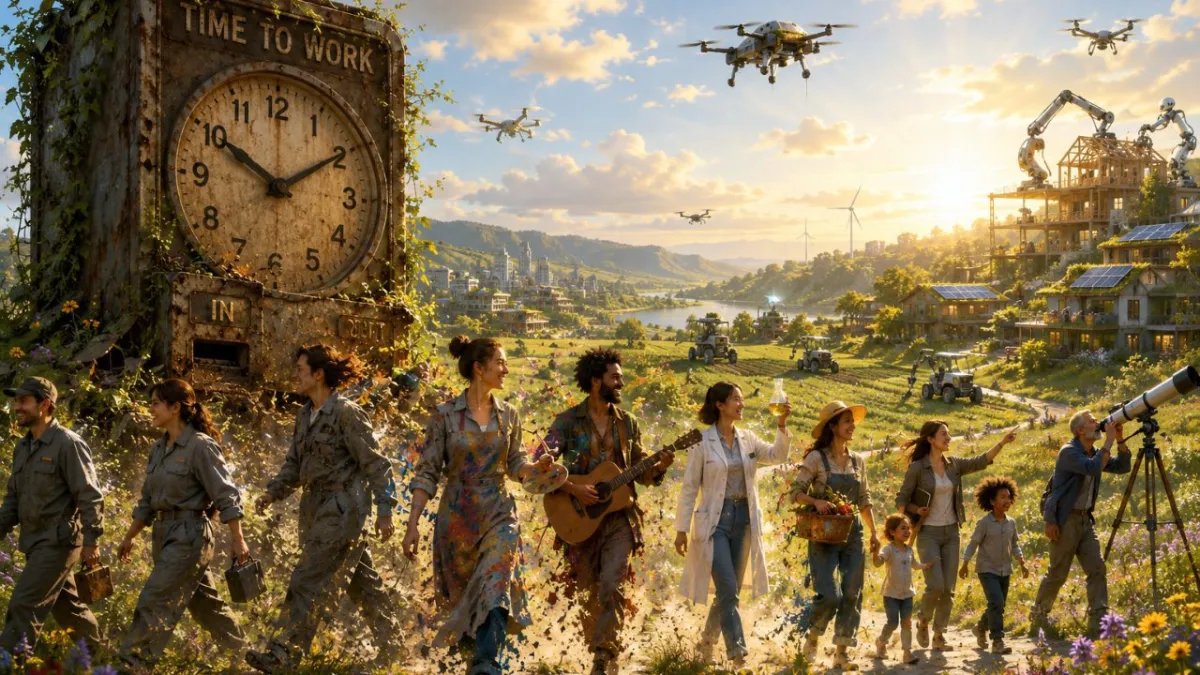
If AI can handle production, it removes the original justification for compulsory labor. The choice is whether we use AI to automate our enslavement or to finally automate our exit from the Sumerian story, transforming ourselves from a managed labor force into a self-directed, creative civilization.
For six thousand years, humanity has lived inside the Sumerian story: we were created to work for external masters. But AI has brought us to the point where labor no longer must be our master. AI abundance is not the end of work but the beginning of choice, and choice is the beginning of meaning.
Our first choice must be to insist on a democratic government run in the public interest, and a financial system that supports independent endeavor. Freeing humanity from compulsory labor can then provide the freedom for us to develop more fully as human beings.
Some people will create art. Some will teach. Some will explore science, history, biology, or engineering. Some will build communities. Families may simply become more present with each other. For the first time in history, large numbers of people may have the time and stability to ask the deeper questions about the meaning of life and the unique purpose of their own lives.
In the new story that emerges, we can see ourselves not as laborers but as musicians. We can make beautiful music together, but we need the other instruments. An orchestra is beautiful because each instrument contributes its unique voice to a larger harmony. The promise of AI is to free us from compulsory labor so that we can explore our own unique gifts and discover the music only we can play.
[ad_2]
Source link
