
[ad_1]
Tracing a rifle to a settler implicates the transfer itself, so no U.S. administration wants to run that trace, writes Imran Khalid. That is what the incident with Rho Khanna in the occupied West Bank reveals.
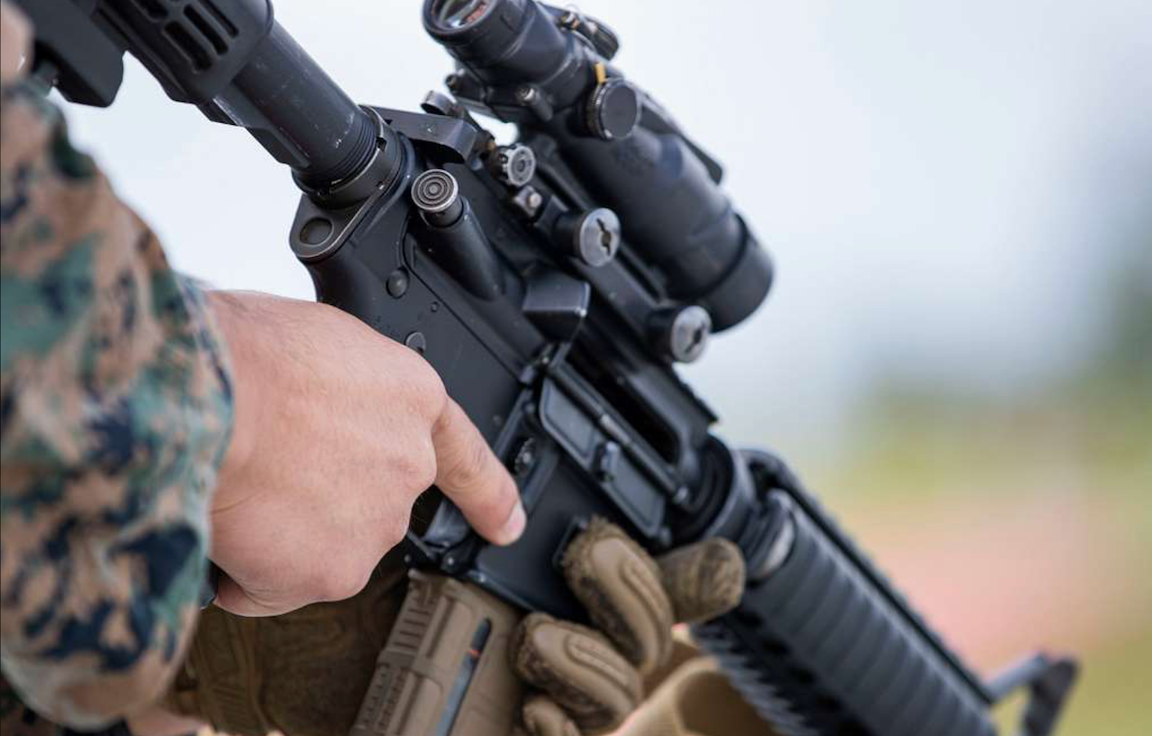
U.S. Marine loads an M4 Carbine service rifle, 2020. (U.S. Marine Corps/ Zachary Larsen/Defense Visual Information/Public Domain )
By Imran Khalid
Z Network
A sitting United States congressman was detained for more than an hour last week by armed men carrying American-made rifles, and when soldiers arrived they took the gunmen’s side.
Ro Khanna, Democrat of California, was surrounded near Khirbet Zanuta, a Palestinian hamlet in the southern West Bank, by Israeli settlers wielding M4 rifles. His van was blocked. His aides appealed to the American embassy.
By his account, when the Israeli military showed up it sided with the settlers, and only the later arrival of police ended the standoff. The weapons in the settlers’ hands were made in the country the congressman represents.
Israeli settlers, brandishing American made M4s, detained me & other Americans on my trip to Palestine.
When the IDF arrived, they sided with the settlers & continued our detention.
They made a huge mistake.
You will be hearing more soon. https://t.co/rZw8bRAn64 pic.twitter.com/4z50Ye4I7K
— Ro Khanna (@RoKhanna) July 11, 2026
The coverage has fixed on the two obvious angles, and both miss the point.
One is that this is a chapter in Khanna’s presidential ambitions, since he told Reuters he is more resolved to run after the trip. The other is that it is one more skirmish in the widening rift between Democrats and Israel. Both are true and both are secondary.
The story that will still matter after the campaign is that American weapons were leveled at an American official by non-state actors Washington neither vetted nor controls, and that the system moving those weapons cannot say how they got there.
Follow the rifle. United States military aid to Israel runs at $3.8 billion a year and includes light weaponry, the M4 among the categories funded.
Once a transfer clears, American visibility into where individual weapons end up is close to nil. The Pentagon does not track a rifle to the hand that eventually holds it.
In fact, a Pentagon inspector general report in December found the department lost track of over $13 billion in weapons sent to Israel, warning that such lapses increase the risk of U.S. technology falling into the wrong hands.
In the West Bank, settlers are increasingly armed, often with state-issued or state-adjacent weapons, and the line between a civilian militia and an official force blurs in exactly the places where Khanna was standing.
When an American-made rifle turns up pointed at Americans, the absence of end-use tracking stops being a bureaucratic footnote and becomes a man with a gun blocking a road.
Political Cover Is Thinning
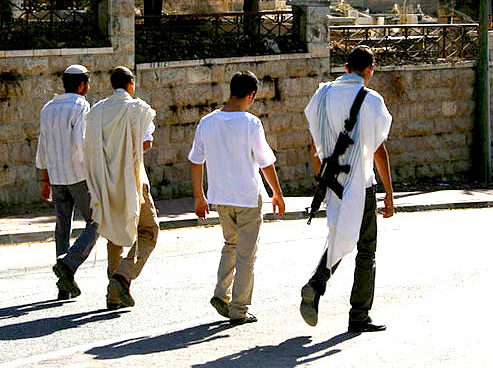
Settlers on Shuhada Street in Hebron, 2010. (ISM Palestine – Flickr/Wikimedia Commons/ CC BY-SA 2.0)
This is the shift worth naming. For decades the American-Israeli weapons relationship ran on trust and minimal oversight, because the domestic politics rewarded exactly that. No member of Congress lost a seat demanding to know where the rifles went.
That political cover is now thinning fast, and the data behind the thinning is stark. Israel’s favorability among Democrats fell from 59 percent in 2018 to 22 percent in May, according to Reuters and Ipsos polling. A growing bloc in the House wants military aid conditioned or cut. Khanna is not an outlier voice on the fringe. He is a mainstream Democrat describing where his party’s center is moving.
Here is the distinction the coming argument will blur. Conditioning aid is a political act, a vote to be won or lost, and it will dominate the 2028 primary because it makes for a clean applause line. Tracking weapons is an administrative act, a matter of end-use monitoring and the vetting statutes already on the books. The second is duller and far more consequential, because it is where actual leverage lives.
Congress can demand to know which units and which armed civilians are holding American equipment. It has rarely used that power on Israel, and the reason it has not is precisely what this incident exposes: tracing a rifle to a settler implicates the transfer itself, and no administration wants to run that trace.
That is why the pressure is about to move. As Democratic support for Israel collapses and episodes like this accumulate, the question shifts from “how much aid” to “where did the weapons go,” and the current system has no answer prepared.
I’m voting yes on @RepThomasMassie’s
amendment to zero out all aid to Israel, including aid for offensive and defensive weapons like the Iron Dome.I cannot vote for aid to a country that committed genocide and has used tax dollars to detain Americans like me. pic.twitter.com/Fu1NS9Efb9
— Ro Khanna (@RoKhanna) July 14, 2026
Khanna was not the only likely presidential candidate in the region that week.
Rahm Emanuel, in Tel Aviv, warned that Israeli conduct toward Palestinians is eroding the American base of the alliance. Two Democrats weighing a White House run, in the same country in the same week, delivering versions of the same message. That is not a coincidence. It is a party relocating its position in real time.
The near-term consequences are readable — and they arrived faster than expected. Within days, the narrative pivoted from the rifles to a credibility war.
Israeli Ambassador to the U.S. Yechiel Leiter publicly accused Khanna of a “cheap media provocation,” insisting he entered a closed military zone without coordination. U.S. Ambassador to Israel Mike Huckabee echoed that framing, calling the episode a “stunt.”

Huckabee, on left, during a visit to the Galilee last week. (US Embassy Jerusalem. Flickr/CC BY 4.0)
The Israel Defense Forces offered a competing timeline, admitting the area was not actually a closed zone and that an off-duty soldier’s conduct is under review – yet they still defended the soldiers’ hesitation.
Khanna has forcefully rejected these accounts, calling the ambassador a liar and insisting his team coordinated with local police.
The Jerusalem Post’s analysis reveals the settlers had no right to detain him, as the military zone designation had expired — yet the soldiers still refused to intervene until police arrived.
Note the deflection. The ambassador’s framing — “closed military zone,” “no coordination” — is designed to bury the weapons-tracking question under a pile of procedural accusations.
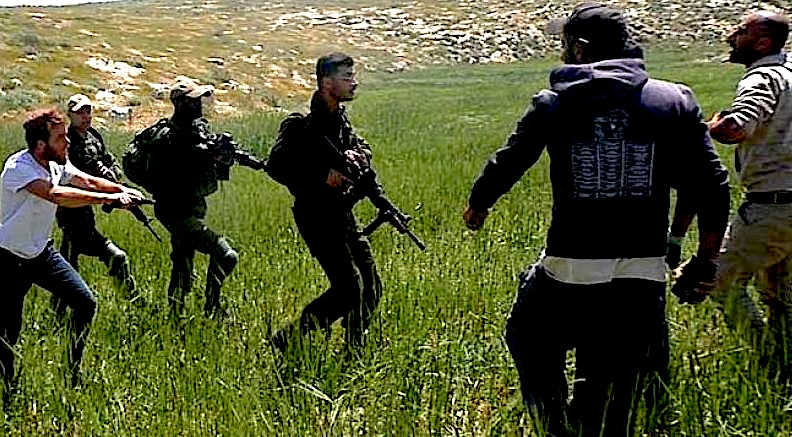
Armed Israeli settler accompanied by soldiers threatens Palestinian farmers near a-Tuwani, South Hebron Hills, April, 18, 2020. (Basel al-’Adrah, BT’selem volunteer, Wikimedia Commons/CC BY 4.0)
But the deflection does not answer the fundamental failure. Whether Khanna was justified or reckless in being there, the fact remains: a non-state actor pointed an American weapon at a U.S. congressman.
The off-duty soldier at the scene, the expired zone designation, the soldiers’ failure to intervene — none of these details answer how those specific American rifles ended up in those specific civilian hands.
Expect Democratic members to demand end-use accountability rather than only aid cuts, because accountability is harder to caricature as abandoning an ally.
Expect Israel to resist any tracking regime as an intrusion on its sovereignty. Expect the administration to slow-walk both, because the honest result of a weapons trace would be politically radioactive on all sides.
For defense contractors and the aid package itself, the near-term effect is minimal, but the medium-term risk is real: future transfers may arrive with congressional strings that did not exist a decade ago, and firms that build their forecasts on frictionless American-Israeli arms flows are pricing in a past that is closing.
There is a historical rhyme here worth a line. The United States has been surprised by its own weapons before, in Afghanistan, in Iraq, in Syria, each time discovering that arms handed to a trusted partner traveled somewhere unintended.
The pattern is consistent enough to be a rule: a government that does not track where its weapons go will eventually meet them again in the wrong hands. The novelty this week is only the setting, an ally rather than a war zone, and the target, a member of Congress rather than a soldier.
Khanna will use the footage, and he should. The more important use is the question it forces into the open.
A government that cannot say where its rifles went cannot credibly claim to control how they are used, and cannot answer for them when they turn up aimed at its own citizens.
Washington now faces a choice it has ducked for 40 years. It can build the traceability its own laws already permit, or it can keep learning, one incident at a time, that American weapons do not stay where American policy assumed they would.
The next time may not end with a police escort and a safe ride out — and the ambassador’s press release will not make the rifles disappear.
Imran Khalid is a geostrategic analyst and columnist on international affairs. He is a senior fellow at Foreign Policy In Focus.
This article is from Z Network, is funded solely through the generosity of its readers.
Views expressed in this article and may or may not reflect those of Consortium News.
Please Donate to
CN’s Summer
Fund Drive!


[ad_2]
Source link
