
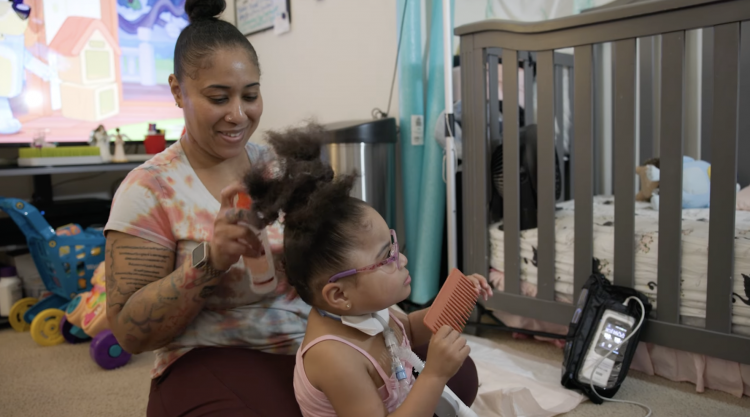
When Chaquan May’s baby girl was born at 23 weeks with life-threatening conditions, she never could have imagined that fighting a powerful union would be one of the many difficulties of providing her daughter’s medical and nursing services herself at home.
At first, May placed her daughter at an inpatient facility for medically fragile children, those with complex medical challenges who require 24-hour skilled nursing care. But she soon grew concerned about her daughter’s treatment there and her family’s limited access to her.
May, 39, received training to become a home worker through Medicare’s In-Home Support Services, or IHSS, to care for her then-infant. In the summer of 2023, as a mandatory part of her training, she attended an IHSS orientation. May was expecting to learn about the program’s rules, payroll procedures, and her legal responsibilities for compliance. Instead, she says that 75% of the orientation was devoted to pressuring her to join the local chapter of the Service Employees International Union.
At the end of the presentation, May said a representative from the Service Employees International Union local 2015 locked the doors of the orientation room and told attendees that “no one is leaving until everyone signs” a union membership card.
The union official then sat at the end of the row of desks, collecting the signed cards, according to May’s account. May said she told the SEIU 2015 official that she would like to take the form home to review it but was pressured to return it immediately and reluctantly signed.
SEIU 2015, a statewide California division of SEIU that represents hundreds of thousands of home care workers, began deducting dues from May’s paycheck the following year. After she noticed the deduction, May sent a certified opt-out letter, which requested a copy of her membership agreement and dues authorization. Instead, she says SEIU 2015 ignored her for nearly two years.
“They locked us in a room, which was odd to me because I had never been in a situation like that,” May said in an interview. “One of the head union workers literally hovered over me at the table and stood there and told me, ‘What are you waiting for? Just sign it.’ And I kind of honestly felt scared and just went ahead and signed it out of fear.”
May’s daughter is now four years old and still requires constant care. She remains on a ventilator, is non-verbal, and has experienced developmental issues that delayed her ability to walk until she was two and a half.
“It’s not easy taking care of her, but ultimately, I get it done. And I feel like she’s happier here at home,” May said. “I feel like SEIU 2015 doesn’t see me as an individual with a story. They just look at me as a number or a signature.”
“To me it’s easy to get into but hard to get out of,” she added, noting she spent two years trying to stop the dues deductions from her paycheck.
May is one of more than three dozen IHSS workers who have come forward with similar stories. Some of them say they signed up for a home care union in California under pressure and then found it impossible to reverse course and withdraw their memberships. Others claim that they never signed up at all, but suddenly, dues deductions from their paychecks started occurring each month. Still others argue they were mistakenly enrolled under names they don’t recognize. All tried contacting SEIU and other home care unions in various ways – phone calls, emails, and certified letters – but were ignored until the Freedom Foundation, a free-market organization that helps public-sector employees opt out of union membership, intervened.
In mid-June, the foundation filed unfair labor practice charges against SEIU Local 2015, SEIU Local 721, and the United Domestic Workers of America on behalf of these California home care workers who say union dues were deducted from their wages without their consent. The legal complaint alleges that IHSS works directly with the union to determine the deductions and doesn’t respond to workers’ requests to opt out of union membership.
In 2018, the Supreme Court determined in Janus v. AFSCME that public employees cannot be compelled to financially support a union without their consent. The Freedom Foundation argues that the California home care workers unions’ actions also violate the state’s Meyers-Milias-Brown Act, which established that public employees have the right to refuse to join any employee organization and bars any effort to “interfere with, intimidate, restrain, coerce, or discriminate against public employees for exercising that right.”
The legal action, filed with the California Public Employment Relations Board, the Los Angeles County Employee Relations Commission, and the Los Angeles City Employee Relations Board, alleges a systematic pattern of interference, coercion, and, in several cases, outright forgery – all aimed at keeping workers locked into union memberships – even some home care workers who never agreed to join.
In one case, the foundation says a Riverside County worker who asked for her card back within minutes of signing it was told by a union rep it wouldn’t be processed, then had dues deducted anyway for months.
“These unions aren’t just ignoring opt-out requests, they’re forging signatures, locking workers in rooms and stonewalling anyone who asks questions,” Freedom Foundation CEO Aaron Withe said in a statement. “Thirty-seven workers came to us because they tried to leave and couldn’t. That’s not a clerical error – that’s a system built to trap people.”
Since Chaquan May’s formal legal complaint, SEIU 2015 has reimbursed all of her dues. The SEIU and the UDW have sent 12 other Freedom Foundation clients refund checks, although some are not for the full amount due, according to a foundation spokeswoman. Freedom Foundation officials argue that it shouldn’t have taken formal legal action to ensure California unions are following well-established law. They also wonder how many more IHSS have experienced similar alleged union tactics without knowing where to turn for legal help.
“A refund check to a handful of them doesn’t dismantle that system,” Withe said. “That’s why we’re pursuing injunctions, not just settling for repayments.”
“This is SEIU’s modus operandi – they repeatedly defraud employees who try to opt out,” Freedom Foundation deputy chief litigation counsel Shella Alcabes asserts. “Simply getting the money back after the fact doesn’t solve the underlying problem. If this were a one-off, it might not warrant further action, but because this pattern recurs, an injunction is needed to force a change in SEIU’s behavior – not just individual repayments after the fact.”
The charges of union coercion from three dozen home care workers add a new wrinkle to the national story of Medicare and Medicaid fraud. California’s IHSS program, which allows children, seniors, and others with disabilities to receive personal care at home instead of in an institution, has ballooned in recent years. The number of people receiving in-home care increased from 555,000 in the 2019-20 fiscal year to 875,000 this year, according to IHSS Connect, an organization that aims to connect patients and home care workers in California.
At the same time, the IHSS program more than doubled in total funding over the past decade or so, making it one of the fastest-growing programs in the California state budget – driven mainly by an aging population and expanded eligibility.
In the 2020-21 fiscal year, California received $14.9 billion from the federal government for IHSS, which has grown to $33.5 billion in the 2026-27 budget.

Calif. Gov. Gavin Newsom argues that the growth of the IHSS is intentional and should be celebrated. (AP Photo/Jeff Chiu)
The Trump administration in May suspended $1.1 billion in Medicaid funding from California’s IHSS program over fraud concerns. The program loses as much as $12 billion a year nationally to scam artists – providers billing for services not performed, forging timesheets, and exploiting vulnerable seniors, according to an April report by the Manhattan Institute’s City Journal.
Advocates for the program, including California Gov. Gavin Newsom, argue the growth is intentional and should be celebrated. In-home health services provided by private companies are far too costly for many families who desperately need the care. Such services can cost $30,000 per person annually, Newsom said at a May press conference. Skilled nursing facilities can cost four to five times that.
But California’s policy changes also have driven up costs and enrollment. Those include significantly increasing the amount of property and savings a person can have and still qualify for IHSS home care, the extension of eligibility to undocumented immigrants, and steady minimum-wage increases for IHSS providers.
The incentive for labor unions to enlist as many IHSS workers as possible is obvious. With such a big increase in these types of workers, the unions are reaping a windfall from those having dues deducted from their stipends.
Union monthly dues are calculated based on a percentage of hours worked and can range between $15 and $45 a month per worker. SEIU 2015 has 275,177 dues-paying members on its annual report filed with the Labor Department.
Before the rapid expansion of IHSS members, the SEIU was already the most powerful union in California, donating to a variety of liberal political causes and Democratic Party campaigns including Newsom’s election and reelection campaigns. The SEIU also has spent roughly $31 million to get the proposed billionaire tax, a one-time 5% wealth tax on Californians worth more than $1 billion, onto the November ballot. (Newsom has opposed the measure, though he recently announced a proposal for a national wealth tax.)
Shella Alcabes argues that the SEIU and other unions don’t have to provide a lot of work and benefits for the hundreds of millions of union dues they’re receiving from IHSS providers.
“These are usually temporary workers in desperate situations who are caring for a loved one for a limited time for very low wages, so the union dues that come out of their salary hurt them the most,” Alcabes told RealClearPolitics. “It’s not like they’re a professor for UCLA or some other type of salaried public-sector job where the union dues don’t hurt that much.”
Benefits listed on SEIU 2015’s website include access to lower-priced group life insurance; vision and dental insurance plans; legal benefits under a MetLife plan for “a variety of personal needs” such as immigration consultation, landlord/tenant negotiations, and assistance with Medicare and Medi-Cal documents and a variety of other marketplace benefits; clean energy and transportation benefits; and a scholarship fund.
SEIU 2015 also represents home care workers in contract negotiations with each county in California to increase pay and expand eligibility for health care benefits and increase training funds for skills like CPR and dementia care. The union also has lobbied against IHSS budget cuts and efforts to reduce the IHSS work week from 66 to 50 hours a week, according to its website. It produces a podcast called “Who Cares” that features union officials’ interviews with lawmakers, caregivers, and other labor leaders.
Theresa Mier, spokeswoman for California’s Department of Social Services, defended the IHSS program as providing “critical support to eligible people over the age of 65 and people with disabilities.”
Mier said counties administer the IHSS program with oversight from her state department, which doesn’t determine union membership status.
“Union membership issues are handled directly between the provider and the union, and any formal complaints are reviewed by the appropriate labor relations authority,” she said in a statement.
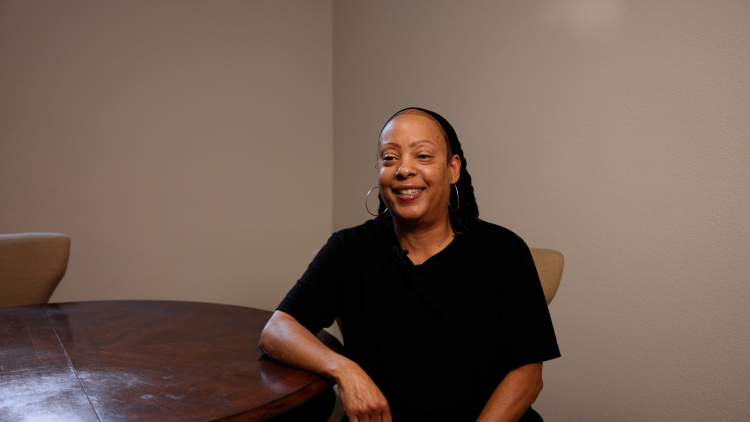
Shequita Chamberlain, one of three dozen IHSS workers coming forward with reports of SEIU harassment and unathorized collection of union dues.
Freedom Foundation
When RCP tried to contact SEIU California by calling the phone number listed on its website, the call first rang busy, then failed. Subsequent calls produced the same results. RCP requested comment from SEIU California, which referred the call to Mara Ortenburger, SEIU 2015’s communications director. Neither Ortenburger nor Kayla Blado, a press contact listed on the United Domestic Workers union’s website, returned emails seeking comment.
The unions’ lack of response is all too familiar for Shequita Chamberlain, an IHSS worker in Los Angeles County who says she sent four certified opt-out letters in five years, called repeatedly, and emailed with no response. When someone did answer the phone, she said she was either redirected to someone else or told to opt out by mail. In 2022, Chamberlain said she showed up at SEIU 2015’s headquarters in person only to be turned away under COVID protocols. As of the date of her filing, dues were still coming out of her paycheck.
“I absolutely feel trapped in my union, considering it’s been since 2020, and I never signed up to be in a union in the first place,” Chamberlain, 59, said in an interview. “So, it’s like I’m being held hostage.”
Roxanna Castro, who has provided home care services for patients suffering from multiple sclerosis, said she joined SEIU 2015 because she thought the benefits would be helpful, but no one at the union responded to her calls and questions about their offerings. Castro, 55, said she was working so few hours that too much of her paycheck was going to union dues, and she couldn’t get out of it.
“I tried to contact them many times to ask about the benefits I would be receiving, but they were always busy,” she said in an interview. “They’d put me on hold for maybe half an hour or more, and at the end they’d tell me they were going to call me back.”
One month, Castro said she worked just 12 hours for a total of $116, and her union dues were $45. During another month, SEIU 2015 had taken $45 dues out twice.
“That left me with only $60, and my gas bill was $62 that month,” Castro said. “I was working for nothing – if I was working to pay my utility bills, the union was taking that money instead. So, I decided I had to resign [from the union]. It didn’t matter what it took.”
Castro says she called the union repeatedly and told a woman she said was named Angela that she wanted to cancel her membership. Instead of processing the request or telling her how to do so, Castro said Angela kept telling her not to cancel.
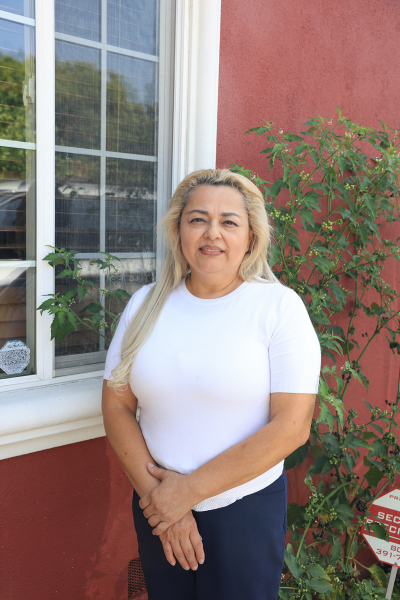
Roxanna Castro, who has provided home care services for patients suffering from multiple sclerosis, joined SEIU 2015 but has been unable to receive reimbursement for union dues taken out ‘by mistake.’
Freedom Foundation
“I wanted to scream out loud, but I couldn’t,” she said. “They try to make you feel like, as providers, we’re wrong, and they’re right – all the time.”
When she called again in January to cancel, she said the SEIU 2015 worker she spoke to informed her that she would have to wait for a full year before she could cancel. After the dues were taken out again in February, she called the union back, and that worker admitted that the dues deduction should have stopped, that there was no waiting period. Castro then demanded reimbursement for her February dues, but she said the worker told her that wasn’t possible.
“They admitted it wasn’t my mistake – it was their mistake,” she said. “They didn’t do their job – but why should I have to pay for their mistake?”
Susan Crabtree is RealClearPolitics’ national political correspondent.
