
[ad_1]
Steven Hill, Democracy SOS.
\America’s greatest anti-poverty program has long been the great income leveller in an unequal economy and democracy.
And now it faces an existential threat.
A financial tsunami of giant proportions is heading our way. It is due to arrive in about six years, and if it strikes with full force it will amount to another blow to America’s representative democracy. Policymakers have known about this tsunami for some time, but in June, we found out the Big Wave is taller than anyone knew.
That’s when the Social Security Trustees released their latest report on the financial health of the popular Social Security retirement program. According to the trustees’ report, the outlook is alarming – Social Security’s solvency is in danger. By 2032, the Social Security fund will fall short by about $2.5 trillion of the money needed to pay the 52 million American retirees their full retirement benefits. Previously, it was thought that the tsunami would make landfall in 2034, but the finances are deteriorating faster than expected. If no presidential and congressional intervention is mounted, retirees will take about a 22 percent haircut, meaning any senior beneficiary who was receiving $3000 per month will see that chopped to about $2300 per month, a loss of about $8000 per year.
That’s not chump change for retirees living on a fixed monthly income. Three-quarters of American seniors depend heavily on their monthly benefits, and nearly half would be living in poverty without it. Social Security income has been especially crucial to retired women and racial minorities, who have suffered from historical wage discrimination and therefore have less retirement savings. During economic downturns, it has acted as an “automatic stabilizer,” keeping money in people’s pockets, maintaining consumer spending levels, providing customers for businesses, and preventing deeper recessions. Social Security has been the most stable component of our nation’s retirement system, especially compared with Americans’ other chief sources of savings — their homeownership and their 401(k)s and IRAs — which are struggling amid the current affordability crunch driven by rising costs for housing, healthcare, and groceries.
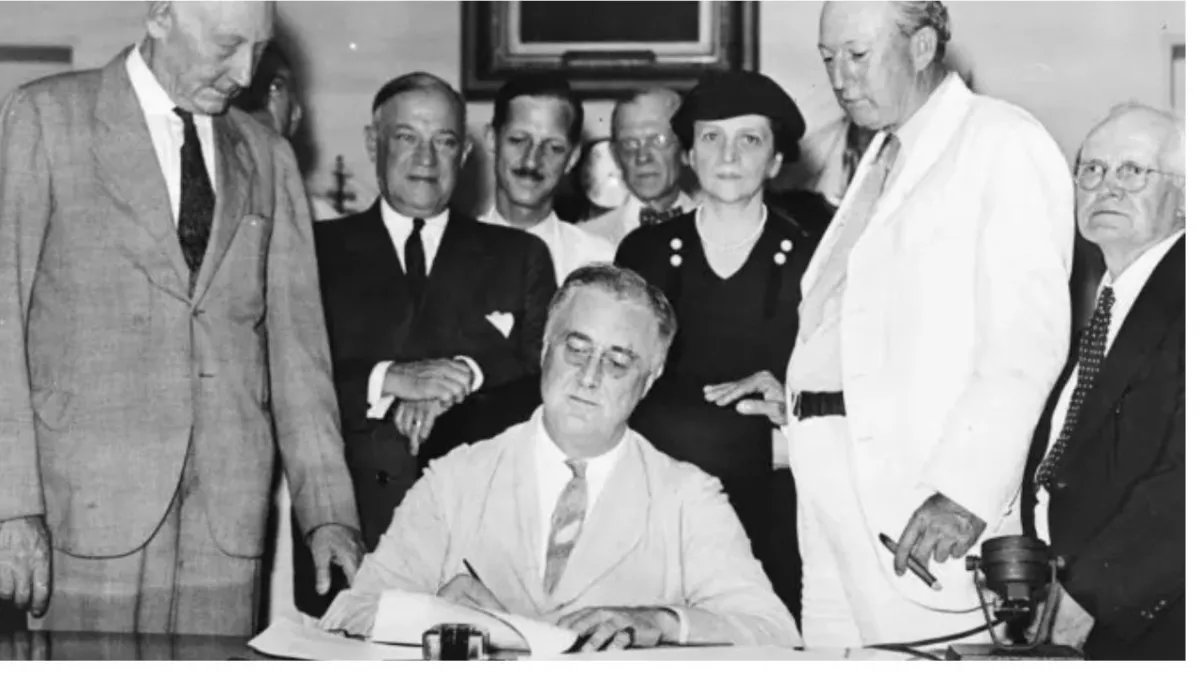
In short, Social Security not only has been the greatest anti-poverty program ever, keeping tens of millions of older Americans afloat in their elderly years, it has kept the American economy afloat during numerous economic downturns. It has been a vital part of the financial fabric of the American Dream for almost a hundred years, when it was launched by President Franklin Roosevelt in 1935. And right now the threat against it is growing by the day while the Do-Nothing Congress dawdles. 2032 is not that far away. A Social Security crisis in six years means it will loom over the next president’s term.
This is not the first time that the popular Social Security program has hit a financial roadblock. In 1983, a bipartisan commission came together and successfully solved the then-looming crisis. But today the spirit of bipartisanship is so broken that it is scarily possible that any attempt at solving today’s crisis will collapse in a bitter mess of partisan finger-pointing and blaming. And then, we will be standing at the edge of a financial cliff, looking past our collective toes down into the abyss, as we fall off without a parachute.
Why is Social Security so…insecure?
Given the foundational importance of Social Security to the nation’s retirement system and overall economic vitality, why has it reached the current “red threat” level? Most experts agree that there have been a few causes for the growing crisis. First, it’s good news that Americans are living longer, but it also means they are collecting more in Social Security retirement benefits. In the 1950s, the average retiree received a monthly Social Security check of $554 (inflation-adjusted), was retired for 10 to 15 years, and received a total lifetime payout of $65,000 to $110,000. An average retiree today receives a bit more than $2000 per month for 15 to 25 years and will receive a total lifetime payout of $380,000 to $640,000. Sure, American workers receive much higher wages today and pay more into the Social Security fund, but it’s not been enough to keep up with the increased benefits being paid out (note that this is different than what is called the “dependency ratio.” While the ratio of workers to non-working dependents (children, disabled and retirees) has declined, past labor productivity increases and job creation have allowed the Social Security trust fund to receive adequate revenues to maintain benefit levels, despite the declining ratio).
Second, there has been an upward redistribution of income due to greater inequality among wage-earners. Consequently, revenue collected from the Social Security payroll tax has been declining as a share of national income. The funding mechanism for Social Security is peculiar. Unlike income taxes, in which the more income a person earns, the higher the tax on every dollar earned, or unlike Medicare, in which every American pays the same tax rate on every dollar earned, Social Security has a cutoff called a payroll cap. Any income earned by an individual above $184,500 is exempt from the 6.2 percent Social Security payroll tax. Their employers also stop paying their payroll match, so a total of 12.4 percent in tax revenue is lost on income above the payroll cap. About 11 million of the wealthiest Americans exceed the taxable maximum wage and stop paying into the Social Security fund.
Consequently, less total income is being taxed by the Social Security administration. In 1982, just 10 percent of national wage income went to high-wage earners whose income escaped further taxation by exceeding the payroll tax cap. But over the last quarter century, close to 17 percent of wage income has gone over the cap and therefore has not been subject to the Social Security tax. This upward redistribution of wage income has substantially reduced the revenue flowing into the Social Security trust fund.
A third cause undermining Social Security’s finances is relatively new but will have an increasing impact. That’s the passage from last July of President Donald Trump’s One Big Beautiful Bill (OBBB), which gave a special tax break to seniors over 65, reducing the amount of tax they pay into the Social Security trust fund. This was a sweetener that Trump threw into his bill to blunt opposition to the massive tax giveaways to the wealthiest of the wealthiest Americans contained in that law. But it meant less tax revenue for the Social Security trust fund.
This temporary tax break for seniors will last only through 2028, but the Committee for a Responsible Federal Budget estimates that the loss of tax revenue from OBBB will accelerate the projected depletion date of the Social Security fund by a full year. At that point, many of those same seniors who received the tax break will get a 22% haircut on their Social Security monthly payout. Anti-Social Security Republicans cleverly used smoke-and-mirrors legislative tactics to undermine this “entitlement” program, as they like to call it, since politically they don’t dare call for the abolishment of one of the most popular federal programs ever. Clever, MAGA Trump, clever.
A fourth cause, according to the Trustees’ report, is Donald Trump’s anti-immigration policies. Although those policies have been in effect for only a short time, they are already making this problem worse. It turns out most of those immigrants are working-age adults who pay into the system for many years before they collect benefits. The Trustees’ report concluded that lower immigration will result in a loss of tax revenue and greatly deepen Social Security’s financial hole. Trump’s immigration policies are further endangering Social Security’s already deteriorating financial condition.
Another uncertain factor is the impact of AI. If, as many fear, AI accelerates rising income inequality and stagnant or reduced wages, it will further reduce the payroll tax receipts that currently pay for Social Security.
Can Social Security—and retirees’ benefits—be saved?
So, is it possible to save retirees’ Social Security benefits? The short answer is: absolutely. I actually wrote a whole book about this a few years ago, Expand Social Security Now: How to Ensure Americans Get the Retirement They Deserve. This is not an economic or financial problem; it is a classic “guns versus butter” dilemma for modern governments. In other words, it’s a political will problem rather than a budget crash up. There are numerous adjustments that could be made to shore up Social Security benefits, and even to increase the amount of the benefit for Americans. Here are just a few of them:
* Eliminate the unfair Social Security payroll cap, currently set at $184,500, beyond which an individual and their employer pay no more Social Security tax. The practical effect of the cap is that billionaire bankers and CEOs contribute a far lower percentage of their income to Social Security than their secretaries and chauffeurs do. Requiring every American and their employers to pay 6.2% on every dollar of income would not only be fairer and more equal, but also raise hundreds of billions of dollars to close the financing gap. That’s how the Medicare tax works; why not Social Security?
* Apply the Social Security tax to investment income. Many affluent Americans derive much of their wealth from investment income rather than wages. Yet they make zero Social Security contributions based on that investment income. By applying Social Security rules to this income — which is how Medicare is partly funded — we would raise billions of dollars to help stabilize Social Security.
* Eliminate tax shelters and loopholes for one-percenter households and businesses, including for capital gains, “carried interest” and the truly outrageous “step-up in basis,” which exclusively benefits inherited wealth. These function as direct federal subsidies to the most affluent Americans, and they cost the national treasury some $350 billion per year.
The “step-up in basis” exemption is particularly repugnant. When a yacht or mansion or any other type of expensive asset is sold, the seller’s profit is subject to the capital gains taxation rate of 15–20 percent — about half the 37 percent tax rate that the wealthiest pay on their wage income. Normally, the amount subject to taxation is the appreciated value, which is the difference between the amount the seller originally paid for that particular asset, which might have been many years ago, and the usually much higher sale price. But for inherited property, the difference is calculated using the date that the previous owner died and left it to the heirs. As a result, the appreciation in value is much less, and so are the capital gains taxes. This effectively erases decades of capital gains taxes for the heirs.
Rather than a “step-up in basis,” this dodge might more accurately be termed a “step-up in privilege.” Of the more than 200 federal tax expenditures in the individual and corporate income-tax systems, this is one of the 10 largest. And of course none of the income received from the sale of these inherited assets is taxed for Social Security purposes. If it were, at the usual 6.2-percent Social Security tax rate that all workers pay, it would generate billions more for the Trust Fund.
Other tax deductions result in tens of billions of dollars in federal subsidies for the wealthiest Americans. These include federal subsidies of individual retirement savings accounts, like 401(k)s and IRAs – nearly 80 percent of the federal subsidy goes to the top 20 percent of income earners – and the home mortgage interest deduction – a massive 86 percent of this federal subsidy goes to Americans in the top 10-percent income bracket. These tax-code favoritisms are nothing more than “entitlements for wealthier Americans.”
In short, just a few revenue streams would raise more than enough money not only to save Social Security but also to increase the monthly Social Security payout. In fact, in my book Expand Social Security Now, I proposed doubling the monthly payout, bringing it to levels that other nations already provide, and showed how we could raise the revenue to do that. If other countries can do it, why can’t we Americans?
Yet not even Democrats are calling for that, even though doing so not only would provide a more stable, secure retirement for every American, it would make the economy itself more secure by levelling out the ups and downs of the economic cycle.
Will our political leaders save Social Security?
According to the Social Security trustees’ June report, the amount of additional funds needed to keep paying full benefits for the next 25 years is 1.06 percent of the nation’s GDP. To put that in perspective, the Trump administration has proposed increasing military spending by $420 billion next year, equivalent to about 1.4 percent of GDP. So “We the People” have financial and budgetary options, but are “We the Leaders” listening? It’s all a matter of what we, as a society, decide to prioritize.
If the Democrats want a popular issue to run on, championing the rescue of America’s most popular federal program, and going further to expand it, seems like a smart campaign slogan. If no party decides to prioritize this, America in 2035 is going to look much different compared to America today, and not for the better. Not only will our economy suffer, but representative democracy itself will further decay as inequality grows and its tentacles creep into every household, city and town. We are coming to a fork in the road. I hope we take the right turn.
Steven Hill @StevenHill1776 bsky.social @StevenHill1776
Editor’s Note: At a moment when the once vaunted model of responsible journalism is overwhelmingly the play thing of self-serving billionaires and their corporate scribes, alternatives of integrity are desperately needed, and ScheerPost is one of them. Please support our independent journalism by contributing to our online donation platform, Network for Good, or send a check to our new PO Box. We can’t thank you enough, and promise to keep bringing you this kind of vital news.
You can also make a donation to our PayPal or subscribe to our Patreon.
Please share this story and help us grow our network!
[ad_2]
Source link
