
[ad_1]
Jeffrey D. Sachs China Daily
On Saturday, the United States will mark the 250th anniversary of its Declaration of Independence. The occasion deserves reflection — not only on what the US has become, but on the founding principles it has so often forgotten. Three of those principles, set out by the founders themselves, would, if remembered today, transform the conduct of US foreign policy and improve the prospects for global peace.
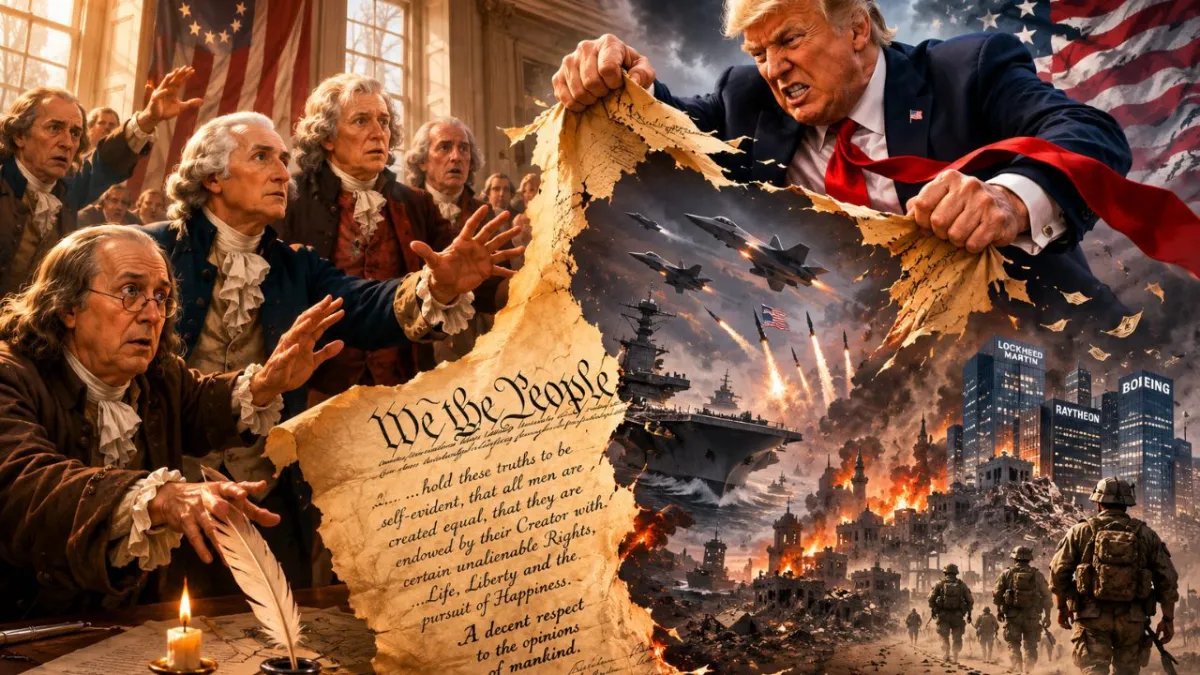
The first is contained in the opening of the Declaration of Independence. The American colonists explained their decision to separate from Britain by appealing to “a decent respect to the opinions of mankind”. This was a remarkable formulation. The Continental Congress claimed legitimacy by reasoned argument addressed to the wider human community whose opinions deserved respect. The new republic, in announcing itself to the world, did so as a member of the human family, not as its intended master. To be worthy of the respect of others — rather than to demand their submission — was offered as the foundation of American political identity.
The second principle is president George Washington’s counsel in his Farewell Address of 1796. Frustrated by his countrymen’s partisan attachments to either Britain or France, the first president urged a different course: “It is our true policy to steer clear of permanent alliances with any portion of the foreign world.” Five years later, in his first inaugural address, Thomas Jefferson distilled the same wisdom into the sentence that has echoed ever since: “Peace, commerce, and honest friendship with all nations, entangling alliances with none.” A young republic gained nothing, and risked much, by binding its fortunes to the rivalries of the foreign powers.
The third principle is the most misunderstood today. The Monroe Doctrine, proclaimed in president James Monroe’s annual message to Congress on Dec 2, 1823, is currently invoked — by both friends and critics of the US — as a founding charter of US hegemonic ambition in the Americas.
The actual text is something quite different. Monroe asserted no US supremacy over Latin America. Instead, he warned the European powers that the newly independent republics of the Americas were “henceforth not to be considered as subjects for future colonization by any European powers”.
In return, Monroe pledged that the US would stay out of European affairs, and especially European wars: “In the wars of the European powers, in matters relating to themselves, we have never taken any part, nor does it comport with our policy to do so.”
The original Monroe Doctrine was a doctrine of mutual noninterference and mutual respect: Europe was to stay out of the Americas, and the US was to stay out of Europe.
It was only later, with Theodore Roosevelt’s “Corollary” of 1904, that the doctrine was transformed into a claim of US police power over the Western Hemisphere.
These three principles — a politics worthy of others’ respect, a foreign policy free of entangling alliances and a posture of mutual noninterference among the world’s great regions — formed a coherent vision of how a nation should conduct itself in the world: with reason, with restraint and with the awareness that the reasoned opinions of mankind are the proper measure of legitimacy.
Yet from the beginning, the US also pursued an opposite impulse: the impulse to empire. Even as American leaders quoted Washington and Jefferson, American armies waged a century of war against the Native peoples of North America, dispossessing them of their lands in the name of “Manifest Destiny”. In the 20th century, the US’ imperial impulse swept across the Pacific to the Philippines, across the Straits of Florida to Cuba, and into the long string of Cold War interventions in Korea, Vietnam, Iran, Guatemala, Chile, the Congo and Indonesia. In the 21st century, it has run on through Afghanistan, Iraq, Libya, Syria, Yemen and Ukraine. And at the end of February, the US joined Israel in a blatant war of aggression against Iran, attacking a sovereign nation in defiance of international law and the United Nations Charter.
The US has spent two-and-a-half centuries oscillating between its better self and its imperial temptation. The imperial temptation, in our time, has often won, and often led to disastrous outcomes.
The 250th anniversary is the occasion for the US to choose again. The world today is not a stage on which a single superpower can act with impunity. It is and should be a community of nations that should live together with mutual respect and on equal terms. The path back to the founders’ wisdom is also the path forward to peace, a path the US should pursue with China, Russia, Iran, the BRICS group and the emerging and developing countries of every region. The US should not bully the world but rejoin it as a valued friend and partner for the common good. That, at 250, would show the worthiest respect to the founders and to the community of nations they sought to join.
The author is University Professor at Columbia University and president of the UN Sustainable Development Solutions Network.
The views do not necessarily reflect those of China Daily.
Editor’s Note: At a moment when the once vaunted model of responsible journalism is overwhelmingly the play thing of self-serving billionaires and their corporate scribes, alternatives of integrity are desperately needed, and ScheerPost is one of them. Please support our independent journalism by contributing to our online donation platform, Network for Good, or send a check to our new PO Box. We can’t thank you enough, and promise to keep bringing you this kind of vital news.
You can also make a donation to our PayPal or subscribe to our Patreon.
Please share this story and help us grow our network!
[ad_2]
Source link
