
[ad_1]

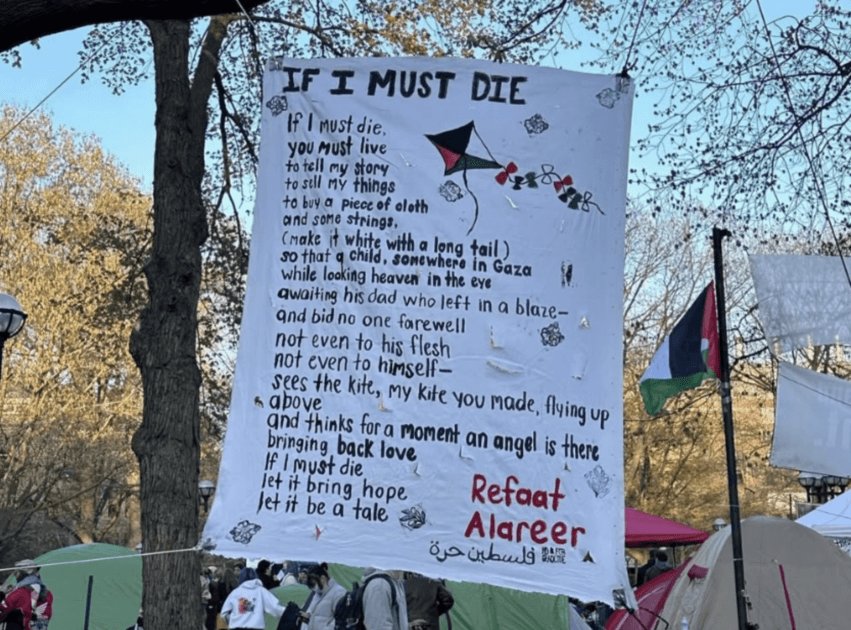
A banner with Refaat Alareer’s poem “If I Must Die” hanging on a tree in the Gaza solidarity encampment at the University of Michigan, Ann Arbor. Alareer, an influential Palestinian writer, teacher, and activist, was killed by Israel in Gaza in December 2023. Israel also killed Alareer’s eldest daughter and her infant child in April 2024. Photo by AHRIR Coalition.
The University and the Trump administration want to criminalize Palestine solidarity as part of their push to also crush labor organizing.
On June 10, 2026, we woke up to the news that the homes of individuals involved in Palestine solidarity activism at the University of Michigan, where we teach, had been raided by the FBI. Assisted by the University’s police, federal agents in military gear drew their guns, threw flashbangs, and deployed drones to arrest several individuals in a neighborhood in Ypsilanti, Michigan. Those arrested were taken away barefoot, made to walk on shattered glass from the house door the agents had broken through. That morning, the FBI also arrested individuals in Illinois and Wisconsin connected to Palestine activism on our campus. Several of the defendants are current or former students at the University.
The display of force was part of the US government’s effort to brand these activists, now known as the “Michigan 8,” as dangerous terrorists. The Justice Department indicted the defendants on bogus “conspiracy” charges – even though their alleged actions amount to little more than property damage, directed at local institutions and individuals complicit in the genocide in Gaza. But the defendants now potentially face decades in prison.
We are appalled by this violence against our students and community members. Sadly, these recent raids are only the latest in a repressive program that the University of Michigan, the police, and allied politicians have been developing together for years. What is happening in Michigan reflects a wider push to criminalize solidarity with Palestinians. Yet the target of the repression is not only Palestine solidarity, but workers’ solidarity generally.
In recent years, there has been a proliferation of campus unions that organize the diverse workers (graduate students, faculty, staff, and even undergraduates) who make the university run. These unions fight for better wages and conditions, but university administrators also fear their potential to challenge the university’s investments in war. The fear is justified by signs of broader change within labor organizing: last month, United Auto Workers voted to divest from Israel Bonds, going against a long history of big unions aligning with US government foreign policy.
On our campus at the University of Michigan (UM), labor organizing and Palestine solidarity organizing have become almost inseparable. Two of the Michigan 8 defendants were also campus labor organizers who helped expose how the apparel bearing the University’s block “M” logo, which Nike has licensed for over $173 million, is produced in sweatshops in the Global South under abusive conditions. Much of the Palestine solidarity work on campus involves the graduate student union – Graduate Employees Organization (GEO), Local 3550 of the American Federation of Teachers – which represents over 4,000 graduate workers. The people organizing for Palestine are often the same people organizing for better wages, better health insurance, and access to gender-affirming care for graduate students. In 2025, after the University suspended the major pro-Palestinian student group, Students Allied for Freedom and Equality (SAFE), GEO continued organizing with the group’s members to keep Palestine solidarity work going.
The University knows that attacking union members for their Palestine activism can disrupt union organizing. In 2024, the University worked with Michigan State Attorney Dana Nessel to bring criminal charges against students, including graduate workers, who had participated in the campus Gaza solidarity encampment. (An investigation by the Guardian later revealed that the University also hired private investigators to follow and intimidate pro-Palestine student activists.) When these cases fell apart and Nessel had to drop the charges, the University turned to internal disciplinary procedures to try to punish these students, right as the union was preparing for contract negotiations. As GEO noted at the time, “If the University can punish any student at any time for activism undertaken months or even years prior, we effectively lose our right to assemble and organize freely.”
These overlapping movements also share a common enemy: the police. The university police force that participated in the FBI raids against the Michigan 8 was also sent to crush GEO’s six-week-long strike in April 2023 – the longest strike in the University’s history. During that strike, university police were called to detain graduate student workers who tried to talk with then-President Santa Ono about their demands after the University had docked their wages. Cops were also sent to surveil picket lines and make intimidating home visits to graduate students active in the union. The following spring, the same police force violently disbanded the Gaza solidarity encampment on campus, trashing communal food, confiscating personal belongings, and massively pepper spraying the crowd, resulting in at least two people being hospitalized.
In an earlier, 2020 strike, GEO called to disarm and defund the University of Michigan police; if those demands had been met, the University would have had more difficulty repressing the movement for Palestine that blossomed a few years later – demonstrating again how labor organizing and Palestine solidarity can strengthen one another.
Palestine solidarity is also itself a class struggle. The high-up administrators – the president, provost, and various deans – who seek to crush both the local unions and Palestine solidarity activism receive huge salaries from our public university. They are paid handsomely to protect the University’s economic interests, including its investments in Israel’s US-backed genocide in Gaza. That includes endowment money invested in Israeli entities, which student activists have called to divest, but also more direct investments: UM has a center that develops vehicle technologies for the US Army, an Economic Growth Institute program dedicated to optimizing the supply chains of weapons developers for the Defense Department, and a Ross Business School initiative where faculty consult for Boeing, the top manufacturer of missiles and munitions given to Israel in 2023.
Meanwhile, the university police force that shields these investments from activists receives the lion’s share of funding, at the expense of workers and taxpayers. UM police have a yearly budget of over $35 million, while necessary campus services such as mental health care and support for sexual assault survivors remain under-resourced. In 2023, the median salary for a University of Michigan, Ann Arbor police officer was about $85,000, while for campus daycare workers it was $44,000 and for cafeteria kitchen staff $41,000; not enough to live on in the highly gentrified town of Ann Arbor. A similar story can be told about most major US universities.
The growing convergence of labor and Palestine solidarity has the potential to challenge this unjust system as a whole. This is why the University of Michigan and allied government forces are going for the most draconian responses. They know that sending chills through the Palestine solidarity movement – with the Michigan 8 being the latest, most extreme example – could also freeze labor organizing. We must not let this happen; these struggles are stronger when they are fought together.
[ad_2]
Source link
