
[ad_1]
The fragile ceasefire between Iran and the United States has been broken once again. The United States has been bombing Iran, claiming that its attacks are in retaliation for Iran attacking three vessels near Straight of Hormuz, which it considers as violation of the Islamabad agreement, officially known as the Memorandum of Understanding (MoU) between the two nations.
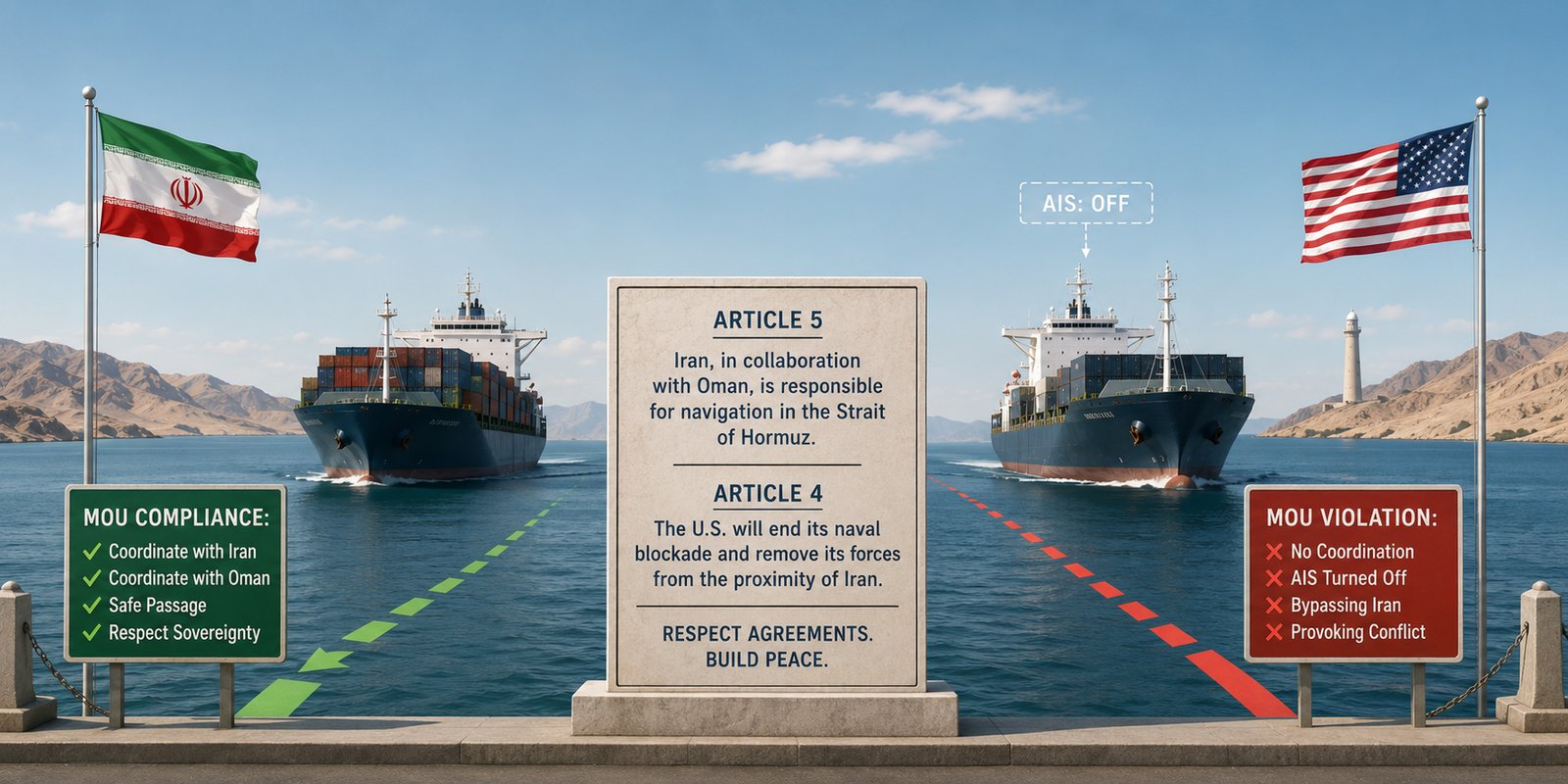
But it is in fact the United States that has been violating the MoU because its interpretation of Article 5 of the MoU is simply false. According to Article 5 of the MoU, Iran is obligated to
“Make arrangements using its best efforts for the safe passage of commercial vessels with no charge for 60 days only from the Persian Gulf to the Sea of Oman, and vice versa. The traffic of commercial vessels will immediately start, and considering the need for removing the technical and military obstacles and de-mining by the Islamic Republic of Iran, will be instated within 30 days. The Islamic Republic of Iran will conduct dialogue with the Sultanate of Oman to define the future administration and maritime services in the Strait of Hormuz, in discussion with other Persian Gulf littoral states, in line with the applicable international law and the sovereign rights of coastal states of the Strait of Hormuz.”
The statement is unambiguous, and cannot be interpreted in any way other than Iran, in collaboration with Oman, is the party responsible for navigation in the Strait of Hormuz. It also clearly distinguishes a temporary arrangement for 60 days, and the long-term traffic regime in the Strait. Therefore, any vessel passing through the Strait must coordinate it with Iran, as well as Oman.
But this is not what the United States has been doing. In an effort to test Iran’s resolve for its control of the Strait, and to weaken it, Arab States of the Persian Gulf and others, with direct support of the United States, dispatched several commercial vessels to pass through Oman’s territorial water without any coordination with, or even informing, Iran. They had even turned off their Automatic Identification System (AIS) transponders to evade Iran. This is in clear violation of Article 5, which Iran will not accept. Indeed, no self-respecting nation will.
This view is fully supported by Article 4 of the MoU:
“Immediately upon the signing this MoU, the United States of America will begin the removal of its naval blockade and any disturbances or impediments against the Islamic Republic of Iran, and will fully end the naval blockade within 30 days. During this period, the traffic of vessels will be in proportion to the numbers of pre-war traffic being restored by the Islamic Republic of Iran. The United States of America further undertakes to remove its forces from the proximity of the Islamic Republic of Iran within 30 days after the final deal.”
In other words, it is Iran that should restore the vessel traffic through the Strait to its pre-war level. Thus, once again, no vessel can pass through the Strait, unless it is coordinated with Iran, at least as one of the two parties specified by Article 5.
The United States cannot also invoke, at least during the 60 days period, the claim that Oman, a sovereign nation, has decided on its own to allow passages of vessels through its territorial waters in the southern part of the Strait, because Oman is not a party to the MOU. In other words, the United States cannot take actions through a non-party in order to bypass its obligations under the MoU. If this act were to become the standard practice, then, what would be the point of consultation and negotiations between Iran and man, which the MOU specifies?
A review of the MoU’s other Articles still buttresses the view expressed above. According to Article 14, the permanent maritime regime in the Strait of Hormuz will be endorsed by the United Nations Security Council. This is supposed to happen after the conclusion of negotiations between Iran and the United States, signing an agreement. In other words, until such times as when that endorsement is secured, which will happen after the negotiations are completed, the MOU is in force, unless another interim agreement is agreed upon.
The United Stats cannot also claim that it is protecting the right to free navigation in international waters. Aside from the fact that the U.S. does not have such a mandate by the United Nation Security Council, the fact is that at its narrowest point, the Strait is only 21 miles (34 km) wide. The international conventions on the law of sea have recognized the first 12 nautical miles (roughly 22 km) of any water adjacent to a state as its territorial sea. Iran obtained sovereign rights on its territorial sea since the first convention was adopted by the United Nations in 1959. Oman, which is on the opposite side of the Strait, has claimed the same, which means the two territorial waters overlap, leaving no residual in between as “international waters.” All universally agreed international law standards provide that any otherwise implication on the passage of vessels through Iran’s territorial water, arising from the 1982 United Nations Convention on the Law of the Sea, does not adversely affect Iran’s sovereign rights because Iran has not ratified the latter convention, although it has signed it.
Aside from all such considerations, there is another crucial aspect that the Trump administration must consider, if it is serious to reach a long-term agreement with Iran. Iran’s hardliners have opposed the MoU and have even issued death threats against the chief Iranian architectures of the MoU, namely, President Masoud Pezeshkian, Foreign Minister Abbas Araghchi, and Speaker of the Majles [parliament] Mohammad Bagher Ghalibaf. Hardliners’ emotions have been running high this week due to the funeral processions of the late Supreme Leader, Ayatollah Ali Khamenei, to the extent that they physically assaulted the President and Araghchi. Bombing Iran during such times will only prove to them once again that what Khamenei repeated over the years, that “the United States cannot be trusted,” is true, making a future long-term agreement that much harder to reach.
Both Iran and the United States should take a long view of the current state of affairs. After decades of economic sanctions, two illegal wars, and constant threats by the United States against Iran, Iran remain steadfast in defending its sovereign rights. There is for the first time a real opportunity for the two nations to reach accommodation, which will be greatly beneficial to the entire Middle East, and world peace. They should not squander the chance for real peace over disputes that, although they may seem significant now, they will have no significance if a long-term agreement between the two nations can be reached.
Muhammad Sahimi, Professor of Chemical Engineering and Materials Science and the NIOC Chair in Petroleum Engineering at the University of Southern California, is co-founder and editor of the website, Iran News & Middle East Reports.
[ad_2]
Source link
