
[ad_1]
Where does the Communist movement go from here? That’s the first question Betwa Sharma asks Mohammed Salim, a leader of the Communist Party of India (Marxist).

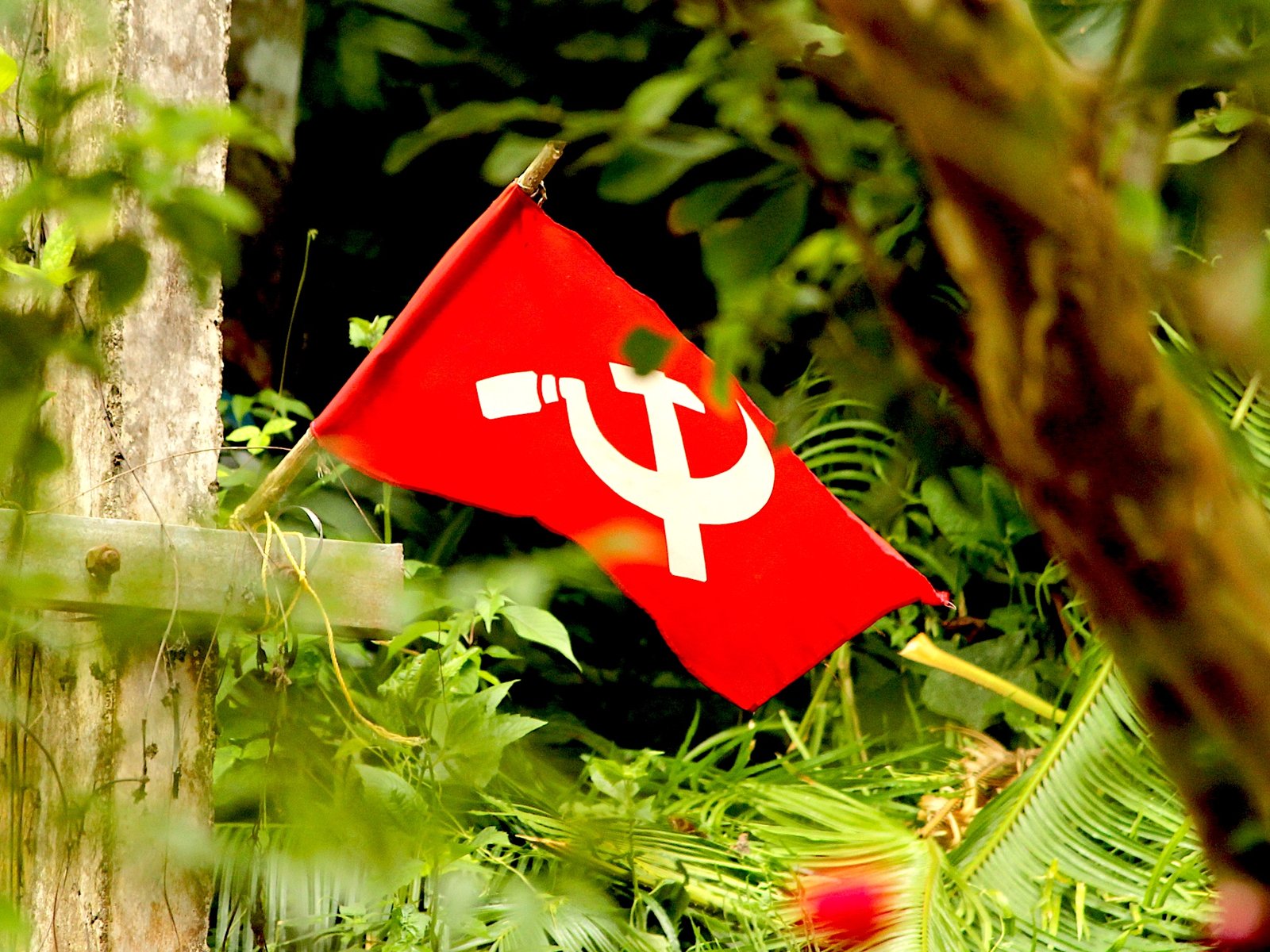
A communist flag in Kottayam, Kerala, India, 2015. (Praveenp/Wikimedia Commons/CC BY-SA 4.0)
By Betwa Sharma
in Delhi, India
Special to Consortium News
 With the loss of Kerala, the communists are no longer in power anywhere in India for the first time since 1977.
In an accompanying piece on communism in India, Mohammed Salim, a top leader of the Communist Party of India (Marxist), argued that communism in India was never sustained by governments alone, but by movements on the streets, in factories, on campuses and in villages.
Salim, a former minister in the West Bengal government who is currently West Bengal’s state secretary is a four-time lawmaker — he served twice in the Lok Sabha, India’s lower house of Parliament; once in the West Bengal Legislative Assembly and once in the Rajya Sabha, India’s upper house of Parliament.
He said decades of religious, caste and regional identity politics fractured working-class unity, alongside the rise of Hindu nationalism and an increasingly hostile political climate under the BJP.
At the same time, Salim said the left still has relevance, particularly among young people questioning inequality and authoritarianism, because issues such as poverty, displacement and exploitation remain deeply unresolved in India today.
This full interview covers the strengths, weaknesses, relevance and future of the communist movement, the division with Left politics, the six-decade long Maoist (Naxal) insurgency, and the right’s sustained attack on the Left under the Hindu nationalist Bharatiya Janata Party (BJP).
You are not in power in any state after the loss in Kerala. Where does the Communist movement go from here?
Definitely, it is a debacle as far as the CPI (M) movement in India is concerned. But even in the sixties, when there was no communist party in government, there was a much more active left movement and farmer-, worker- and student-led movement, particularly when Vietnam was being bombed.
The youth flocked together under the leadership of the left, which led to the formation of governments in Kerala, Bengal and Tripura. It is not only when we are in government that the left movement is relevant. When we were not in government, in the sixties and the early seventies, that was a golden era of movement by the opposition and the left in particular.
The Communist Party sustains its strength not only from state power but from street movements and struggles, particularly by empowering the marginalised section.
Welfare policies will continue in one form or another. These are rights-based, but the Congress (Indian National Congress) party, the BJP (Bharatiya Janata Party) or the TMC (Trinamool Congress—a regional party in West Bengal) will find a way of exclusion, not rights-based but entitlement. The communist movement will be stronger by raising the question of rights rather than entitlements. It is not dole or largesse to be distributed.
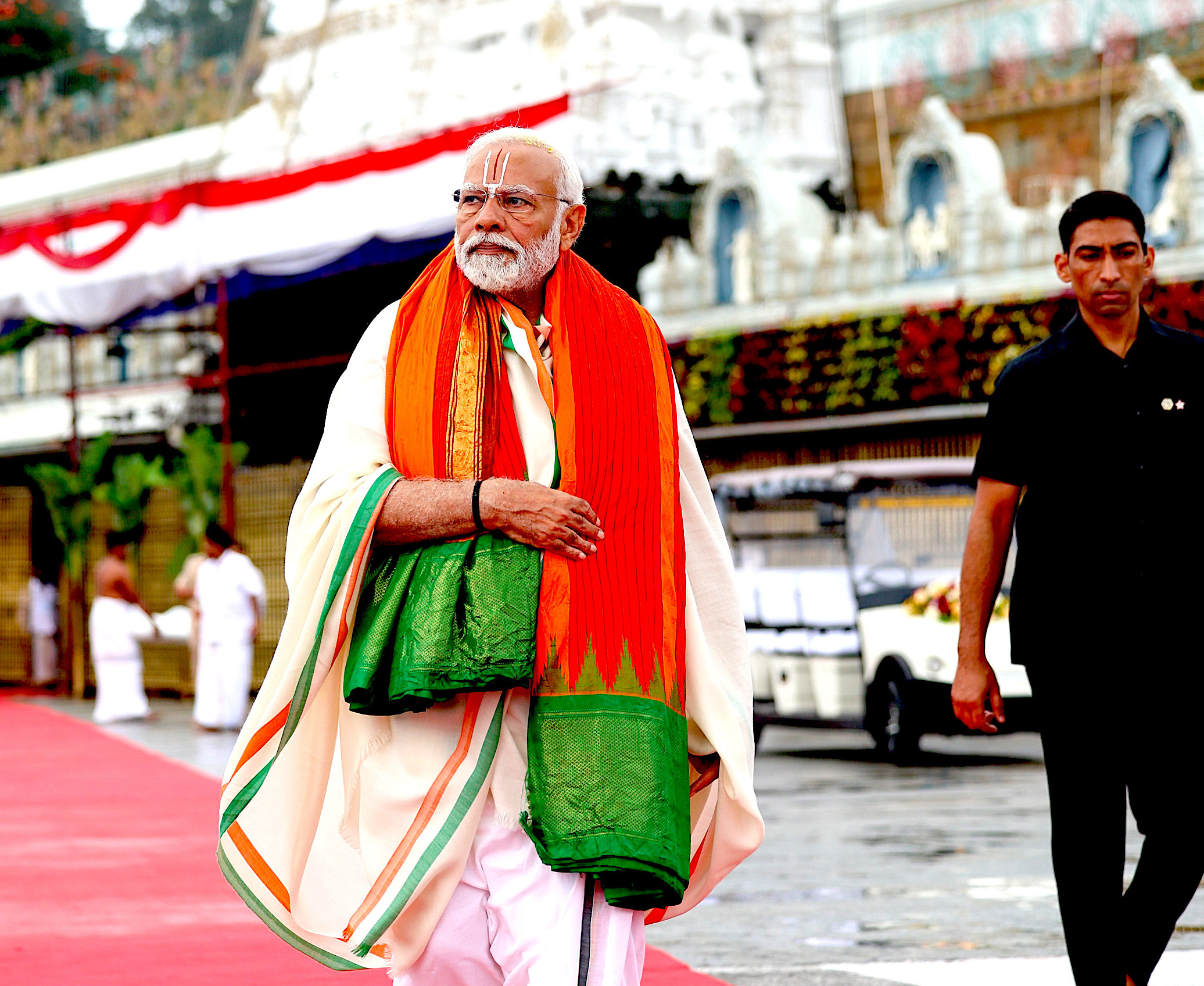
Prime Minister Narendra Modi offers prayers at Sri Venkateswara Swamy Temple in Tirumala, Andhra Pradesh on November 27, 2023. (Prime Minister’s Office of India, Wikiimedia Commons, GODL-India)
How did the communist parties get to this point?
That is a question that we are also addressing. There is no simple answer. Since pre-Independence days, the communists were not throughout the country. It was mainly the workers’ belt, Lahore, Peshawar, Mumbai, Kanpur, Chennai and Calcutta.
Then, in the thirties, the kisan (farmer) movement in north India spread its wings, not politically, but because of poverty. After the Partition, we got stronger in Bengal and Punjab because of the migration of many leaders and organisers from Lahore and outposts of the left movement, and the repressive measures in the fifties by the regime in Pakistan, where the Communist Party was banned.
Then the divisions came. When division takes place based on religion, region or language, the unity of the working people and the student community get divided.
The Communist Party faced setbacks in Assam and Punjab, where, after Bengal, Kerala and Tripura, some development was taking place in the seventies. Even prior to that, in the late sixties, Andhra Pradesh was also a strong centre for the communist movement, but internal conflict between the extreme left and the left cost us dearly in Andhra and north India.
Since the mid-eighties, when divisive politics developed over religion, we have had a setback because young people in northern India got divided into Hindu-Muslim identity, as was the case in the northeast, based on tribal identity.
More division on regional identity, caste, sub-caste and religion has cost the left movement because unless the people get united, they cannot resist. Instead of giving rise to the labour movement, the kisan (farmer) movement, the student movement, the major energy of the CPI (M) in the eighties and nineties went into checking the divisive forces and fighting against communalism, casteism, regionalism and identity politics.
The communist movement still has a huge appeal in student politics but it does not translate from college campuses to the mainstream. Why is that?
It is true the campus always used to be the centre for the left and progressive movement but after (economic) liberalisation, this has also changed. Private campuses have flourished where campus politics is not allowed and secondly in government-funded universities there is hardly any democratic space anymore.
The rise of the rightists is always a threat to the campus, not only campus politics but to the campus as a whole. They think the status quo cannot be maintained if there is democratic space and debate and discussion and a political consciousness is developed among the students. The more they learn, the more they learn to question the establishment. The rightist establishment all over the world including the Modi regime attack the people who will question.
Still, we are trying to survive, but you can hardly find democratic space in most of the state-run universities. The same in Pakistan and Bangladesh. There was no political discourse inside their campuses for two decades. They think by one or two decades of a gag order, there won’t be new recruits.
But you have seen this Cockroach Party (a satirical online movement critical of the government that exploded in India last week). They are not politically guided and I don’t know what will happen to them, but the new generations are generally anti-establishment, no matter who is in power.
The youth, the age, because they don’t have much luggage to carry, they question. Our problem is to retain them. Post-campus, most of them go for their own livelihood and professions instead of giving time and energy and experience to organise workers and peasants. That will be our task. How to retain them and how they can function in villages, slums and the industrial belt. We are weak in that and we have to address it.
Has factionalism within the communist movement weakened it politically? Have these differences blurred with time?

CPI(M) North Chennai candidate U.Vasuki campaigning in 2014 with T.K.Rangarajan, left foreground, a leader of the Communist Party of India (Marxist). (Jaffar Theekkathir /Wikimedia Commons.CC BY-SA 3.0)
I will not say factionalism. From the beginning of the community party, even in Russia, there were various traits that emerge from how you view the existing society, economy, approach towards the ruling class and what is the process of the revolution. There were debates from the thirties in India and they got sharpened after Independence. You will see this in many countries.
Secondly, the external factors, the influence and interference of the big communist parties of Russia and China. CPI (M) from the beginning said we should be free from the influence of Moscow and Beijing.
When the first split took place, the CPI (Communist Party of India) was influenced by the Khrushchev regime. When the CPI (ML—Marxist Leninist) split from the CPI (M-Maoist), there was influence from the Mao regime. We see that also in Bangladesh, Pakistan and Nepal.
That apart, now with time, these traits are more blurred and not so sharp. With international developments, national developments and the challenges that we face, it is not a small thing that all the communist parties, especially the CPI and CPI (M), have been coming together since the 1980s, more than 45 years.
Even now, the CPI (ML) Liberation, a major section of the Naxalites have amended their ways and are now with the CPI and CPI (ML), and they contested some seats. It is no small matter that, despite their different approaches to organisation and views on the revolutionary path, the left parties have come together to face this fascistic strain and the current onslaught from the right.
How are your differences with the Congress Party different from your differences with the BJP?
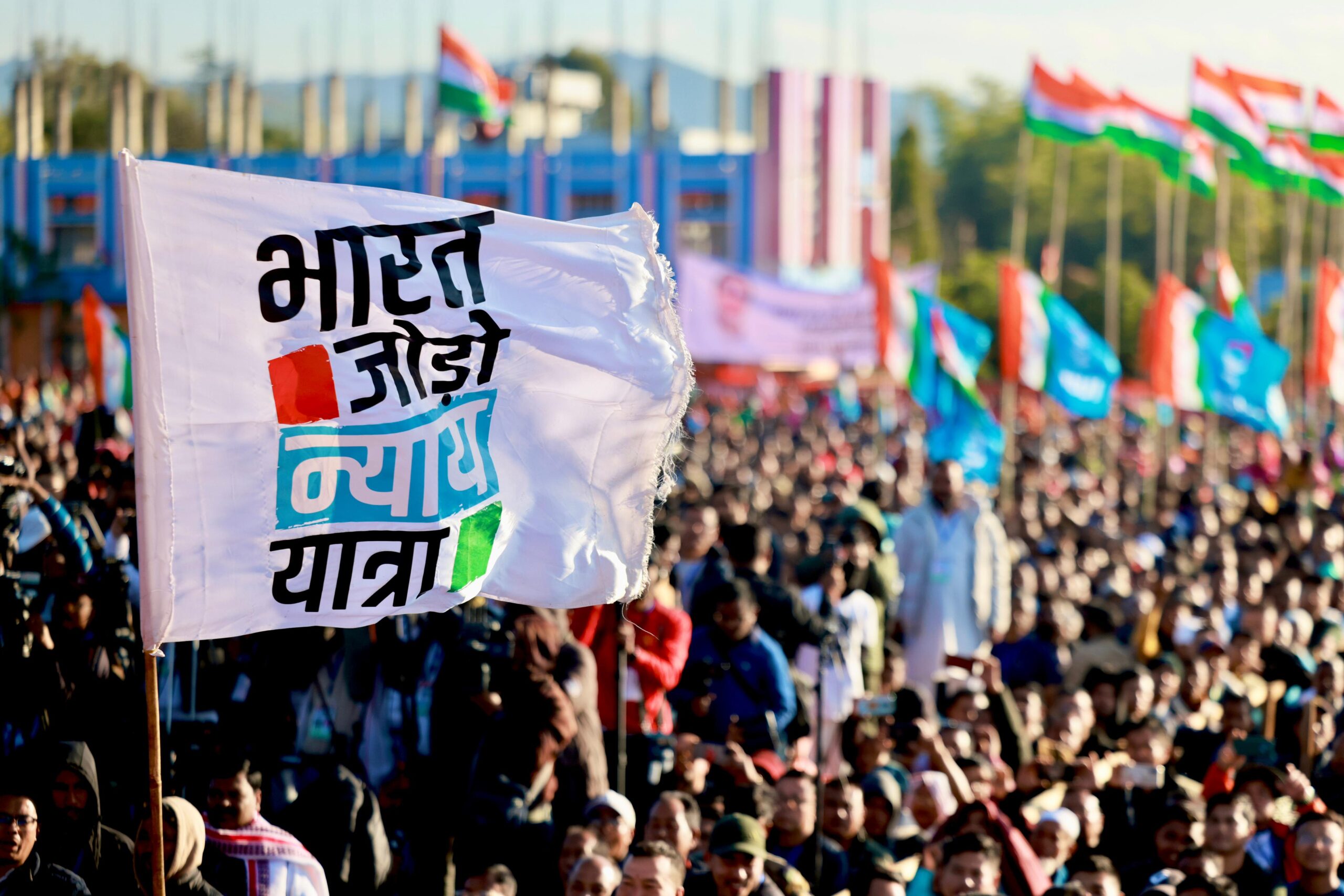
A Congress Party 2024 campaign rally kicks off in January in Thoubal, Manipur, India. (Wikimedia Congress, Public Domain)
Do you remember the quote from a journalist turned politician about what is the difference between BJP and Congress? BJP is Congress plus cow (considered holy by many Hindus, used by Hindu extremists to attack and kill Muslims in the name of cow protection in the past decade).
Otherwise, it has the same economic policies, same societal attitude of the ruling class. The social coalition of Congress in the pre-Independence days of SC (marginalised castes), STs (scheduled tribes), OBCs (other backward classes), minorities (religious), and upper castes, was broken. Through social engineering, BJP is also making a larger coalition of many strains of Hinduism under the pretext of this so-called political project, Hindutva (Hindu majoritarianism). It is a corporate and communal nexus. The left will fight this. We need a united front with the Congress, not because it is Congress, but because it is the left and the centre against the extreme right.
With the rise of the extreme right the world over, the rightists have turned to the extreme right and the centrist have moved towards the right. So, that is the fallacy. In this case, our effort should be that we get the left united and centrists must take the left- of-centre position. That is how we can counter the extreme rightist forces.
The Naxal insurgency has been very violent, but it has forced us to confront the realities of poverty, exploitation and stark inequalities. What is its relevance today?
The ideological and political debate continues between the extreme left and the left. In the Indian context, the Naxalites and the organised left movement. To quote Lenin, it is adventurism. But adventurism has its appeal among the youth. And you are right about the poverty, deprivation and the marginalised sections.
When they get more marginalised, this kind of violent response is inevitable. In all the forests and mineral-rich places, you see how it is handed over to the Adanis, Vedantas and the big corporations by uprooting the poorest of the poor. So, naturally, the reaction will be an extreme form. Congress tried to counter this through Salwa Judum (a state-backed militia movement) and the BJP through extreme force.
You can destroy a movement, but you can’t destroy the will to fight as long as extreme poverty and exploitation continue. History will remember the Naxal movement, but the cause for it has to be addressed. The Naxalites started in Bengal, but then land reform and land distribution took place, and the Naxalites also withered away there.
It is childish adventurism, which is also fatal for the organised movement because it is not going to succeed. The rightist establishment and state power always prefer anarchism to the organised left. They fear the organised left. When you had the farmers’ protest that left a mark, and Modi had to bow to the pressure.
What do you make of the term “urban naxal” by the right?
The coinage of urban naxal is extremely dangerous. The extreme rightists want to paint everyone with the same brush, all red flags are the same. Whoever asks questions, whoever stands against the government, whoever fights fascism, whoever asks for democracy, civil liberties and the constitutional rights, they will term them as urban naxal.
This is an old practice. If you want to kill a dog, give it a bad name. Urban Naxal is a threat to the people who are serving in the field of culture, literature, music and economy. This coinage has been worked out to bundle them up so an attack can be made against the progressive, secular, democratic forces.
Betwa Sharma is the managing editor of Article 14, the former politics editor at HuffPost India, and the former U.N./New York correspondent for the Press Trust of India. She has also reported for numerous publications, including The New York Times and The Intercept.
Views expressed in this article may or may not reflect those of Consortium News.
Please Donate to the
Spring Fund Drive!


[ad_2]
Source link
