

[ad_1]
A list of the wars of the United States in a blood-soaked quarter of a millenium as the nation marks 250 years of independence, domestic suppression and homage to militarism.
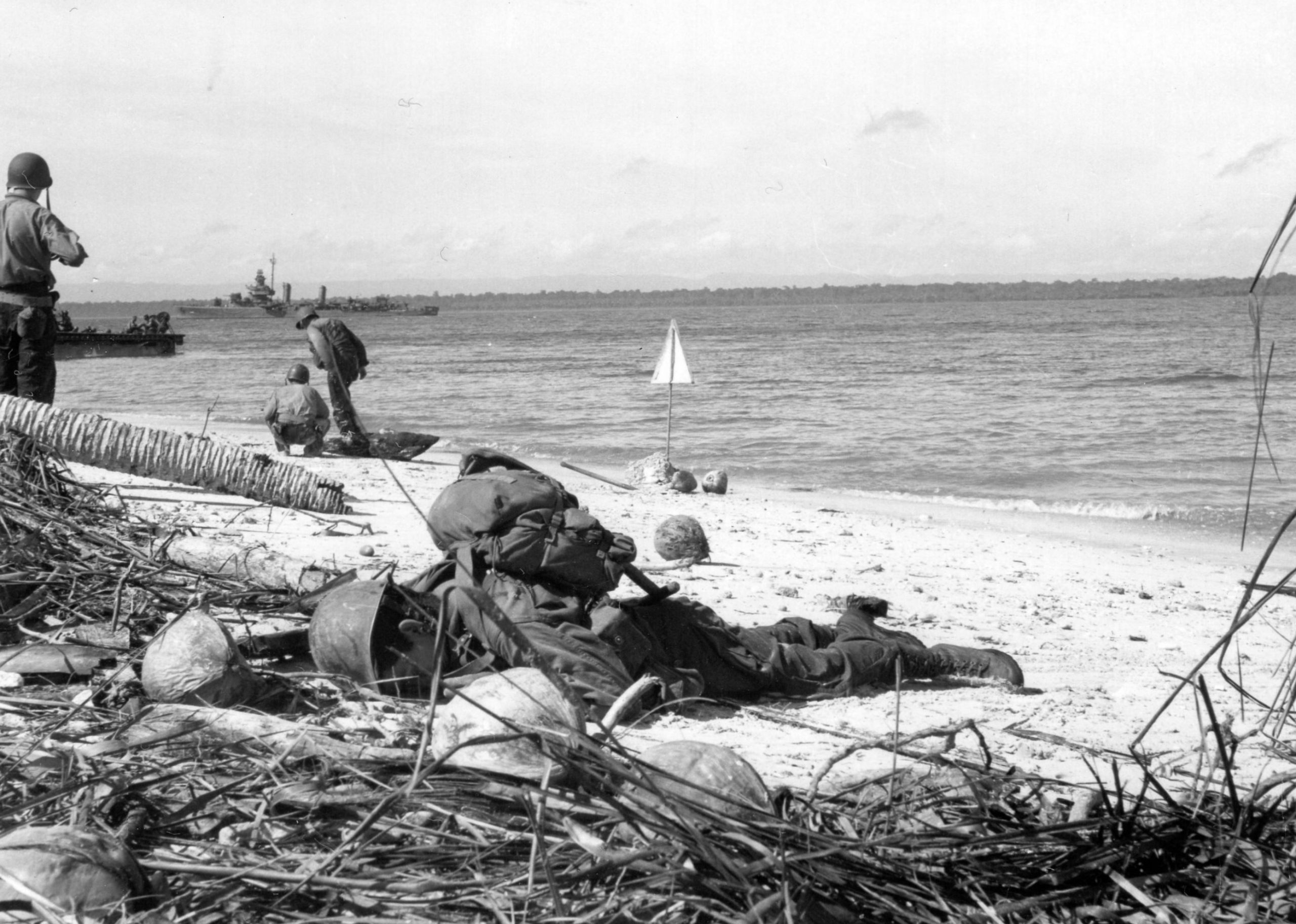
Dead American soldier on the beach at Wakde, Dutch New Guinea, May 18, 1944. (U.S. National Archives/Wikimedia Commons)
The wars of the United States of America dating from its independence, conquest of much of the North American continent, its overseas territories and indirect rule in a mad quest for global dominance.
The British Empire began to war against the native population in 1586. Britain exterminated, by direct killings, from 1586–1776 in the range of 20,000–100,000+, concentrated in major conflicts like the Pequot War, King Philip’s War, and repeated wars with Powhatan and other tribes. This does not include indirect deaths from disease.
Total population loss from all causes in British-colonized areas was likely in the hundreds of thousands. Between 1492–1600, native population estimates for the area that became the U.S. range from about 2–7 million. The Eastern Woodlands (where most British settlement occurred) likely had hundreds of thousands to over a million. By 1776, the native population in the future U.S. had fallen to roughly 500,000–600,000 or lower in many regions, with massive losses east of the Mississippi.
In 1776 the United States took over these wars alm0st immediately after independence, completing the genocide 114 years later in 1890. About 30,000–45,000 Native Americans were killed in combat, massacres, and related frontier conflicts after U.S. independence. When factoring in other causes, such as disease, the numbers are also in the hundreds of thousands. The native population fell from roughly 500,000–600,000 between 1776–1800 to about 250,000 by 1890–1900.
U.S. Wars and Military Conflicts: 1776–2026
1770s–1790s (Founding and Early Republic)
- 1775–1783: American Revolutionary War – The colonies successfully fought for independence from Britain. Key events include the Declaration of Independence (1776), alliance with France, and decisive victory at Yorktown. Ended with the Treaty of Paris; established the United States as a sovereign nation.
- 1776–1795: Cherokee–American wars and related Native American conflicts – Series of clashes as American settlers expanded westward. U.S. forces and settlers generally prevailed, forcing significant land cessions from Cherokee and allied tribes through treaties and military pressure.
- 1785–1795: Northwest Indian War – U.S. forces battled a confederacy of Native tribes in the Ohio Valley. Early U.S. defeats were reversed by victory at Fallen Timbers (1794). Led to the Treaty of Greenville and opened the Northwest Territory to American settlement.
- 1798–1800: Quasi-War (undeclared naval war with France) – Naval conflict over French seizures of American ships. U.S. Navy achieved several victories at sea. Ended diplomatically with the Convention of 1800; helped establish an independent U.S. Navy. Led President John Adams in 1798 to push the Sedition Act through Congress, which John Adams to push the Sedition Act through Congress, which permitted deportation, fine, or imprisonment of anyone deemed a threat or publishing “false, scandalous, or malicious writing” against the U.S. government. This was only seven years after the First Amendment and the Bill of Rights was ratified.
1800s–1850s (Expansion and Early Interventions)
- 1801–1805: First Barbary War (against Tripoli) – America’s first overseas war was fought to end Barbary pirate seizures of U.S. ships and tribute demands. U.S. naval and Marine operations succeeded. It was begun by President Thomas Jefferson without a formal declaration of war by Congress though the Constitution, ratified just 13 years earlier, required one. James Madison warned of excessive executive power if presidents, rather than Congress, decide when to go to war.
- 1812–1815: War of 1812 (against Britain) – Declared over impressment of sailors and trade restrictions. Mixed results: British burned Washington D.C., but U.S. won at New Orleans. Treaty of Ghent restored pre-war boundaries; often viewed as a strategic stalemate that boosted U.S. nationalism.
- 1817–1818: First Seminole War – U.S. invasion of Spanish Florida under Andrew Jackson to stop Seminole raids. U.S. forces prevailed. Resulted in Spain ceding Florida to the United States.
- 1810s–1850s: Various Indian Wars (Arikara War 1823, Black Hawk War 1832, Second Seminole War, etc.) – Conflicts driven by westward expansion and removal policies. U.S. military and settlers ultimately prevailed in most, enforcing Indian Removal (including Trail of Tears).
- 1846–1848: Mexican–American War – Triggered by Texas border disputes. U.S. forces decisively defeated Mexico and captured Mexico City. Treaty of Guadalupe Hidalgo gave the U.S. vast western territories; one of America’s clearest expansionist victories as the United States, born of the British Empire, began to establish an empire of its own.
1850s–1890s (Civil War and Western Expansion)
- 1850s–1860s: Multiple Indian Wars & Bleeding Kansas – Clashes over land, resources, and slavery. U.S. forces maintained the upper hand in most engagements.
- 1861–1865: American Civil War (Union vs. Confederacy) – Brutal internal conflict over slavery and union. Union victory after over 600,000 deaths; preserved the nation and abolished slavery via the 13th Amendment.
- 1860s–1890s: Continued Expansionist Wars Against Sovereign Native Nations (Dakota War 1862, Little Bighorn 1876, Wounded Knee 1890, etc.) – U.S. campaigns against Plains and Western tribes. Despite occasional Native victories (e.g., Little Bighorn), the U.S. ultimately prevailed, ending major armed Native resistance by 1890.
- 1898: Spanish–American War – Quick war sparked by the USS Maine and Cuban independence. Decisive U.S. victories in Cuba and Philippines. Acquired Puerto Rico, Guam, and the Philippines; marked America’s rise as a global, imperial power. Sparked Anti-Imperialist League, whose members included Mark Twain, Henry James and Grover Cleveland.
1900s–1940s (Emerging Global Empire)
- 1899–1902: Philippine–American War – Insurrection against U.S. control after Spain’s defeat. U.S. forces won after brutal guerrilla fighting with high civilian toll. Established long-term American colonial rule in the Philippines.
- 1900s–1910s: Banana Wars, Boxer Rebellion (1900), Mexican Border War – Interventions to protect U.S. imperial interests in Latin America and China. For the U.S., generally successful short-term occupations or shows of force.
- 1917–1918: World War I – U.S. joined Allies against Germany. Provided decisive manpower and resources leading to Allied victory. Woodrow Wilson rebuffed Washington’s admonition that the U.S. not get entangled in European affairs. Wilson helped shape the post-war order, which saw U.S. influence in Europe grow, though the U.S. later rejected Wilson’s proposed League of Nations.
- 1918–1920: Limited intervention in the Russian Civil War – Small expeditions in Siberia and North Russia with minimal impact. U.S. forces withdrew without achieving anti-Bolshevik goals.
- 1932: Shanghai, China – U.S. forces protected the International Settlement during Japanese-Chinese fighting. No combat; successful evacuation and defense of American citizens.
- 1933: Cuba – Naval demonstration during anti-Machado revolution. No landings; symbolic show of force.
- 1934: Fuzhou (Foochow), China – Brief Marine landing to protect the U.S. consulate. Limited and successful protection mission.
- 1941–1945: World War II – Total war after Pearl Harbor against Axis powers. Complete U.S. and Allied victory, mostly thanks to Russia in Europe; established America as the world’s leading imperial power and it helped found the United Nations.
1950s–1990s (Cold War Era)
- 1950–1953: Korean War – U.S.-led U.N. defense of South Korea. Ended in armistice near the 38th parallel after heavy casualties; strategic stalemate but prevented full communist takeover of the South.
- 1960s–1975: Vietnam War (and related actions in Laos and Cambodia) – Prolonged and brutal U.S. effort, killing around 3 million people, to prevent communist takeover of South Vietnam. The U.S. ultimately withdrew and Vietnam was unified in 1975 — a major American strategic defeat.
Cold War proxy wars and coups (1940s–1990s)
This era saw U.S. meddling in Western European elections and C.I.A. backing of coups in xx countries from 1945 to 1990. In many cases, such as Iran in 1953, Guatemala IN 1954 and Chile in 1973 and Indonesia in 1975?, the U.S. helped overthrow democratic governments and replaced them with monarchies or dictatorships. The Truman Doctrine set the Cold War in motion in earnest and its first application was in Greece.
- 1947–1949; 1967: Greece – U.S. intervened to fight communist and other partisans who had resisted the Nazis leading to their defeat in a brutal counter-insurgency that became a blueprint for Vietnam. In 1967 the U.S. backed a military coup against a democratically-elected, moderately leftist government. A torturous, right-wing military dictatorship was openly supported by the Nixon administration until ended in 1974.
- 1953: When Iran tried to nationalize its oil industry, Britain and the U.S. overthrew the popular, democratically-chosen Iranian Prime Minister Mohammed Mossadegh and restored a king to his throne–a complete reversal of 1776.
- 1954: Guatemala – C.I.A.-backed coup overthrew the elected president, Jacobo Árbenz, who introduced land reforms, largely in the interest of the United Fruit company.
- 1961: Cuba (Bay of Pigs) – Failed invasion by U.S.-backed exiles; major embarrassment for the Kennedy administration.
- 1960s–1970s: Laos/Cambodia – Secret bombing campaigns contributed to regional destabilization and failed to help U.S. win the Vietnam War.
- 1965: The U.S. began meddling in Indonesia in the mid-1950s to undermine the non-aligned leadership of President Sukarno.
- In 1965, the military, with U.S. knowledge and support, launched a violent purge targeting the Indonesian Communist Party (PKI) and suspected leftists.
- Scale: Hundreds of thousands (estimates 500,000–1 million+) were killed in one of the 20th century’s worst massacres. Villages were razed, torture and rape were widespread, and bodies were dumped in rivers.
- U.S. Role: The U.S. embassy and CIA provided lists of thousands of PKI members and leftists to the Indonesian military for targeting. Washington supplied weapons, communications equipment, and economic aid while praising the events. Propaganda portrayed it as a necessary anti-communist action. Sukarno was gradually sidelined and placed under house arrest.
- Motivations: Sukarno’s neutralism/non-alignment, his “Guided Democracy,” protection of the PKI, and policies threatening Western economic interests (e.g., in oil and plantations). The U.S. welcomed Suharto’s pro-Western, anti-communist dictatorship, which opened Indonesia to foreign investment.
- 1975-1984: Latin America military dictatorships
- Operation Condor was a U.S.-backed intelligence and assassination network involving right-wing military dictatorships in Chile, Argentina, Uruguay, Bolivia, Paraguay, Brazil (and to varying degrees Peru, Ecuador, and others). It coordinated cross-border operations to hunt, kidnap, torture, and murder perceived leftists, exiles, and opponents.
- The U.S. (via the C.I.A., State Department, and Pentagon) provided training, intelligence sharing, financial support, and technical assistance (e.g., through the School of the Americas and other channels). This included lists of targets and communications equipment.
- Scale of Atrocities: Tens of thousands killed or “disappeared” across the region. Blum ties it to the broader pattern of U.S.-installed or -supported regimes using death squads and torture as standard tools against any challenge to pro-U.S., anti-communist rule.
- 1975–2002: Angola – U.S. support for anti-communist factions ultimately failed as MPLA retained power.
- 1980s: Nicaragua – Contra support failed to overthrow Sandinistas; linked to Iran-Contra scandal, which CN’s founder, Robert Parry, helped to uncover.
- 1979–1989: Afghanistan – U.S.backing helped force Soviet withdrawal, though it led to rise of Taliban, al-Qaeda and 9/11.
- 1980s: El Salvador – U.S. backed anti-communist government survived but conflict ended in negotiated settlement.
- 1982–1984: Lebanon – Peacekeeping mission ended in humiliation after 1983 Beirut bombing killed 254 U.S. marines; U.S. withdrew failing to achieve stability.
- 1983: Grenada – U.S. invasion of small Caribbean island was condemned by the U.N. General Assembly as “a flagrant violation of international law.” A similar measure in the Security Council “deeply deploring” the invasion got 11 votes but was vetoed by the U.S. Coming eight years after defeat in the unpopular war in Vietnam, this was a small scale, probing invasion to test public and international opinion about aggressive U.S. action.
- 1986: Libya – Air strikes on Col. Gaddafi 185 years after Jefferson’s attack on Tripoli.
- 1989–1990: Panama – U.S. killed thousands of innocent civilians in operation to seize Noriega.
First Gulf War
- 1990–1991: After deceptively giving a green light to Saddam Hussein to invade Kuwait, U.S.-led a coalition that invaded Iraq, burying Iraqi soldiers alive with bulldozers and shooting thousands of retreating soldiers in the back. Iraq was driven out of Kuwait. U.S. encouraged Shia and Kurdish rebellions against Saddam but then failed to support them. U.S. left Hussein, who had been a U.S. ally in the 1980s war against Iran, in power.
2000s–2026 (So-Called ‘War on Terror’)
- 2001–2021: War in Afghanistan – Longest U.S. war, launched to destroy al-Qaeda and remove the Taliban, but failed to do either, ending in ignominious retreat in 2021 after 20 years. Taliban regained power in a U.S. strategic defeat.
- 2003–2011: Iraq War – Invasion removed Saddam Hussein but led to insurgency, civil war, and rise of ISIS. U.S. achieved regime change but at enormous cost and with unstable long-term outcomes. Now widely seen as one of the greatest strategic blunders in U.S. history.
- 2000s–present: ‘War on Terror’ (Yemen, Somalia, Syria, etc.) – U.S. allied with al-Qaeda and ISIS to overthrow Syrian government, which after more than a decade of failure, eventually achieving with an al-Qaeda terrorist becoming president. Ongoing drone and special operations continue around the region. “War on Terror” enabled the Patriot Act and warrantless domestic surveillance on Americans.
- 2011: Libya intervention – Helped oust Gaddafi but contributed to failed state and regional instability.
- 2014-2026: The U.S. backed coup in Kiev, empowering neo-nazi militias and instigated a civil war against ethnic Russians in the east of Ukraine who resisted the coup, because of which, Crimea re-joined Russia. After eight years of deceptive diplomacy, refusal to negotiate a treaty, and threatening renewed attacks by the U.S-proxy, coup government in Kiev, Russia took the bait and invaded in February 2022. After annexing four oblasts, Russia still fights to gain control of all of Donbass, as European drones and long-range missiles strike on an almost daily basis deep inside Russia, putting the outcome of the war in question.
- 2015-2026: Two phases of U.S.- Israel war of aggression against Iran: the first in June 2025 lasted 12 days. The major war began on Feb. 28, 2026, resulting in assassination of Iranian leaders, but defeat to Iran, whose regime did not fall and which retaliated extensively against U.S. military bases in the region and against Israel. Close of Strait of Hormuz threatens worldwide depression. Israel wants to press on while the U.S. wants a negotiated end to the war, realizing this may have been an even bigger blunder than the 2003 invasion of Iraq.
Based loosely on a timeline compiled by Grok (built by xAI), which took an almost jingoistic, pro-American point of view, talking about U.S. “successes” and never mentioning the words “defeat” or “failure.” It was edited substantially to more closely reflect reality by Consortium News. Sources include Congressional Research Service reports and standard historical references, and especially William Blum’s Killing Hope.
Please Donate to
CN’s Summer
Fund Drive!


[ad_2]
Source link
